Supplement to Archimedes: On the Solid Geometry of Figures Next to Conoids and Spheroids
Nova stereometria doliorum vinariorum 1615, p. 32–60
Part of Nova stereometria doliorum vinariorum
Johannes Kepler, “Supplement to Archimedes,” in Nova stereometria doliorum vinariorum, inprimis Austriaci, figurae omnium aptissimae; et usus in eo virgae cubicae compendiosissimus et plane singularis. Accessit stereometriae Archimedeae supplementum (Linz: Johannes Planck, 1615), 32–60, available online https://doi.org/10.3931/e-rara-11051.
Kepler counts 92 kinds of solid made by turning a circle, ellipse, parabola or hyperbola about a line, names them after apples, quinces, plums, lemons and spindles, and finds the volumes of the ring, the apple and the lemon, leaving open problems for Snellius and other geometers. [This is an automatically generated summary]
Source: The supplement to Archimedes in Kepler's Nova stereometria doliorum vinariorum (Linz: Johannes Planck, at the author's expense, 1615).
English translation of the 1615 Linz printing, made for Plain Old Text. Each paragraph translates the corresponding paragraph of the original. Kepler’s letters in the diagrams and his figures are kept as printed, including his slips, and so are his numbers for the kinds of solid, in square brackets; his marginal notes are given as footnotes. Kepler’s Latin names for the solids are kept as English words where they are fruit: malum “apple”, cotoneum “quince”, citrium “lemon”, prunum “plum”, oliva “olive”, pyrum “pear”; fusum is “spindle”, annulus strictus “close ring” (a ring with no hole), and tunica “coat”.
Source
-
Go to source
Text
- View as markdown
- View on GitHub
-
Submit a correction
Email your correction to plainoldtext@vjbe.net.
This English translation was machine translated and has not been checked by a Latinist.
Supplement to Archimedes. On the solid geometry of figures that come next after conoids and spheroids.
Thus far Archimedes and the ancient geometers went, investigating the nature and measurements of regular figures, straight-lined and curved, and of the solids generated from them at the next step.
Huc usque Archimedes & Geometræ veteres progressi sunt, inquirentes Naturam & Dimensiones figurarum ordinatarum rectilinearum & curvilinearum, quæque ab ijs solida proximo gradu gignuntur.
Johannes Kepler, “Supplement to Archimedes,” in Nova stereometria doliorum vinariorum, inprimis Austriaci, figurae omnium aptissimae; et usus in eo virgae cubicae compendiosissimus et plane singularis. Accessit stereometriae Archimedeae supplementum (Linz: Johannes Planck, 1615), 32, available online https://doi.org/10.3931/e-rara-11051.
But since the shape of the barrel strays further from the regular figures, I thought it would be worth my while to set before the eyes, gathered as it were in one table, its generation and that of its relatives and the degrees of their kinship with the regular figures: both so that the proofs to follow should have more light, and also so that I might rouse the industry of the geometers of this age and, opening the gates of the most spacious field of geometry, proclaim by my announcement what still remains in it to be cultivated and explored.
Cæterùm quia figura Dolij longius à Regularibus excurrit, operæ precium me facturum putavi, si genesin illius & cognatarum, gradusque cognationis earum cum Regularibus, eâdem quasi Tabella comprehensas ob oculos exhiberem, cùm vt demonstrationes secuturæ plus lucis haberent: tum verò etiam, vt industriam Geometrarum hujus ætatis excitarem, portisque spaciosissimi agri Geometrici pansis, quæ ad huc in eo excolenda, quæ indaganda restent, præconio meo promulgarem.
Johannes Kepler, “Supplement to Archimedes,” in Nova stereometria doliorum vinariorum, inprimis Austriaci, figurae omnium aptissimae; et usus in eo virgae cubicae compendiosissimus et plane singularis. Accessit stereometriae Archimedeae supplementum (Linz: Johannes Planck, 1615), 32, available online https://doi.org/10.3931/e-rara-11051.
On the sections of the cone, the mothers of solids.
The conic sections of a curved surface that produce the various solids to be considered at this time are four curved lines, which I show here compared with one another in a schema. For every section of this kind is either a circle, CFE, or a parabola, PCQ, or a hyperbola, MCN, or an ellipse, CHI.
Sectiones Conicæ curuæ superficiei, quæ uaria solida progignunt, hac vice consideranda, quatuor sunt curvilineæ; quas hic in Schemate exhibeo inter se comparatas. Nam omnis hujusmodi sectio aut Circulus est CFE, aut Parabole PCQ, aut Hyperbole MCN, aut Ellipsis CHI.
Johannes Kepler, “Supplement to Archimedes,” in Nova stereometria doliorum vinariorum, inprimis Austriaci, figurae omnium aptissimae; et usus in eo virgae cubicae compendiosissimus et plane singularis. Accessit stereometriae Archimedeae supplementum (Linz: Johannes Planck, 1615), 32, available online https://doi.org/10.3931/e-rara-11051.
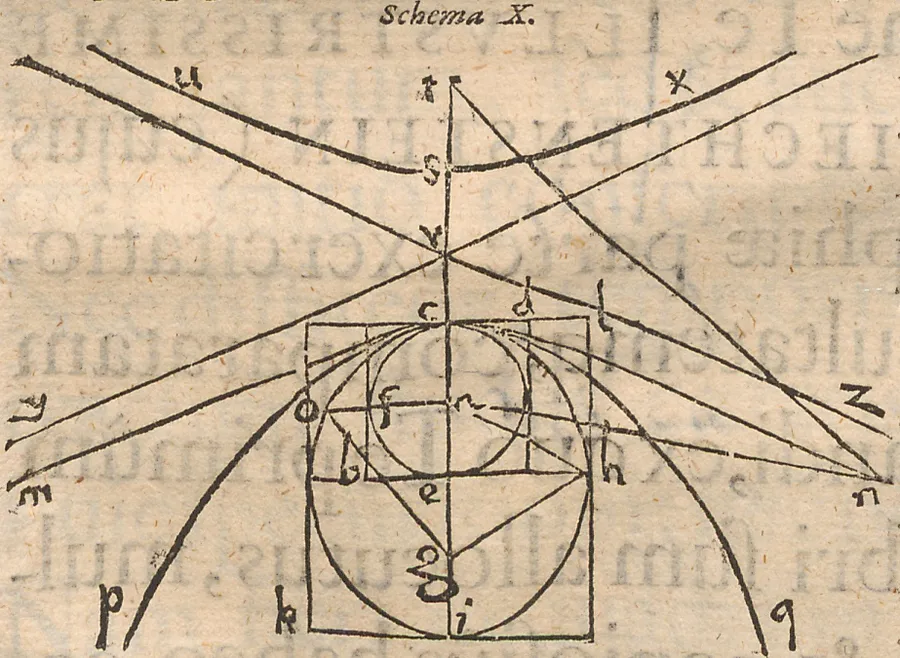
By reason of simplicity the order of these figures is this: first the circle, then the ellipse, then the parabola, and last the hyperbola. Of these the first two, the circle and the ellipse, return into themselves; but the two latter figures, the parabola and hyperbola, are so made that, if you continue them, they run out to infinity, always coming nearer and nearer to straightness, yet never wholly reaching it; and with this difference, that the arms of the parabola CP, CQ become more and more parallel to the single straight line CI, and so to each other, though meanwhile they move apart by an infinite distance; while the arms of the hyperbola CM, CN follow the course of two straight lines RY, RZ, which meet at R and from there move apart to infinity towards Y and Z; which come ever nearer to the arms of the hyperbola, yet never meet them; from which property the lines RY, RZ are called asymptotes.
Harum figurarum causa simplicitatis hic est ordo, vt primus sit circulus, sequatur Ellipsis, inde Parabole, vltimo loco sit Hyperbole. Inter has duæ primæ in seipsas redeunt, Circulus & Ellipsis: duæ verò posteriores figuræ, Parabole & Hyperbole sic sunt comparatæ, vt in infinitum, si continues, excurrant, semper quidem ad rectitudinem magis atque magis accedentes; nunquàm verò eam penitus assequentes; & id hoc discrimine, quòd brachia Paraboles CP, CQ, vni rectæ CI, adeòque inter se ipsa etiam, magis atque magis fiunt parallela, quamvis interim infinito intervallo ab invicem discedant: brachia verò Hyperboles CM, CN sequantur ductum duarum Rectarum RY, RZ, concurrentium in R, eoque versus Y. Z. in infinitum ab invicem discedentium; quæ brachijs Hyperboles semper approximant magis magisque, nunquam tamen cum ijs concurrunt; à qua proprietate, Rectæ RY, RZ dicuntur Asymptoti.
Johannes Kepler, “Supplement to Archimedes,” in Nova stereometria doliorum vinariorum, inprimis Austriaci, figurae omnium aptissimae; et usus in eo virgae cubicae compendiosissimus et plane singularis. Accessit stereometriae Archimedeae supplementum (Linz: Johannes Planck, 1615), 32–33, available online https://doi.org/10.3931/e-rara-11051.
Again, of each pair there is one that alone fills its kind: of the finite ones the circle, of the infinite the parabola. But there are as many forms of ellipse as there can be forms of rectangles LK, and as many forms of hyperbola as of angles YRZ formed by the two lines RY, RZ. For as the circle CE is related to its uniform circumscribed square DB, and the parabola PCQ to the single axis or straight line CI, so ellipses CI are related to the infinite kinds of rectangles LK, and hyperbolas MCN to the infinite kinds of meeting lines YR, ZR, each to its own.
Rursum ex vtraque biga est vna, quæ sola suam implet speciem, ex finitis quidem circulus, ex infinitis Parabole: Ellipsium verò illinc tot sunt formæ, quot possunt esse formæ rectangulorum parallelogrammorum LK: Hyperbolarum hinc formæ tot, quot angulorum YRZ, à binis rectis RY, RZ formatorum. Sanè quia, vt circulus CE se habet ad circumscriptum quadratum vniforme DB, & vt Parabole PCQ, ad Axem seu rectam CI vnicam, sic Ellipses CI, se habent ad Rectangulorum LK, Hyperbolæ MCN ad Concurrentium rectarum YR, ZR, species infinitas, quælibet ad suam.
Johannes Kepler, “Supplement to Archimedes,” in Nova stereometria doliorum vinariorum, inprimis Austriaci, figurae omnium aptissimae; et usus in eo virgae cubicae compendiosissimus et plane singularis. Accessit stereometriae Archimedeae supplementum (Linz: Johannes Planck, 1615), 33, available online https://doi.org/10.3931/e-rara-11051.
And note, for the drawing of the figures, that just as in the circle all the distances AC, AF, AE are equal to each other, so in the ellipse any two distances AC, OG, measured not from the centre E but from the two foci A, G, are equal to any other two, AH, HG, or AC, CG, or AI, IG. In the parabola, whose focus is A, if any line KI is drawn in the same plane at right angles to the axis GI, again the two lines AC, GI are equal to any other two such as AO, OK. In the hyperbola, whose one focus A is inside and the other T outside, with the similar figure VSX about it, the two distances of any point, such as N, from the foci A, T always have one and the same difference CS, the line between the vertices C and S, etc. See more a little below, on the number of solid figures.
Et nota propter descriptionem figurarum, quod sicut in circulo omnia intervalla AC, AF, AE, inter se sunt æqualia, sic in Ellipsi bina semper intervalla AC, OG, non à centro E, sed à duobus Focis A, G, æstimata, binis quibuscunque AH, HG, vel AC, CG, vel AI, IG, sunt æqualia. In Parabola, cujus focus A, ducta quacunque KI in eodem plano, rectâ ad axem GI, rursum binæ lineæ AC, GI. binis quibuscunque alijs vt AO, OK æquales sunt. In Hyperbola, cuius focus vnus A intus, alter T. exterius, & circa eum figura similis VSX, intervalla bina cuiusque puncti, ut N, & focorum A, T, semper vnam & eandem habent differentiam CS, lineam inter vertices C, & S, &c. Vide plura paulò infra de figurarum solidarum numero.
Johannes Kepler, “Supplement to Archimedes,” in Nova stereometria doliorum vinariorum, inprimis Austriaci, figurae omnium aptissimae; et usus in eo virgae cubicae compendiosissimus et plane singularis. Accessit stereometriae Archimedeae supplementum (Linz: Johannes Planck, 1615), 33, available online https://doi.org/10.3931/e-rara-11051.
On the ways of generation.
Further, from the turning in a circle of these four plane figures (for we are not speaking of other forms at this time) are created infinitely many forms of solids, whose surfaces are not, like those of the cone and cylinder, straight in one direction, but curved in every direction, though more and less.
Porro ex circumductu circulari quatuor harum planarum figurarum (de alijs enim formis hac vice non loquimur) creantur infinitæ solidorum formæ, quarum superficies non, vt Coni & Cylindri, altrinsecus rectilineæ, sed quaquaversum curvilineæ sunt, secundum magis tamen & minus.
Johannes Kepler, “Supplement to Archimedes,” in Nova stereometria doliorum vinariorum, inprimis Austriaci, figurae omnium aptissimae; et usus in eo virgae cubicae compendiosissimus et plane singularis. Accessit stereometriae Archimedeae supplementum (Linz: Johannes Planck, 1615), 33, available online https://doi.org/10.3931/e-rara-11051.
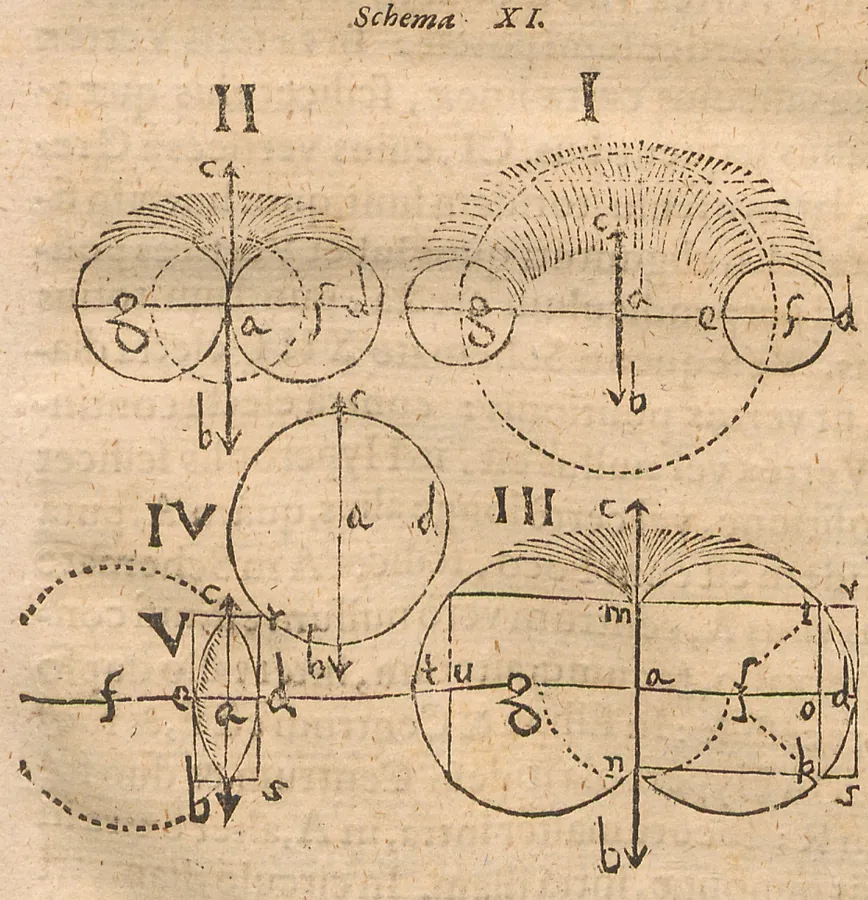
The kinds of turning are in general five, but they are later subdivided more finely when we come to more compound figures. In the adjoining schema these kinds are shown roughly. For I. the axis CB about which the figure is to be turned either stands further from the centre F of the figure ED to be turned than to meet the figure. Then the figure DE, turned straight round in the circle FCG with its breadth upright, makes a ring, with a space in the middle whose centre is A. II. Or this axis of generation, such as AB, touches the figure FD to be turned; let it touch at A, and, the point A of the circumference staying fixed, let the whole circle be turned about CB: then figures are generated that you might call close rings. III. Or the axis of generation cuts the figure to be turned off its middle, as if the greater segment MDN of a circle is to be turned about its chord MN, so that the centre F passes through G; and a figure is generated hollow in two opposite places, namely about M and N, which is the shape of the apple, the fruit of the tree. IV. Or the axis of generation passes through the very centre of the figure, as if the semicircle CDB is to be turned about the fixed diameter CAB; and then a sphere or perfect globe is generated. V. Or finally the axis of generation cuts the figure to be turned within its middle, as if the remaining or lesser segment CDE of the circle MDN is to be turned about its chord CAD; and then a figure is generated pointed in two opposite places, which you might name from the shape of the lemon.
Circumactûs autem species generaliter sunt quinque, sed quæ minutius postea subdividuntur, cùm ad figuras magis compositas ventum fuerit. In adjecto Schemate expressæ sunt hæ species vtcunque. Nam I. Axis CB, circa quem figura est circumagenda, vel longius stat à centro F. figuræ ED circumducendæ, quàm vt concurrat cum figura. Tunc figura DE directè circumacta in circulum FCG, cum latitudine sua erecta, creat Annulum, in quo spacium est intermedium, cuius centrum A. II. Vel tangit axis iste geneseos, vt AB, figuram FD circumagendam; Tangat in A, & manente puncto circumferentiæ A, totus circulus circa CB circumagatur: tunc figuræ gignuntur, quas possis Angulos strictos apellare. III Vel secat axis geneseos figuram circumagendam extra medium, vt si maius circuli segmentum MDN circa sectionem MN, sit circumagendum, ita ut centrum F per G transeat, gignitur autem figura in duobus locis oppositis cava, scilicet circa M & N, quæ Mali fructus arborei forma est. IV. Vel transit axis geneseos per ipsum centrum figuræ, vt si semicirculus CDB circa manentem diametrum CAB sit circumagendus; & tunc gignitur Sphæra seu globus perfectus. V. Vel denique secat axis geneseos figuram circumagendam intra medium, vt si residuum seu minus segmentum CDE de circulo MDN, sit circumagendum circa sectionem suam CAD: & tunc gignitur figura, in locis duobus oppositis acuta, quam à Citrij mali figura possis denominare.
Johannes Kepler, “Supplement to Archimedes,” in Nova stereometria doliorum vinariorum, inprimis Austriaci, figurae omnium aptissimae; et usus in eo virgae cubicae compendiosissimus et plane singularis. Accessit stereometriae Archimedeae supplementum (Linz: Johannes Planck, 1615), 33–34, available online https://doi.org/10.3931/e-rara-11051.
On the number and differences of the figures.
If the three remaining figures, which arise from the section of a cone, were as simple as the circle we have been speaking of, the solid figures produced in these five ways would be twenty in all, five from each of them, as so far from the circle, for the five ways of circular creation. But because of the mixed nature of the remaining figures, this number of twenty solids is extended to ninety.
Quod si tres figuræ reliquæ, sectione Coni ortæ, tam essent simplices, quàm circulus, de quo hactenus: figuræ solidæ his V. modis procreatæ essent in vniversum Viginti, à qualibet earum, vt hactenus à circulo, quinque, pro quinque modis Creationis circularis. Sed propter mixtam reliquarum figurarum Naturam, Vicenarius iste solidorum numerus ad Nonaginta extenditur.
Johannes Kepler, “Supplement to Archimedes,” in Nova stereometria doliorum vinariorum, inprimis Austriaci, figurae omnium aptissimae; et usus in eo virgae cubicae compendiosissimus et plane singularis. Accessit stereometriae Archimedeae supplementum (Linz: Johannes Planck, 1615), 34, available online https://doi.org/10.3931/e-rara-11051.
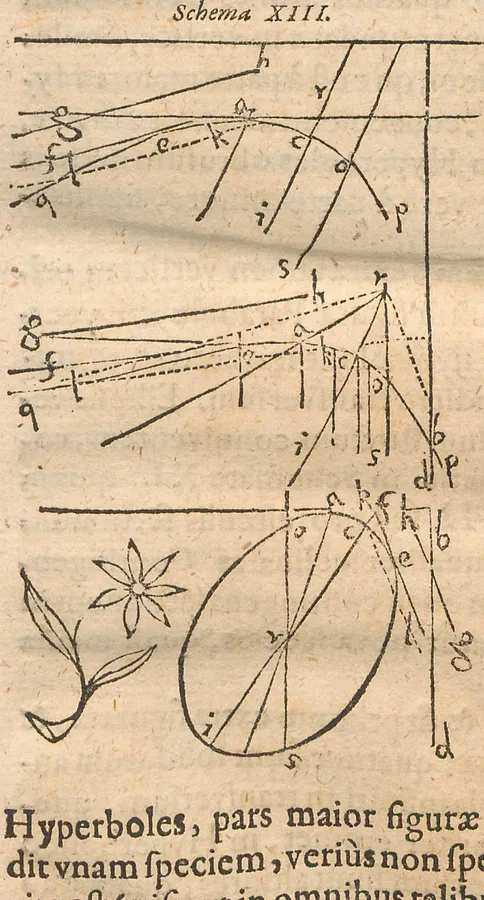
For since the three figures properly called conic are not alike all round, it happens that what for the circle is a single line, taken as the axis of generation, becomes several for these figures, and a single point in the circle becomes several points in the others. In the circle the vertex is spoken of in one and the same way, and any point of the circumference can be taken as the vertex. In the others the primary vertex is nothing but the end of a certain line, namely that called the axis, which in the two following figures is CI, whose vertices are represented by C; but vertices in a wider sense are as many as the lines chosen in the figure for the axis of generation, or parallel to it; which we may call vertices of position, because when such a line is set upright, the highest point of the whole figure becomes its vertex. So in the following Schema XIII, if the diameter OS is chosen for the axis of generation, A becomes the vertex of position; whereas if the tangent EF is chosen as the axis of generation, there is either no vertex, namely in obtuse-angled hyperbolas in a certain position, or one far other than A, say about O. In the circle the centre is the same as the focus, namely A in Schema X above. In the parabola there is one focus A, but no centre; unless you imagine its centre to have withdrawn to an infinite distance, and the other focus to twice that distance, along the line CI from the vertex C. In the ellipse there is both a centre E and two foci A, G, all within the figure. In the hyperbola likewise a centre and two foci; but the centre is outside the figure at R, and of the foci one is inside, at A, the other outside, at T, which is inside the opposite section VSX. In the circle all diameters serve as axes; in the others the axis is often one thing and the diameter another, as species is one thing and genus another.
Cûm enim figuræ tres propriè dictæ Conicæ, non sint vndique similes: fit vt quæ respectu circuli vnica est linea, pro axe geneseos assumpta, respectu harum figurarum fiant diversæ, punctum in Circulo vnicum, diversa puncta sint in cæteris. In circulo Vertex vno & eodem modo dicitur, & omne circumferentiæ punctum pro vertice sumi potest: In cæteris Vertex primarius est, non nisi extremitas alicuius certæ lineæ, scilicet eius quæ axis dicitur, quæ est in figuris duabus sequentibus, CI, cuius vertices à C repræsentantur: contrà Vertices, latiore sensu, totidem sunt, quot lineæ in figura pro axe geneseos, vel ei parallelis, eliguntur; quos lubet Vertices positionis appellare, quia lineâ tali ad perpendiculum erecta, punctum totius figuræ altissimum, fit vertex ejus. Vt sequenti Schemate XIII. electa diametro OS pro axe geneseos, A fit vertex positionis: contrà electa contingente EF in axem geneseos, Vertex vel nullus est, in Hyperbolis scilicet obtusangulis, & certa earum positione, vel certè longe alius, quàm A, puta circa O. In circulo Centrum idem est cum Foco, scilicet A in Schemate X. præmisso: In Parabola Focus vnus A, centrum verò nullum est; nisi concipias, centrum eius infinito intervallo, focumque alterum, intervallo duplo majori, in linea CI, à Vertice C, recessisse: In Ellipsi & Centrum est E, & foci duo A. G. omnia intra figuram: In Hyperbola itidem Centrum & duo foci; sed centrum extra figuram in R; focorum alter intra, in A, alter extra in T. qui est respectu VSX sectionis oppositæ, intra illam. In circulo diametri omnes pro axe sunt, in cæteris sæpe aliud axis, aliud diameter, vt aliud est species, aliud genus.
Johannes Kepler, “Supplement to Archimedes,” in Nova stereometria doliorum vinariorum, inprimis Austriaci, figurae omnium aptissimae; et usus in eo virgae cubicae compendiosissimus et plane singularis. Accessit stereometriae Archimedeae supplementum (Linz: Johannes Planck, 1615), 34, available online https://doi.org/10.3931/e-rara-11051.
And in the parabola (to return to Schema XIII following) all the diameters are equidistant, such as CI, OS, HA; but in the hyperbola and the ellipse they all pass through the centre of the figure R, which in the hyperbola is outside, in the ellipse inside in the middle. In the circle all the diameters are equal; in the ellipse they differ in length, as CI, OS; in the parabola and hyperbola they have no finite length. In the circle and the ellipse every line touching the figure has a diameter equidistant from it; in the parabola and hyperbola a line equidistant from any tangent, as PK from FE, cannot be a diameter of the figure. According to the difference of these points and lines, then, the plane figures, when turned, produce kinds of solid that are different too, always in fact and mostly also to the eye; which I shall not be reluctant to go through one by one, without, however, repeating the five kinds arising from the circular section of the cone, each of which leads a family of those that follow, while some have followers in common.
Et in Parabola quidem (vt redeamus ad Schema XIII. sequens) diametri omnes æquidistant, vt CI, OS, HA. in Hyperbola verò atque Ellipsi omnes per centrum figuræ R traducuntur, quod est in Hyperbola extra, in Ellipsi intus in medio. In circulo æquales sunt omnes diametri; in Ellipsi differunt longitudine, ut CI, OS; in Parabola & Hyperbola non est earum finita longitudo. In circulo & Ellipsi omnis lineam tangens habet æquidistantem sibi diametrum. in Parabola & Hyperbola, quæ tangenti cuicunque æquidistat, vt PK ipsi FE, diameter figuræ esse non potest. Secundum horum igitur punctorum linearumque differentiam figuræ planæ circumactæ, varias etiam, & re quidem semper, plerunque verò etiam ad oculum differentes species solidorum procreant: quas sigillatim recensere non pigebit, non tamen repititis quinque speciebus ex circulari Coni sectione ortis, quæ singulæ familias singulas ducunt jam sequentium, quasdam interim communes habent clientelas.
Johannes Kepler, “Supplement to Archimedes,” in Nova stereometria doliorum vinariorum, inprimis Austriaci, figurae omnium aptissimae; et usus in eo virgae cubicae compendiosissimus et plane singularis. Accessit stereometriae Archimedeae supplementum (Linz: Johannes Planck, 1615), 35, available online https://doi.org/10.3931/e-rara-11051.
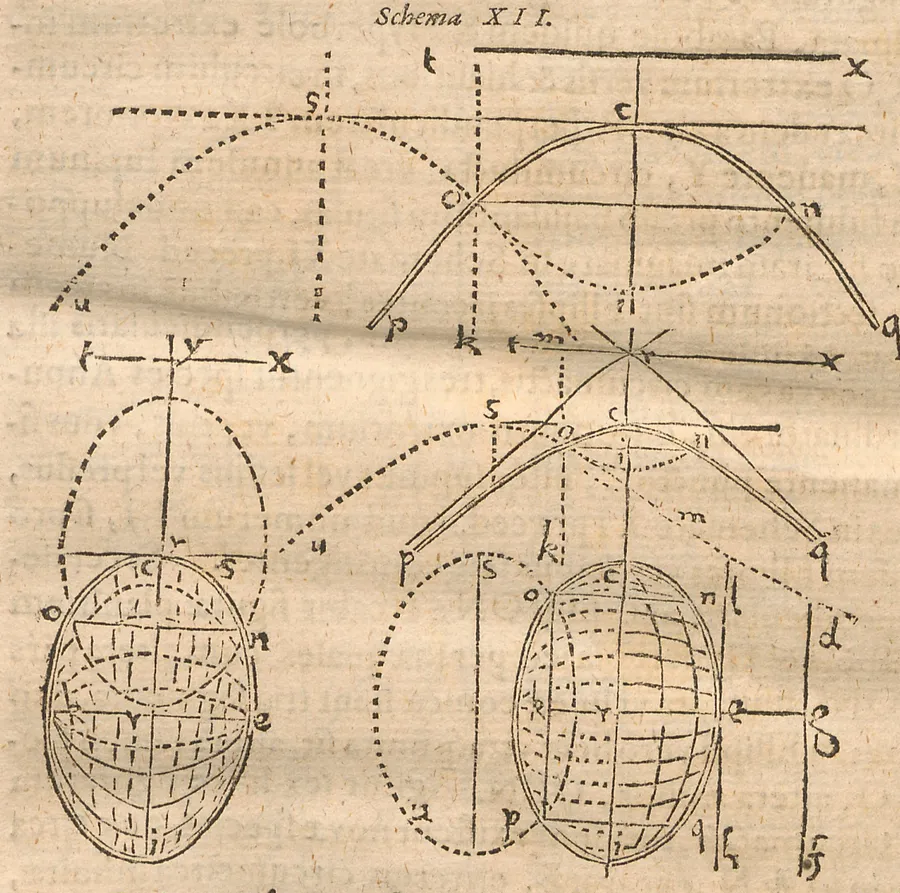
Let us begin with those at which Archimedes stopped. In the adjoining schema let the axis of the figure be CI, about which the figure PCQ is turned, so that, CI staying fixed, the point N passes through the point O, and Q through P. Two conoid solids are thus created, the parabolic and the hyperbolic, and the long spheroid, or egg shape, whose vertices are C, I and widest circle ERK; on which Archimedes wrote in his book On Conoids and Spheroids. The way of generation is that of number IV, the same as the globe’s. There are three kinds, by the number of the lines. [1. 2. 3.]
Incipiamus ab ijs in quibus desijt Archimedes, & sit in Schemate adjecto, axis figuræ CI; circa quem figura PCQ circumagatur, sic vt manente CI, punctum N, per punctum O transeat, Q per P. Creantur igitur solida duo Conoidea, Parabolicum & Hyperbolicum, & Sphæroides longum, seu figura Ovi: cuius vertices C, I; circulus amplissimus ERK; de quibus Archimedes libro de Conoidibus & Sphæroidibus. Modus genesios est è Numero IV, idem qui globi. Species sunt 3. numero linearum. [1. 2. 3.]
Johannes Kepler, “Supplement to Archimedes,” in Nova stereometria doliorum vinariorum, inprimis Austriaci, figurae omnium aptissimae; et usus in eo virgae cubicae compendiosissimus et plane singularis. Accessit stereometriae Archimedeae supplementum (Linz: Johannes Planck, 1615), 35, available online https://doi.org/10.3931/e-rara-11051.
Now let the axis of generation be not the axis CI of the figure itself but one parallel to it. It will then be either outside the figure, as at DF, or touching it, as LH touching at E: both of which have place only in the ellipse. For in the others every line parallel to the axis in the same plane cuts the figure when continued. In the ellipse, then, DF staying fixed and the whole figure NOPQ being carried round at the distance RG of the centre, a kind of ring is generated that you might call a tall ring: it is like the garland of country girls, since it has a space in the middle. So, LH staying fixed and the point of contact E, the whole figure NOPQ likewise being carried round, a solid of the same name results, but with no space in the middle, that is, a close ring. Imagine both in Schema XI at numbers I and II, but understand upright ellipses in place of the circular sections. [4. 5.]
Sit jam axis geneseos non ipse axis figuræ CI. sed ei parallelus. Erit igitur vel extra figuram, vt in DF, vel contingens eam, vt LH contingens in E: quæ duo in sola Ellipsi locum habent. Nam in cæteris, omnis linea parallela axi in eodem plano, secat figuram continuatam. In Ellipsi igitur, manente DF, & totâ figura NOPQ in distantia centri RG circumlata, gignitur annuli species, quem arduum dixeris: similis est serto puellarum rusticarum, quippe spacium habet in medio. Sic manente LH & puncto contactus E, tota itidem figura NOPQ circumlata, fit solidum ejusdem nominis, sed sine spacio in medio, hoc est annulus strictus. Vtranque imaginare tibi in Schemate XI. ad Numeros I. II. sed pro circulis sectionum intellige Ellipses erectas. [4. 5.]
Johannes Kepler, “Supplement to Archimedes,” in Nova stereometria doliorum vinariorum, inprimis Austriaci, figurae omnium aptissimae; et usus in eo virgae cubicae compendiosissimus et plane singularis. Accessit stereometriae Archimedeae supplementum (Linz: Johannes Planck, 1615), 35, available online https://doi.org/10.3931/e-rara-11051.
Or the axis of turning will be inside the figure; let it be OK, and let it lie either on this side of the axis CI of the figure, so that the axis CI with the greater portion OCQ of the figure is turned about OK, and, O staying fixed, the vertex C passes through S and Q through V: then the parabola and hyperbola, the latter more so, make the figures QCOSV, like Mount Etna because of the hollow in its summit, which the Greeks celebrate with the word crater; but the ellipse in this way creates a figure like the quince, which you will imagine in Schema XI above at number III, but understanding, in place of the joined circles of the section, joined upright ellipses, as in Schema XII. [6. 7. 8.]
Vel erit intra figuram axis circumductionis; sit OK, & consistat vel citra CI axem figuræ, sic vt axis CI cum portione figuræ majore OCQ circa OK agatur, & manente O, vertex C per S transeat, & Q per V: tunc Parabole & Hyperbole, magis ista, figuras faciunt QCOSV, montis Ætnæ similes, propter cavitatem ejus in vertice, quam Græci vocabulo Craterum celebrant: Ellipsis verò figuram hoc pacto creat similem Mali Cotonei, quam imaginaberis in Sche. XI. præced. apud Numerum III: sed pro consertis circulis sectionis intellige consertas Ellipses erectas, vt in Schem. XII. [6. 7. 8.]
Johannes Kepler, “Supplement to Archimedes,” in Nova stereometria doliorum vinariorum, inprimis Austriaci, figurae omnium aptissimae; et usus in eo virgae cubicae compendiosissimus et plane singularis. Accessit stereometriae Archimedeae supplementum (Linz: Johannes Planck, 1615), 36, available online https://doi.org/10.3931/e-rara-11051.
Let the said OK also lie beyond the axis CI of the figure, parallel to it, so that the lesser part PO of the figure, which does not have the axis, is to be turned about the fixed OK: then from the parabola and hyperbola certain kinds of straight horns MNP arise, some pointed, others blunt, as in cattle when they first begin to grow horns. But the ellipse gives OQ, the shape of an olive or plum, like number V of Schema XI above. [9. 10. 11.]
Consistat etiam dicta OK vltra axem figuræ CI sibi parallelum, sic vt PO minor pars figuræ, quæ axem non habet, circa manentem OK circumagenda sit: tunc à Parabola atque Hyperbola species quædam nascuntur Cornuum rectorum MNP, quorum alia sunt acuta alia obtusa, vt in pecudibus quando primùm coniscant cornibus. Ellipsis verò dat OQ figuram Olivæ vel Pruni, similem illi Numero V. Schematis præmissi XI. [9. 10. 11.]
Johannes Kepler, “Supplement to Archimedes,” in Nova stereometria doliorum vinariorum, inprimis Austriaci, figurae omnium aptissimae; et usus in eo virgae cubicae compendiosissimus et plane singularis. Accessit stereometriae Archimedeae supplementum (Linz: Johannes Planck, 1615), 36, available online https://doi.org/10.3931/e-rara-11051.
Now, leaving the axis CI, let its perpendicular in the same plane take its place, and let it first be outside the figure, as TX. The figures turned about TX, then, create regular ring-shaped solids, those of the parabola and hyperbola infinite outwards, with the arms CP, CQ turned outwards and gaping, carried round in a circle. But the ellipse, turned about such an outer perpendicular TX to the axis CR, at the distance RY of the centre, Y staying fixed, creates a lying or sitting ring, like the flattened pad on which those who carry buckets set them on their heads. [12. 13. 14.] Again imagine this figure in Schema XI above at number I, but with lying ellipses, their vertices turned towards each other, in place of the circular sections. Next let this perpendicular to the axis touch the figure at the vertex C, and let it be CS; and when the figures are turned about it, three kinds of regular close rings will be generated, two infinite outwards, as before, and one finite, from the ellipse GI, the point C staying fixed; and it is lying, sitting or flattened, as before, to be imagined in Schema XI above at number II, if in place of the circular sections there were ellipses touching each other at their vertices. [15. 16. 17.] Finally let this perpendicular to the axis cut the figure, and let it be ON: it will cut the plane of the figure into two parts, in the parabola and hyperbola always unequal, since one part PONQ is infinite and ONC finite, so that the conic lines become three segments, two infinite and one finite; but in the ellipse, although both are finite, one is mostly greater, NIO, the other less, OCN. When these six segments of the figures are turned about ON, then, as many new kinds will arise: two hollowed on both sides about the middle (namely at O and N), infinite outwards all round, coming from the infinite parts PONQ turned about ON, and one, from the greater segment of the ellipse, lens-shaped, with the form of a navel above and below. A kind of small sitting melon that is eaten whole grows in such a shape; some mushrooms too grow in this shape on top. [18. 19. 20.] Imagine this in Schema XI above at number III, at the figure of the apple, but understand, in place of the joined circles of the section, joined ellipses with the same axis, as in the present Schema XII. Finally, from the lesser parts ONC of the figures come the three remaining solid figures, alike to look at but in fact different; you might not inaptly name the elliptical one OCNL from the fat plum, and for distinction’s sake the parabolic and hyperbolic OCNI from spindles. [21. 22. 23.] And these two, especially the one from a very obtuse-angled hyperbola, are particularly notable: for they make figures with a vertex at each end and a circular belly of conspicuous roundness, the rest of the body coming nearer to the straightness of cones towards the vertices on both sides. Among these we shall have to seek the true shape of the barrel, with the vertices O, N cut off.
Iam omisso axe CI, succedat ejus perpendicularis in eodem plano, & sit primùm extra figuram vt TX. Ergo circum TX actæ figuræ, solida creant annularia ordinata, Parabole quidem & Hyperbole extrorsum infinita, brachijs CP, CQ extrorsum versis & hiantibus, in circulum circumlatis. Ellipsis verò circa talem axis CR perpendicularem TX exteriorem, intervallo centri RY, manente Y, circumducta, creat annulum supinum seu sessilem, similem fulmento presso bajulantium situlas, capitibus suppositis. [12. 13. 14.] Rursum hanc figuram imaginare in Schemate XI, preced. Numero I. sed pro circulis sectionum sint Ellipses jacentes, verticibus invicem obversæ. Contingat exinde figuram in C vertice, perpendicularis ista axis, sitque CS; & figuris circa eam circumactis, tres gignentur species Annulorum strictorum ordinatorum, duo infiniti extrorsum, vt prius, vnus finitus ab Ellipsi GI, manente puncto C, estque supinus vel sessilis vel pressus, vt prius; imaginandus in Schemate XI præced. apud numerum II, si pro circulis sectionum essent Ellipses verticibus sese contingentes. [15. 16. 17.] Secet denique figuram ista perpendicularis axi, sitque ON: secabit figuræ planitiem in partes duas, in Parabola & Hyperbola semper inæquales, cum altera pars PONQ infinita sit, ONC finita, ita vt lineæ conicæ fiant tria segmenta, duo infinita, vnum finitum; in Ellipsi verò licet vtraque finita sit, altera tamen plerunque major est, NIO, altera minor, OCN. Igitur sex hisce figurarum segmentis circa ON circumactis, totidem existent novæ species, duæ circa medium vtrinque (sc. in O. & N) excavatæ, exterius circumcirca infinitæ, quippe à partibus infinitis PONQ, circa ON circumactis, vna quæ est ab Ellipseos segmento maiori, lenticularis, supra & infra vmbilici forma. Provenit tali forma genus quoddam Melonis sessilis minuti, qui totus editur: proveniunt tali forma superius etiam boleti aliqui. [18. 19. 20.] Hanc in Schemate XI. præcedenti, Numero III, apud figuram Mali imaginare, sed pro consertis circulis sectionis, intellige consertas Ellipses eodem axe, vt in Schemata præsenti XII. Denique minoribus figurarum partibus ONC, tres reliquæ figuræ solidæ fiunt, aspectu similes inter se reipsa diversæ; Ellipticam quidem OCNL à Pruno crasso, Parabolicam verò & Hyperbolicam OCNI à Fusis distinctionis causâ non ineptè denominaveris. [21. 22. 23.] Atque hæ duæ, præsertim illa, quæ est ab Hyperbola multùm obtusangula, præcipuè sunt notabiles: Fiunt enim figuræ verticosæ, cum ventre circulari, rotunditatis conspicuæ, reliquo corpore versus vertices vtrinque magis ad Conorum rectitudinem accedente. In his erit nobis quærenda genuina figura dolij, prælectis verticibus O. N.
Johannes Kepler, “Supplement to Archimedes,” in Nova stereometria doliorum vinariorum, inprimis Austriaci, figurae omnium aptissimae; et usus in eo virgae cubicae compendiosissimus et plane singularis. Accessit stereometriae Archimedeae supplementum (Linz: Johannes Planck, 1615), 36–37, available online https://doi.org/10.3931/e-rara-11051.
It was said that in this form of section the segments of the ellipse are not always unequal. When, then, this perpendicular to the axis passes through the centre of the figure R, and is called the minor axis or upright and shorter diameter, then half the figure, turned about this ERK, so that, E staying fixed, the vertex C is carried through I, creates the other kind, the broad spheroid, whose vertices are at E and K and widest circle CRI, on which Archimedes also wrote. [24.]
Dictum est, in hac forma sectionis, segmenta Ellipseos non semper esse inæqualia. Cùm ergò hæc axi perpendicularis per centrum figuræ R transit, quam axem vel diametrum rectam & breviorem appellant, tunc figuræ dimidium, circa hanc ERK circum actum, sic vt manente E, vertex C per I traducatur, creat alteram speciem Sphæroidis lati, cuius vertices in E, K, circulus amplissimus CRI, de quo itidem Archimedes. [24.]
Johannes Kepler, “Supplement to Archimedes,” in Nova stereometria doliorum vinariorum, inprimis Austriaci, figurae omnium aptissimae; et usus in eo virgae cubicae compendiosissimus et plane singularis. Accessit stereometriae Archimedeae supplementum (Linz: Johannes Planck, 1615), 37, available online https://doi.org/10.3931/e-rara-11051.
Thus far it would have sufficed, for wine barrels, to list and distinguish the solid figures. But since I said beforehand that in this inquiry I would look a little further beyond the bounds of this little book, I shall add, for kinship’s sake, the remaining kinds of solid too.
Huc vsque recensere & distinguere figuras solidas suffecisset ad Dolia vinaria. At cum prædixerim, me in hac speculatione paulò longius vltra libelli hujus metas prospicere; adjungam cognationis causa etiam reliquas solidorum species.
Johannes Kepler, “Supplement to Archimedes,” in Nova stereometria doliorum vinariorum, inprimis Austriaci, figurae omnium aptissimae; et usus in eo virgae cubicae compendiosissimus et plane singularis. Accessit stereometriae Archimedeae supplementum (Linz: Johannes Planck, 1615), 37, available online https://doi.org/10.3931/e-rara-11051.
In the present Schema XIII, then, let any other diameter OS take the place of the axis CI, and let the axis of generation be set in it. Here the ellipse is cut through the centre R into two similar halves, either of which, turned about the fixed OR, creates the shape of a pear, which by right of kinship asks to be joined to the apples, quinces and plums, so that this dessert may be complete. [25.] But the other two figures are cut into parts unlike each other, both infinite; and in the obtuse-angled hyperbola there are two cases: for either the obtuse angle is cut by the chosen diameter into two acute parts, or only one part is acute and the other obtuse or right. The parts of the figures, then, except in the last case, when turned, create figures that to the eye do not differ at all from the craters and horns marked with numbers 6, 7, 9 and 10, though in fact they are different, because of the turning of the axis CI, here conical, there cylindrical, and the obliquity here of the whole generating part. [26. 27. 28. 29.]
Succedat igitur in præsenti Schemate XIII. pro axe CI alia quæcunque diameter OS, & in ea statuatur axis geneseos. Hîc Ellipsis quidem secatur per centrum R, in duas medietates similes, quarum vtralibet circumducta circa OR manentem, creat formam Pyri, quæ iure cognationis postulat adiungi Malis & Cotoneis & Prunis, vt constet his bellariis sua integritas. [25.] At reliquæ duæ figuræ secantur in partes dissimiles inter se, vtrasque infinitas, sed in Hyperbola obtusangula casus duo sunt: Nam aut secatur angulus obtusus ab electa diametro in duas partes acutas, aut vna sola pars est acuta, altera obtusa vel recta. Partes igitur figurarum, excepto casu vltimo, circumductæ creant figuras, quæ ad oculum nihil differunt à Crateribus & Ceratoidibus, Numeris 6. 7. 9. 10. insignitis; etsi reipsa diversæ sunt, ob axis CI circumvolutionem, hic conicam illic cylindricam, totiusque hic partis generantis obliquitatem. [26. 27. 28. 29.]
Johannes Kepler, “Supplement to Archimedes,” in Nova stereometria doliorum vinariorum, inprimis Austriaci, figurae omnium aptissimae; et usus in eo virgae cubicae compendiosissimus et plane singularis. Accessit stereometriae Archimedeae supplementum (Linz: Johannes Planck, 1615), 37, available online https://doi.org/10.3931/e-rara-11051.
But in the obtuse section of the obtuse angle of the hyperbola, the greater part of the figure, turned about such a diameter, adds one kind, or rather not a kind. For it is infinite both downwards and outwards (unless, as in all such, you set an end to it by a conical or cylindrical surface, which arises from the drawing of a straight line), and it lacks a vertex; in its place it is pressed down in the middle into a navel, and around it rises gently upwards, and that without end. [30.]
In obtusa verò sectione anguli obtusi Hyperboles, pars maior figuræ circa talem diametrum circumducta addit vnam speciem, veriùs non speciem. Nam & deorsum & extorsum infinita est (nisi, vt in omnibus talibus, superficie conica vel cylindrica, quæ oritur ductu rectæ, finem ei statuas (caretque Vertice, sed eius loco, est in medio in vmbilicum depressa, circà ascendit sursum leniter, idque sine termino. [30.]
Johannes Kepler, “Supplement to Archimedes,” in Nova stereometria doliorum vinariorum, inprimis Austriaci, figurae omnium aptissimae; et usus in eo virgae cubicae compendiosissimus et plane singularis. Accessit stereometriae Archimedeae supplementum (Linz: Johannes Planck, 1615), 37, available online https://doi.org/10.3931/e-rara-11051.
In place of the diameter OS let BD, parallel to it, be taken, which in the ellipse needs no separate consideration from the parallel to the tangent, since to every diameter corresponds its own parallel tangent to the figure. It remains to apply this parallel to the other two figures; let it be, then, either outside the figure or inside. Outside it cannot be in the parabola and hyperbola, since all parallels to the diameters enter the figure when continued. Let some parallel to the diameter OS be drawn, then, inside these two figures. But again in the parabola a line parallel to a diameter is itself also a diameter; nothing new arises from it. In the hyperbola alone this case has a place and separate consideration: since the diameter OS has cut it into two unlike parts, this parallel to OS is drawn either in its lesser part or in its greater. Let it be drawn in the lesser, and let it be BD; it too, then, cuts the figure into parts yet more unlike, of which the greater creates something like the craters of number 7, or like the infinite one of number 30, and the lesser something like the horns of number 10. [31. 32. 33.] Now let some parallel to the diameter OS be drawn in the greater part OQ; which in acute-angled hyperbolas has five cases. For it is drawn either between the dividing diameter and the primary vertex, as between C and O; or through the primary vertex C itself; or between the two vertices, the primary C and that of position A; or beyond the vertex of position A. But in obtuse-angled hyperbolas there is no vertex of position. In any one case the figure is cut into two unlike parts. Thirteen kinds therefore arise, of which four are like the craters of number 7, three like the hollow figure of number 30, four like the horns of number 10, being pointed; the remaining two are rounded at the vertex, like the hyperbolic conoid, number 2: the one from the greater part of a hyperbola, either acute-angled or, if obtuse-angled, divided by a suitable diameter, as was said (for it must cut the obtuse angle of the hyperbola into two acute parts), is like the obtuse-angled conoid, and the one from the lesser part like the acute-angled conoid. [34.–46.]
Pro diametro OS sumatur ei parallela BD, quæ in Ellipsi non habet separatam considerationem à parallela lineæ contingentis, quippe omni diametro respondet sua parallela contingens figuram. Restat vt illam pallelam applicemus reliquis duabus figuris; sit igitur vel extra figuram vel intra. Extra esse in Parabola & Hyperbola non potest, cum omnes diametri parallelæ figuram continuatam intrent. Ducatur igitur aliqua diametro OS parallela, intra figuras has duas. Rursum autem in Parabola linea quæ est diametro parallela, ipsa quoque est diameter, nihil hinc gignitur novi. In Hyperbola sola casus iste locum & considerationem separatam habet: quam cum diameter OS in duas dissimiles secuerit partes, jam hæc Parallela ipsi OS vel in minori eius parte ducitur, vel in maiori. Ducatur in minori & sit BD, secat igitur & ipsa figuram in partes magis adhuc dissimiles, quarum maior creat aliquid Craterum Numero 7. simile, aut infiniti Numero 30. minor simile Ceratoidum, Numero 10. [31. 32. 33.] Ducatur jam in maiori parte OQ, aliqua ipsi OS diametro parallela; quod in Hyperbolis acutangulis habet casus quinque. Nam aut inter diametrum dividentem & verticem primarium ducitur, vt inter C, O. aut per ipsum verticem primarium C, aut inter vertices duos, primarium C, & positionis A, aut vltra verticem positionis A Sed in obtusangulis Hyperbolis vertex positionis non datur. In vno quolibet casu secatur figura in duas dissimiles partes. Species igitur nascuntur tredecim, quarum quatuor sunt similes Craterum, Numero 7. tres similes figuræ cavæ Numero 30. quatuor similes Ceratoidum Numero 10. quippe acutæ: duæ residuæ sunt rotundatæ in vertice, similes Conoidi Hyperbolico, numero 2. vna quidem, quæ est à parte maiore Hyperboles vel acutangulæ, vel si obtusangula, convenienti diametro divisæ, vt dictum (debet enim illa secare angulum Hyperboles obtusum in duas partes acutas) similis est obtusangulo, quæ verò à parte minore, similis acutangulo Conoidi. [34.–46.]
Johannes Kepler, “Supplement to Archimedes,” in Nova stereometria doliorum vinariorum, inprimis Austriaci, figurae omnium aptissimae; et usus in eo virgae cubicae compendiosissimus et plane singularis. Accessit stereometriae Archimedeae supplementum (Linz: Johannes Planck, 1615), 37–38, available online https://doi.org/10.3931/e-rara-11051.
Let the last line be a tangent to the section, but away from the primary vertex C, as EF. If the parabola and hyperbola are turned about it, they generate two infinite kinds, like those of numbers 15 and 16, but less regular, since they extend infinitely sideways. [47. 48.] But the ellipse turned about this EF generates a close ring leaning inwards, related to number 17, which you will imagine in Schema XI of the five kinds of turning at number II, but with ellipses, equally inclined towards their mutual contact, in place of the circular sections. [49.] The asymptote could be counted among the tangents, for it is as it were a tangent to the section at an infinitely distant point; and here a new kind is to be considered, as it were midway between open and close rings. [50.]
Vltima linea sit, Contingens sectionem, extra tamen verticem primarium C, vt EF. circa quam si circumagantur figuræ Parabole & Hyperbole, duas gignunt species infinitas, similes ijs quæ sunt numero 15. 16. minus tamen ordinatas, infinitas enim se extendit in transversum. [47. 48.] Ellipsis verò circa hanc EF circumducta gignit annulum strictum conniventem, cognatum illi Numero 17. quem imaginaberis in Schemate XI. quinque modorum circumactus, apud numerum II. sed pro circulis sectionum concipe Ellipses ad mutuum contactum æqualiter inclinatas. [49.] Contingentibus accenseri posset Asymptotos, est enim quasi contingens sectionem in puncto infinitùm distanti: & hic consideratur nova species, quasi media inter annulares laxas & strictas. [50.]
Johannes Kepler, “Supplement to Archimedes,” in Nova stereometria doliorum vinariorum, inprimis Austriaci, figurae omnium aptissimae; et usus in eo virgae cubicae compendiosissimus et plane singularis. Accessit stereometriae Archimedeae supplementum (Linz: Johannes Planck, 1615), 38, available online https://doi.org/10.3931/e-rara-11051.
In place of the tangent let its parallel be taken, and let it first be outside the figure, and let the figures be turned about it as an axis; four kinds of solid rings result: from the parabola and hyperbola rings infinite sideways, whose back in the parabolic one always stands out in a circle, while among the hyperbolic some have a prominent back, and others become higher outwards than where they are narrowest, not very unlike the figure of number 13. [51. 52. 53.] But from the ellipse turned about GH comes a finite ring leaning inwards, wider on one side, very nearly in the shape of a tiara or Turkish turban, if you take away its peak. [54.] Imagine this too at the first form of turning, but with ellipses, equally inclined to each other, in place of the circular sections.
Sit pro contingenti, eius parallela, & sit primum extra figuram, & circa hanc velut axem circumagantur figuræ; quatuor fiunt solidorum annulorum species, ex Parabola & Hyperbola infiniti in transversum, quorum dorsum in Parabolico semper circulariter eminet, in Hyperbolico quidam eminens dorsum habent, alii extrorsum fiunt altiores, quam quo loco sunt angustissimi, non multum absimiles figuræ numero 13. [51. 52. 53.] Ex Ellipsi verò circa GH circumactâ fit annulus finitus connivens, ex altera parte amplior, in forma ferè Tiaræ seu Globi Turcici, si dempseris ei apicem. [54.] Hanc etiam imaginare apud primam formam circumactus, vt tamen pro circulis sectionum concipias Ellipses ad se mutuò æqualiter inclinatas.
Johannes Kepler, “Supplement to Archimedes,” in Nova stereometria doliorum vinariorum, inprimis Austriaci, figurae omnium aptissimae; et usus in eo virgae cubicae compendiosissimus et plane singularis. Accessit stereometriae Archimedeae supplementum (Linz: Johannes Planck, 1615), 38, available online https://doi.org/10.3931/e-rara-11051.
If the parallel to the tangent is inside the figure, as LK, cutting it into two parts, many kinds result, because there are also many cases. For either LK does not cut the axis inside the figure, or it cuts it. And if it cuts it, then either it passes through the primary vertex C, or it takes it in, shutting out the vertex of position about O, which follows from setting the figure upright along EF, if there is one at all (for in the obtuse-angled hyperbola, if LK or FE makes an obtuse angle towards the figure with the opposite asymptote RB, there is no vertex); or it passes through this vertex of position; or it also takes this in, in the part cut off. I have listed five cases, and all have place in all three figures; so fifteen sections, and two segments of the figure in each. But in the hyperbola the three greater segments of the first three cases are double as regards their effect; for the infinite part runs out there either downwards, as in the parabola, or upwards. There are therefore thirty-three kinds of solid from here, of which thirteen are infinite sideways, and of these nine are hollowed into a navel on both sides (six of them with a prominent circular lip, like the craters of number 7, but differing in this, that they are like a mountain hollowed underneath as well; three without a prominent lip, whose height is not finite, like the figure of number 19), two pointed, horns as in number 10, and two with a well-rounded vertex, conoids as in number 2, namely when the line about which the figure is to be turned passes through the vertex of position, where there is one. [55.–67.] Of these thirteen, five are parabolic and eight hyperbolic. The remaining twenty are finite, and thicker on one side and thinner on the other. For of them fifteen kinds (five from each figure) end in a point: nine pointed at both ends, three from each figure, which we may call kernels; three, one from each figure, well rounded at the thicker end and so akin to the broad spheroid, which we can compare to strawberries or pine nuts; and finally three, again one from each figure, hollow at the thicker end and pointed at the thinner, like the husk of the bladder cherry, which the Germans call Jewish cherries, secretly signifying the glans of the penis with its foreskin. [68. 69. 80. 71. 72. 73. 74. 75. 76. 77. 88. 79. 80. 81. 82.] The last five are kinds of pear, generated from the greater part of the ellipse in the five said cases of this section, all hollow, three at both ends and two at one only; at the other, thin end, one is rounded and like a spheroid, and one pointed, almost the same as the bladder cherry, born from the lesser part of the ellipse. [83. 84. 85. 86. 87.] The sum is eighty-seven; and with the five figures from the circle added, as the heads of the families, they make ninety-two forms.
Parallela Contingenti si fuerit intra figuram, vt LK, secans eam in partes duas, multæ fiunt species, quia etiam casus multi. Vel enim LK non secat axem intra figuram, vel eum secat. Et si secat, tum vel transit verticem primarium C, vel eum intercipit, excludens verticem positionis circa O. qui ad erectionem figuræ secundum EF sequitur; si tamen aliquis datur; nam in Hyperbola obtusangula, si LK vel FE cum Asymptoto contraria RB, fecerit obtusum angulum versus figuram, Vertex nullus est: Vel per hunc positionis verticem transit: vel etiam hunc in parte resecta includit. Casus recensui quinque & omnes in omnibus tribus figuris locum habent; sectiones ergo quindecim, & bina in singulis figuræ segmenta. Sed in Hyperbola tria majora trium primorum casuum duplicia, respectu effectus; aut enim deorsum excurrit infinitas ibi, vt in Parabola, aut sursum. Solidorum ergo species hinc sunt tinginta tres, quarum tredecem infinitæ in transversum, & ex his novem vtrinque in vmbilicum excavatæ, (quarum 6. cum eminenti labro circulari, vt Crateres Numero 7, sed in hoc diversi, quod æquiparantur monti etiam subtus excavato; 3. verò sine eminenti labro, quarum non est finita altitudo, similes figuræ Numero 19.) duæ acuminatæ, Ceratoides ut Numero 10. & duæ bene rotundato vertice, Conoides, ut Numero 2; quando scilicet linea, circa quam est circumagenda figura, per verticem transit positionis, ubi is datur. [55.–67.] Harum tredecim, quinque sunt Parabolicæ, octo Hyperbolicæ. Reliquæ viginti sunt finitæ, & altera parte crassiores, reliqua tenuiores. Ex ijs enim quindecim (quinæ ex figuris singulis) species sunt in acumen desinentes, novem quidem vtrinque, ternæ ex figuris singulis, quos Nucleos appellemus: tres verò, singulæ ex figuris singulis, à parte crassiori benè rotundatæ, affines ideò Sphæroidi lato; quas Fragis aut Nuci Pineæ comparare possumus: tres denique, singulæ rursum ex figuris singulis, à parte crassiori cavæ, à tenuiori acutæ, in modum folliculi Vesicariæ, quam Germani Cerasa Iudaica dictitant, occultè signantes glandem penis cum præputio. [68. 69. 80. 71. 72. 73. 74. 75. 76. 77. 88. 79. 80. 81. 82.] Quinque verò vltimæ sunt Pyrorum species, à parte majori Ellipseos, quinque dictis casibus sectionis hujus, generatæ, cavæ omnes, tres vtraque parte, duæ alterâ solum, parte verò reliqua tenui una rotundata, & Sphæroidi similis; vna acuta, ferè concidens cum Vesicaria, ex Ellipseos parte minori nata. [83. 84. 85. 86. 87.] Summa Octuaginta septem, quibus additæ figuræ quinque ex circulo, veluti capita familiarum, efficiunt formas nonaginta & duas.
Johannes Kepler, “Supplement to Archimedes,” in Nova stereometria doliorum vinariorum, inprimis Austriaci, figurae omnium aptissimae; et usus in eo virgae cubicae compendiosissimus et plane singularis. Accessit stereometriae Archimedeae supplementum (Linz: Johannes Planck, 1615), 39, available online https://doi.org/10.3931/e-rara-11051.
So many, then, are the kinds of solid figure that result from conic sections turned in a circle, without now counting separately the segments of each, or figures put together from segments. For example, a pewter dish mostly consists of three surfaces: at the bottom a segment of a sphere, round about a parabolic crater, while the rim is from the surface of a very obtuse cone, or else an oblique zone of a globe. And although the skilful measurements of several of them come to the same thing, the geometer must not be ignorant of such manifold differences of generation, lest, when unwary, he be drawn into inextricable snares in considering generally some that are special. Let geometers, then, exercise themselves on each of these, after the example of Archimedes, who of these considered four only, and a fifth, the globe itself: not because they were the most useful or most common (for what has the parabolic conoid over the ring, the apple, the pear, the plum, the kernel?) but because they were the simplest, and nearest to the globe, and lent themselves to his genius. For the present we shall consider only those by which access lies open to the hyperbolic spindles, whose frustums are our barrels; so I shall add the following theorems about them.
Tot igitur sunt genera figurarum Solidarum à sectionibus conicis in circulum actis resultantium; vt jam segmenta singularum, aut composita à segmentis, seorsim non numerentur. Verbi causa, patina stannea constat plerunque tribus superficiebus, in fundo, segmento Sphæræ, circùm, cratere Parabolico, limbus verò est ex superficie coni valde obtusi, aut etiam Zona Globi obliqua. Etsi verò complurium dimensiones artificiosæ in idem recidunt; non sunt tamen ignoranda Geometræ discrimina generationis tam multiplicia, ne incautus, circa nonnullarum specialium generalem considerationem, pertrahatur in insidias inexplicabiles. Circa has igitur singulas exerceant se Geometræ, exemplo Archimedis; qui ex hisce, quatuor solas, & quintam, Globum ipsum, consideravit: non quòd vtilissimæ aut communissimæ essent, quid enim hic habet Conoides parabolicum præ Annulo, Malo, Pyro, Pruno, Nucleo sed quod simplicissimæ, & proximæ globo, & ingenio se præberent. Nos in præsens illas tantum contemplabimur, per quas accessus patet ad Fusa Hyperbolica, quorum Trunci sunt nostratia dolia: subijciam igitur de ijs theoremata sequentia.
Johannes Kepler, “Supplement to Archimedes,” in Nova stereometria doliorum vinariorum, inprimis Austriaci, figurae omnium aptissimae; et usus in eo virgae cubicae compendiosissimus et plane singularis. Accessit stereometriae Archimedeae supplementum (Linz: Johannes Planck, 1615), 39–40, available online https://doi.org/10.3931/e-rara-11051.
Theorem XVIII.
Every ring of circular or elliptical section is equal to a cylinder whose height equals the length of the circumference described by the centre of the figure turned, and whose base is the same as the section of the ring.
Omnis Annulus sectionis circularis vel ellipticæ, est æqualis Cylindro, cuius altitudo æquat longitudinem circumferentiæ, quam centrum figuræ circumductæ descripsit, basis vero eadem est cum sectione Annulj.
Johannes Kepler, “Supplement to Archimedes,” in Nova stereometria doliorum vinariorum, inprimis Austriaci, figurae omnium aptissimae; et usus in eo virgae cubicae compendiosissimus et plane singularis. Accessit stereometriae Archimedeae supplementum (Linz: Johannes Planck, 1615), 40, available online https://doi.org/10.3931/e-rara-11051.
I mean the section made by a plane drawn through the centre of the space within the ring, at right angles to the ring’s surface. The proof of this theorem is plain in part from Theorem XVI, and can be set up from the same elements by which Archimedes laid down the principles of solid geometry.
Intelligo sectionem, quæ fit, plano traducto per centrum spacij annularis, ad superficiem annularem recto. Huius Theorematis demonstratio patet partim ex Th. XVI, & ijsdem elementis institui potest, quibus Archimedes Stereometriæ principia tradidit.
Johannes Kepler, “Supplement to Archimedes,” in Nova stereometria doliorum vinariorum, inprimis Austriaci, figurae omnium aptissimae; et usus in eo virgae cubicae compendiosissimus et plane singularis. Accessit stereometriae Archimedeae supplementum (Linz: Johannes Planck, 1615), 40, available online https://doi.org/10.3931/e-rara-11051.
For if the ring GCD in Schema XI, but whole, is cut from the centre A of its space into infinitely many smallest slices ED, each of them will be thinner towards the centre A by as much as a part of it, such as E, is nearer the centre A than F is, and the line through F perpendicular to ED in the cutting plane; and thicker by as much towards the outside D: and the said extremes, D and S, taken together, give twice the thickness that is in the middle of the slices.
Annulo enim (in Schemate XI.) GCD sed integro, ex centro spacij A, secto in orbiculos infinitos ED, eoque minimos, quilibet eorum tantò erit tenuior versus centrum A, quantò pars eius, ut E, fuerit propior centro A, quàm est F, & recta per F ipsi ED perpendicularis in plano secante; tantò etiam crassior versus exteriora D: extremis verò dictis, scilicet D, S, simul sumptis, duplum sumitur eius crassitiei, quæ est in orbiculorum medio.
Johannes Kepler, “Supplement to Archimedes,” in Nova stereometria doliorum vinariorum, inprimis Austriaci, figurae omnium aptissimae; et usus in eo virgae cubicae compendiosissimus et plane singularis. Accessit stereometriae Archimedeae supplementum (Linz: Johannes Planck, 1615), 40, available online https://doi.org/10.3931/e-rara-11051.
This reasoning would not hold if the parts of the slices E, D on this side and that of the circumference FG and of the lines perpendicular through F and G were not equal and equally placed.
Hæc ratio locum non haberet, si orbiculorum E, D, partes cis & vltra circumferentiam FG, lineasque per F, G, perpendiculares, non æquales æqualiterque sitæ essent.
Johannes Kepler, “Supplement to Archimedes,” in Nova stereometria doliorum vinariorum, inprimis Austriaci, figurae omnium aptissimae; et usus in eo virgae cubicae compendiosissimus et plane singularis. Accessit stereometriae Archimedeae supplementum (Linz: Johannes Planck, 1615), 40, available online https://doi.org/10.3931/e-rara-11051.
Corollary I.
This way of measuring holds both for the circular form of ring and for the elliptical, tall, sitting or leaning; both for open rings and for close ones: indeed, in all rings, whatever figure results from their upright section in place of the circle ED, provided that in the plane through AD at right angles to the ring the parts of the section on this side and that of F are equal and equally placed on either side. We shall test this on a square section. Let the ring be square in body, and let a square be understood under ED. This ring has another way of measurement as well. For it is the outer part of a cylinder whose base is the circle with radius AD and height DE: from this cylinder, by Theorem XVI, the core must be taken, that is, the cylinder whose base is the circle with radius AE and height ED. So what is made by multiplying ED by the circle AD less the circle AE equals the body of the ring created by the plane square. And if ED were multiplied by the square of AD less the square of AE, the ratio of the body made to the body of a quarter of the ring would be as the square to the circle, namely 14 to 11. Let AE be 1. Then AD is 4, whose square is 16; but the square of AE is 4. So the difference of the squares is 12, which multiply by the height 2: the body is 24, whose four times is 96. And as 14 to 11, so 96 to 75 and three sevenths, the body of the square ring. This is by the rule of Theorem XVI. But by the present way, since AF is 3 and FG 6, and as 7 to 22, so 6 to 19 less one seventh: this will be the length of the circumference FG, for the height of the cylinder. And since ED is 2 and its square 4, for the base of the cylinder, multiply 4 by 19 less one seventh: the result is 76 less four sevenths. See, the theorem is true this way too.
Hæc ratio dimensionis valet tam in circulari forma annuli, quam in elliptica ardua, sessili, connivente, tam in laxis annulis, quàm in strictis: quin imò in omnibus annulis, quæcunque eius, pro circulo ED, existat figura ex sectione eius rectà: dum modò in plano per AD ad annulum recto, sectionis partes cis & vltra F, fuerint æquales æqualiterque sitæ hinc & inde: Quod explorabimus in figura sectionis quadrata. Sit annulus corpore quadrato, & intelligatur sub ED quadratum. Hic annulus habet rationem dimensionis etiam aliam. Nam est pars exterior Cylindri, cuius basis est circulus semidiametro AD, altitudo DE: huic Cylindro ex Th. XVI. adimenda est medulla, seu Cylinder, cuius basis est circulus semidiametro AE, altitudo ED. Quare quod fit ducta ED in circulum AD, minus circulo AE, æquat corpus annuli plano quadrato creati. Et si duceretur ED in quadratum AD, minus quadrato AE, proportio corporis facti, esset ad corpus quartæ partis annuli, vt est quadratum ad circulum, scilicet 14. ad 11. Sit AE 1. Ergo AD 4. cuius quadratum 16. sed quadratum AE. est 4. Ergo differentia quadratorum est 12. quod duc in altitudinem 2, existit corpus 24. cuius quadruplum 96. vt verò 14. ad 11. sic 96 ad 75. cum tribus septimis, Annuli quadrati corpus. Hæc secundum rationem Th. XVI. At secundum modum præsentem, cùm sit AF 3. FG 6. vt verò 7. ad 22. sic 6. ad 19. minus vna septima: erit ergo hæc longitudo circumferentiæ FG, pro altitudine Cylindri: Et cum ED sit 2, & quadratum eius 4, pro basi Cylindri, duc igitur 4. in 19 minus vna septima, prodeunt 76 minus quatuor septimis. Ecce verum etiam sic theorema.
Johannes Kepler, “Supplement to Archimedes,” in Nova stereometria doliorum vinariorum, inprimis Austriaci, figurae omnium aptissimae; et usus in eo virgae cubicae compendiosissimus et plane singularis. Accessit stereometriae Archimedeae supplementum (Linz: Johannes Planck, 1615), 40–41, available online https://doi.org/10.3931/e-rara-11051.
Theorem XIX and Analogy.
A close ring is equal to a cylinder whose base is the circle of the ring’s section and whose height is equal to the length of that circle.
Annulus strictus est æqualis Cylindro, qui habet basin, circulum sectionis Annuli, altitudinem æqualem eius circuli longitudini.
Johannes Kepler, “Supplement to Archimedes,” in Nova stereometria doliorum vinariorum, inprimis Austriaci, figurae omnium aptissimae; et usus in eo virgae cubicae compendiosissimus et plane singularis. Accessit stereometriae Archimedeae supplementum (Linz: Johannes Planck, 1615), 41, available online https://doi.org/10.3931/e-rara-11051.
For this way holds in absolutely every ratio of AE to AF, and holds still in the close ring, where the centre F of the circle EC being turned describes the circle FG, equal to DA turned. For such a close ring is cut from A into slices which at A have no thickness, at D twice the thickness at F, just as the circle through D is twice the circle through F.
Valet enim modus iste in omni omninò proportione ipsius AE ad AF, valetque adhuc in Annulo stricto, ubi circuli EC circumacti centrum F, describit circulum FG, æqualem ipsi DA circumacto. Nam secatur tale strictum ex A, in orbiculos, qui in A habent crassitiem nullam, in D duplam ipsius crassitiei in F, sicut circulus per D. duplus est ad circulum per F.
Johannes Kepler, “Supplement to Archimedes,” in Nova stereometria doliorum vinariorum, inprimis Austriaci, figurae omnium aptissimae; et usus in eo virgae cubicae compendiosissimus et plane singularis. Accessit stereometriae Archimedeae supplementum (Linz: Johannes Planck, 1615), 41, available online https://doi.org/10.3931/e-rara-11051.
Corollary.
The cylindrical body made (in Schema XI) by turning the mixed quadrilateral MIKN is, by force of the same proof, equal to a column that has this quadrilateral for its base and the length of the circle through FG for its height. But the outer rim IKD, surrounding the cylindrical body on the outside as a hoop does a barrel, has nothing at all to do with this theorem, but must be investigated by other principles.
Corpus Cylindraceum, quod fit (in Schemate XI) circumacto quadrilatero mixtilineo MIKN, vi ejusdem demonstrationis æquale est columnæ, quæ hoc quadrilaterum habet pro basi, & longitudinem circuli per FG pro altitudine. Limbus verò exterior IKD, cylindraceum exterius ambiens, ut circulus ligneus dolium, planè nihil attinet ad hoc theorema, sed alijs principijs est indagandus.
Johannes Kepler, “Supplement to Archimedes,” in Nova stereometria doliorum vinariorum, inprimis Austriaci, figurae omnium aptissimae; et usus in eo virgae cubicae compendiosissimus et plane singularis. Accessit stereometriae Archimedeae supplementum (Linz: Johannes Planck, 1615), 41, available online https://doi.org/10.3931/e-rara-11051.
Analogy.
Again, this way holds through all the cylindrical bodies or segments of the apple (as also of the quince), thinner and thinner, until finally IK and MN coincide, which happens in the generation of the globe, number IV, where in place of the two lines MN and IK there is the single BC; so that in that body the proof and use of this theorem first wholly cease.
Rursus autem valet iste modus per omnia corpora seu segmenta Mali (vt & Cotonei) cylindracea, magis magisque tenuia, donec tandem IK & MN coincidant, quod fit in genesi globi, numero IV. ubi pro duabus MN est IK, est vnica BC, quare in illo corpore primùm cessat in solidum, huius theorematis demonstratio & usus.
Johannes Kepler, “Supplement to Archimedes,” in Nova stereometria doliorum vinariorum, inprimis Austriaci, figurae omnium aptissimae; et usus in eo virgae cubicae compendiosissimus et plane singularis. Accessit stereometriae Archimedeae supplementum (Linz: Johannes Planck, 1615), 41, available online https://doi.org/10.3931/e-rara-11051.
Corollary.
A globe is to the close ring created by the same circle as 7 to 33. For a third of the radius multiplied by four times the great circle, or two thirds of the diameter multiplied by the area of the great circle, create a cylinder equal to the globe. But the cylinder equal to the close ring has the same base, and for its height the circumference. So as the circumference is to two thirds of the diameter, 33 to 7, so is the close ring to the globe.
Globus est ad circulum strictum, eodem circulo creatum, ut 7. ad 33. Nam tertia pars semidiametri, ducta in quadruplum circuli maximi, vel duæ tertiæ diametri in aream circuli maximi, creant cylindrum æqualem cubo. At Cylinder æqualis stricto, habet basin quidem eandem; altitudinem verò, circumferentiam. Ergo ut circumferentia ad bessem diametri, 33, ad 7. ita strictum ad Globum.
Johannes Kepler, “Supplement to Archimedes,” in Nova stereometria doliorum vinariorum, inprimis Austriaci, figurae omnium aptissimae; et usus in eo virgae cubicae compendiosissimus et plane singularis. Accessit stereometriae Archimedeae supplementum (Linz: Johannes Planck, 1615), 41, available online https://doi.org/10.3931/e-rara-11051.
Theorem XX.
The zone of an apple is made up of a zone of a globe and an upright segment of a cylinder, the base of which segment is the segment that is missing in the figure that generates the apple, and its height is equal to the circle described by the centre of the greater segment.
Zona Mali componitur ex Zona globi, & segmento recto cylindri, cuius segmenti basis est segmentum, quod deficit in figura, quæ gignit Malum, altitudo vero, æqualis circulo, quem centrum segmenti maioris describit.
Johannes Kepler, “Supplement to Archimedes,” in Nova stereometria doliorum vinariorum, inprimis Austriaci, figurae omnium aptissimae; et usus in eo virgae cubicae compendiosissimus et plane singularis. Accessit stereometriae Archimedeae supplementum (Linz: Johannes Planck, 1615), 42, available online https://doi.org/10.3931/e-rara-11051.
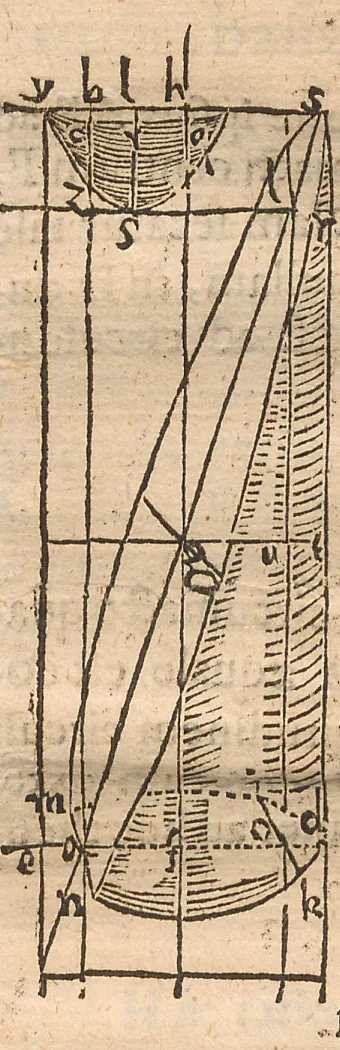
Proof. Let the body of the apple be laid out into a cylindrical segment by the same laws by which Archimedes, Theorem II, laid out the area of the circle into a right-angled triangle; and let AD be the radius of the great circle in the body of the apple, from whose point D let DS be raised, the length of that great circle stretched out straight, to be conceived in a cylindrical surface. For the line MN is as it were a common edge at which all the circular solid segments end. And when the circumference of the great circle is stretched out straight into DS, those circular solid segments are stretched out with it, and become the elliptical MSN, except the first, MDN. But the force of this transformation will shine out more clearly in what follows. Let the area MDN be cut by lines parallel to MN into a number of smallest segments of equal breadth, as it were lines, and let the points A and S be joined, and onto the line AS, from the points of the diameter AD made by the sections of the area, let the perpendiculars FG, OL be drawn. Let F be the centre, and let the perpendicular from F cut AS at G, and through G let GT be drawn parallel to FD. Finally let O be the midpoint of the section IK, and from it the perpendicular OL, cutting AS at L, and through L let LR be drawn parallel to OD. When, then, the figure is turned about MN, the little area at MN creates almost nothing, since it moves least; but its parallel through F now moves in a circle of length FG, the line through O in a circle of length OL, and so all of them; and the parts of the cylindrical body marked by FG, OL are equal to those cylindrical coats, as it were, in the globe which the lines generate in turning the figure MDN about MN, by Theorem XVI. The whole figure, then, namely the prism of the cylinder MNDS, made up of the bodies of all the coats stretched out straight, is equal to the whole body of the apple, made up of the coats.
Demonstratio. Explicetur corpus Mali ijsdem legibus in Cylindricum segmentum, quibus Archimedes Theor. II. explicauit circuli aream in triangulum rectangulum; & sit AD semidiameter circuli maximi in corpore Mali, ex cuius puncto D, erigatur DS, ejus circuli maximi longitudo in rectum extensa, quæ concipiatur in superficie cylindrica. Nam linea MN est veluti communis acies, ad quam terminantur omnia segmenta solida circularia. Extensâ verò maximi circuli circumferentia in rectum DS, segmenta illa solida circularia simul extenduntur, & fiunt Elliptica MSN, præterquàm primum MDN. Sed clarius elucescet vis huius transformationis in sequentibus. Secetur area MDN lineis parallelis ipsi MN in aliquot segmenta æquelata minima, quasi linearia, & connectantur A. S puncta, & in lineam AS, ex AD diametri punctis, per sectiones areæ factis, ducantur perpendiculares FG, OL. sit autem F centrum, & quæ ex F perpendicularis, secet A S in G, & per G ducatur ipsi FD parallela GT. Sit denique O punctum medium sectionis IK, & ex illo perpendicularis OL, secans AS in L, & per L ducatur ipsi OD parallela LR. Cùm igitur figura circa MN circumagitur, nihil ferè creat areola MN, quia minimùm movetur; at eius parallela per F, jam movetur in circulum, longitudine FG, linea per O, in circulum longitudine OL, & sic omnes: & partes corporis cylindracei, per FG, OL signatæ, sunt æquales cylindraceis illis veluti tunicis in Globo, quas gignunt lineæ in circumactu figuræ MDN circa MN: per XVI. Theor. Tota igitur figura, scilicet Cylindri prisma MNDS, constans ex omnium tunicarum corporibus, in rectum extensis, æqualis est toti corpori Mali, ex tunicis constanti.
Johannes Kepler, “Supplement to Archimedes,” in Nova stereometria doliorum vinariorum, inprimis Austriaci, figurae omnium aptissimae; et usus in eo virgae cubicae compendiosissimus et plane singularis. Accessit stereometriae Archimedeae supplementum (Linz: Johannes Planck, 1615), 42, available online https://doi.org/10.3931/e-rara-11051.
Further, the cylindrical body on the base IMNK up to L, the cylinder being cut by the plane in which the lines OL and KI lie, will be equal to the cylindrical body of the apple with the outer zone taken away. And so the little part of the cylinder cut off by this plane, namely LSDO, will be equal to the zone of the apple.
Amplius, cylindraceum corpus super basi IMNK usque in L, cylindro secto per planitiem, in qua sunt OL & KI lineæ, erit æquale cylindraceo Mali, cui dempta est zona exterior. Et igitur Particula cylindri, resecta per hoc planum, scilicet LSDO, erit æqualis Zonæ Mali.
Johannes Kepler, “Supplement to Archimedes,” in Nova stereometria doliorum vinariorum, inprimis Austriaci, figurae omnium aptissimae; et usus in eo virgae cubicae compendiosissimus et plane singularis. Accessit stereometriae Archimedeae supplementum (Linz: Johannes Planck, 1615), 42, available online https://doi.org/10.3931/e-rara-11051.
And since GT is equal to FD, and is the radius of that globe whose great circle is MIKN, and TS is the length of that great circle (because as AD to DS, so GT to TS), the prism of the cylinder above GT up to S will be equal to the globe; and the part GVL will likewise be equal to the cylindrical body of the globe FD described by turning the line IK at right angles to FO. And so the remaining little part of the cylinder LSTV will be equal to the zone of this globe whose section is the segment KDI.
Cum autem GT sit æqualis ipsi FD, & sit semidiameter illius globi cuius maximus circulus est MIKN, & TS sit longitudo illius circuli maximi (quia ut AD ad DS, sic GT ad TS) Prisma cylindri supra GT vsque in S, erit æquale Globo: Et pars GVL similiter erit æqualis cylindraceo corpori globi FD, per circum actum lineæ IK ad FO rectæ, descripti. Et igitur particula cylindri LSTV reliqua, erit æqualis zonæ globi hujus, cuius sectio est segmentum KDI.
Johannes Kepler, “Supplement to Archimedes,” in Nova stereometria doliorum vinariorum, inprimis Austriaci, figurae omnium aptissimae; et usus in eo virgae cubicae compendiosissimus et plane singularis. Accessit stereometriae Archimedeae supplementum (Linz: Johannes Planck, 1615), 43, available online https://doi.org/10.3931/e-rara-11051.
But ODSL is made up of VTSL and of ODTV, a cylindrical segment whose base is the segment IKD and height FG, equal to the circle that F, the centre of the greater segment MIKN, describes if the figure is turned about MN. So their equals are made up likewise; namely, the zone of the apple is made up of the zone of the globe described by the same segment and of the said cylindrical segment.
Sed ODSL componitur ex VTSL, & ex ODTV, segmento cylindraceo, cuius basis IKD segmentum, & FG altitudo, æqualis circulo, quem F centrum segmenti maioris MIKN describit, si figura circa MN circumagatur. Ergo etiam horum æqualia sic sunt; scilicet, vt zona Mali componatur ex Zona Globi ab eodem segmento descripta, & ex dicto segmento cylindraceo.
Johannes Kepler, “Supplement to Archimedes,” in Nova stereometria doliorum vinariorum, inprimis Austriaci, figurae omnium aptissimae; et usus in eo virgae cubicae compendiosissimus et plane singularis. Accessit stereometriae Archimedeae supplementum (Linz: Johannes Planck, 1615), 43, available online https://doi.org/10.3931/e-rara-11051.
Corollary and stereometric practice.
To measure an apple we shall proceed thus. The length MN of the missing segment at A must be given, in proportion to the diameter of the circle or the radius FD; from which the sector MFN to IFK is given, by the corollary to Theorem II. For if half of MN, that is, IO, is expressed in a number of parts of which FD is 100000, MN will be the right sine of the arc DI; and this being given, OF, the sine of the complement, is also given, and OD, the height of the missing segment, or the sagitta or versed sine in the table of sines. Multiplying FO by IO, then, the area of the triangle IFK results; taking this from the sector IFK, the segment IKD remains, which multiply by the circumference of radius AF, by the present theorem, and you will create the segment of the cylinder on the base, the segment of the circle, and with height FG; which is one part of the apple, namely part of the zone of the apple. Take twice the segment of the circle from the area of the circle: there will remain the segment of the circle between IK and MN, which multiply by the same circumference of the circle described with AB, and you will create the cylindrical body of the apple, which is the second part.
Malum mensuri, sic agemus. Datam esse oportet longitudinem MN deficientis segmenti apud A, in proportione ad diametrum circuli seu semidiametrum FD. ex qua datur sector MFN ad IFK, per Coroll. ad Th. II. Nam si dimidia MN, hoc est IO, explicetur numero, qualium FD est 100000, MN erit sinus rectus arcus DI; quo dato, datur & OF sinus complementi, & OD altitudo segmenti deficientis, seu sagitta aut sinus versus in tabula sinuum. Multiplicato igitur FO in IO, prodit area trianguli IFK, qua ablata à sectore IFK, relinquitur segmentum IKD, quod duc in circumferentiam semidiametri AF, per Th. præsens, & creabis segmentum cylindri, super basi, segmento circuli, & altitudine FG; quæ est pars vna Mali, pars scilicet Zonæ Mali: aufer autem duplum segmenti circuli ab area circuli, restabit segmentum circuli inter IK & MN; quod duc in eandem circumferentiam circuli per AB descripti: & creabis cylindraceum Mali; quæ est pars altera.
Johannes Kepler, “Supplement to Archimedes,” in Nova stereometria doliorum vinariorum, inprimis Austriaci, figurae omnium aptissimae; et usus in eo virgae cubicae compendiosissimus et plane singularis. Accessit stereometriae Archimedeae supplementum (Linz: Johannes Planck, 1615), 43, available online https://doi.org/10.3931/e-rara-11051.
And since IK is known, IM is known too. I seek, then, the segment KIM of the globe, whose base diameter is IM, by Theorem XIV; and multiply the same base by the height MN, and you will create the cylinder under this segment of the globe, by Theorem III; add to it the two segments of the globe found, and you will put together the cylindrical body of the globe between IK and MN; take this from the known body of the globe, by Theorem XIII, and the zone of the globe whose section is KD will remain, which is the third part of the apple, namely the other part of the zone of the apple. And the three parts put together give the whole body of the apple.
Et quia scitur IK, scitur igitur & IM. Quæro ergò segmentum globi KIM, cuius baseos diameter IM, per Th. XIV; eandem verò basin duc in altitudinem MN, Creabisque cylindrum sub hoc globi segmento, per Th. III. cui adde duo segmenta globi inventa, conflabisque cylindraceum globi, inter IK, MN; id aufer à corpore globi noto, per Th. XIII, restabitque zona globi, cuius sectio KD; quæ est pars tertia Mali, pars scilicet altera zonæ Mali; tribus vero partibus compositis, totum repræsentatur corpus Mali.
Johannes Kepler, “Supplement to Archimedes,” in Nova stereometria doliorum vinariorum, inprimis Austriaci, figurae omnium aptissimae; et usus in eo virgae cubicae compendiosissimus et plane singularis. Accessit stereometriae Archimedeae supplementum (Linz: Johannes Planck, 1615), 43, available online https://doi.org/10.3931/e-rara-11051.
Corollary II.
So the zone of the quince and the zone of the sitting gourd are made up of zones, the former of the long spheroid, the latter of the broad spheroid, and of segments of a pressed or elliptical cylinder, the former of a flatter one, the latter of a ridged one; the bases of these segments are the segments of the ellipse missing in the figures that created the quince and the sitting gourd, and their heights are equal to the circumferences, stretched out lengthwise, that the centres of the figures describe in turning.
Sic zona Cotonei, & zona Cucurbitæ sessilis, componuntur ex zonis, illa Sphæroidis longi, hæc sphæroidis lati, & ex cylindri pressi seu Elliptici segmentis, illa ex planiori, hæc ex dorsuali: quorum segmentorum bases, sunt Ellipseos segmenta, deficientia in figuris, quæ cotoneum & sessilem cucurbitam creaverant: altitudines verò æquales circumferentijs in longum extensis, quas centra figurarum in circumactu describunt.
Johannes Kepler, “Supplement to Archimedes,” in Nova stereometria doliorum vinariorum, inprimis Austriaci, figurae omnium aptissimae; et usus in eo virgae cubicae compendiosissimus et plane singularis. Accessit stereometriae Archimedeae supplementum (Linz: Johannes Planck, 1615), 43, available online https://doi.org/10.3931/e-rara-11051.
Theorem XXI.
The body of a lemon is the difference between a zone of a globe and the said segment of a cylinder.
Proof. For in the same way as before, when the figure is turned (above in Schema X, number V, CDB about CAB; but here in Schema XIV, IDK about IOK), the segment of the little area ending at IOK itself creates almost nothing, since it hardly moves; but the more distant parts now move through the length of their circumferences, until the last, D, or R corresponding to it, moves through the length RS, as great as the circumference of the widest circle through the body of the lemon. From these elements it follows that the body of the lemon (CDBE in Schema XI) is here, in Schema XIV, equal to the segment of the cylinder LRS. But since AD is twice FO, that is, GV, OL too will be twice CZ. The upright body ODRL, then, is twice VTRI; so the part ODTV is equal to the part VTKL. But RLS is the difference between LSTR and LRTV, of which the former is equal to the zone of the globe and the latter to the segment of the cylinder VDTV. The proposition is therefore plain.
Demonstratio. Nam eodem modo, vt prius, cum figura (superius in Schemate X, Numero V. CDB circa CAB) hic verò in Schemate XIV. IDK circa IOK circumagitur: segmentum areolæ in ipsam IOK terminans, ferè nihil creat, quia penè nihil movetur: at partes remotiores, iam moventur per longitudinem circumferentiarum suarum, donec vltima D, vel ei respondens R moveatur in longitudinem RS, quanta est circumferencia circuli amplissimi per corpus Citrij: ex quibus elementis conficitur, vt corpus Citrij (CDBE, in Schemate XI.) sit hic in Schemate XIV. æquale segmento cylindri LRS. At cùm AD dupla sit ipsius FO, id est GV, erit & OL, dupla ipsius CZ. Corpus igitur ODRL rectum, duplum ipsius VTRI; pars igitur ODTV, æqualis parti VTKL. Sed RLS est differentia inter LSTR, & LRTV, quorum illud æquale Zonæ Globi, hoc æquale segmento Cylindri VDTV. Patet igitur propositum.
Johannes Kepler, “Supplement to Archimedes,” in Nova stereometria doliorum vinariorum, inprimis Austriaci, figurae omnium aptissimae; et usus in eo virgae cubicae compendiosissimus et plane singularis. Accessit stereometriae Archimedeae supplementum (Linz: Johannes Planck, 1615), 44, available online https://doi.org/10.3931/e-rara-11051.
Corollary and Practice.
The length of the axis of the lemon must be given, and of the diameter of the great circle through the middle of its body. Multiplying the axis by itself, then, and dividing the product by the diameter of this great circle in the body of the lemon, there results something to be added to the diameter of the lemon: as this sum is to the diameter of the circle, 200000, so is the axis to the sine of the segment that creates the lemon; and so the diameter of the lemon to the versed sine. From this the calculation is similar to the one before, but shorter by one operation. For we do not need the cylindrical body of the apple; but having found first the segment VTKO and then the zone of the globe LSTV, the former is taken from the latter, and LSR, the body of the lemon, remains.
Oportet esse datam longitudinem axis Citrij, & diametri circuli maximi per corpus medium. Multiplicato igitur axe in seipsum, & facto diviso per diametrum huius circuli maximi in corpore Citrij, prodit aliquid adijciendum diametro Citrij: vt hoc aggregatum est ad diametrum circuli 200000, sic axis ad sinum segmenti quod creat citrium; Sic & diameter Citrij ad sinum versum. Ex eo similis, sed tamen brevior, est calculus vna operatione, quàm prius. Non indigemus enim cylindraceo Mali: sed invento primum segmento VTKO, deinde Zonâ Globi LSTV, aufertur illud ab hac, & restat LSR corpus Citrij.
Johannes Kepler, “Supplement to Archimedes,” in Nova stereometria doliorum vinariorum, inprimis Austriaci, figurae omnium aptissimae; et usus in eo virgae cubicae compendiosissimus et plane singularis. Accessit stereometriae Archimedeae supplementum (Linz: Johannes Planck, 1615), 44, available online https://doi.org/10.3931/e-rara-11051.
Corollary II.
So the body of an olive or elliptical plum is the difference between a zone of a spheroid, long in the one case, broad in the other, and the said segment of an elliptical cylinder.
Sic corpus Olivæ vel Pruni Elliptici, est differentia inter Zonam Sphæroidis illic longi, hic lati, & inter dictum segmentum Cylindri Elliptici.
Johannes Kepler, “Supplement to Archimedes,” in Nova stereometria doliorum vinariorum, inprimis Austriaci, figurae omnium aptissimae; et usus in eo virgae cubicae compendiosissimus et plane singularis. Accessit stereometriae Archimedeae supplementum (Linz: Johannes Planck, 1615), 44, available online https://doi.org/10.3931/e-rara-11051.
Theorem XXII.
The zone of a lemon cut off at both ends by equal circles is made up of the body of a smaller lemon, created by the same segment of a circle by which the proposed zone was created, and of a segment of a cylinder whose base is the same lesser segment of the circle and whose height is equal to the circumference of the cutting circle.
Zona Citrij truncati vtrinque æqualibus circulis, componitur ex corpore minoris Citrii, quod creatur ab eodem circuli segmento, quo & Zona proposita creata est, & ex segmento Cylindri, cuius basis est idem minus segmentum circuli, altitudo æqualis circumferentiæ circuli truncantis.
Johannes Kepler, “Supplement to Archimedes,” in Nova stereometria doliorum vinariorum, inprimis Austriaci, figurae omnium aptissimae; et usus in eo virgae cubicae compendiosissimus et plane singularis. Accessit stereometriae Archimedeae supplementum (Linz: Johannes Planck, 1615), 44, available online https://doi.org/10.3931/e-rara-11051.
For let Schema XIV be repeated. And let there be in it the cylindrical segment ISR, equal to the greater lemon. Let this segment be laid out separately, so that its base comes into view; and this base is the segment of a plane circle that created the greater lemon, the one to be cut. Let this segment of the circle be understood as under the straight line YBLH and the arc YCRQ. And let this lemon be cut off at both ends (such as is seen in the following Schema XVIII with the letters EAH FSQCG), so that we understand it to be created not by the whole segment of the circle but by its inner part BCQH, the arc CRQ being turned about the axis BH. The straight lines BC, HQ will then represent the radii of the cutting circles; and this base will be cut into four parts:
Repetatur enim Schema XIV. Et sit in eo segmentum ISR Cylindraceum, æquale Citrio maiori. Explicetur autem hoc segmentum seorsim, vt basis eius in conspectum veniat, est autem basis ista, segmentum plani Circularis, quod creavit Citrium maius, seu truncandum. Intelligatur segmentum hoc circuli sub recta YBLH, & sub arcu YCRQ. Sit autem Citrium hoc utrinque truncatum (quale, schemate sequenti XVIII. cernitur literis EAH FSQCG) sic ut intelligamus creatum esse non integro segmento circuli, sed parte ejus interiori BCQH, arcu CRQ circa BH axem circumacto. Repræsentabunt igitur rectæ BC, HQ, semidiametros circulorum Truncantium: & Basis ista secabitur in partes quatuor
Johannes Kepler, “Supplement to Archimedes,” in Nova stereometria doliorum vinariorum, inprimis Austriaci, figurae omnium aptissimae; et usus in eo virgae cubicae compendiosissimus et plane singularis. Accessit stereometriae Archimedeae supplementum (Linz: Johannes Planck, 1615), 45, available online https://doi.org/10.3931/e-rara-11051.
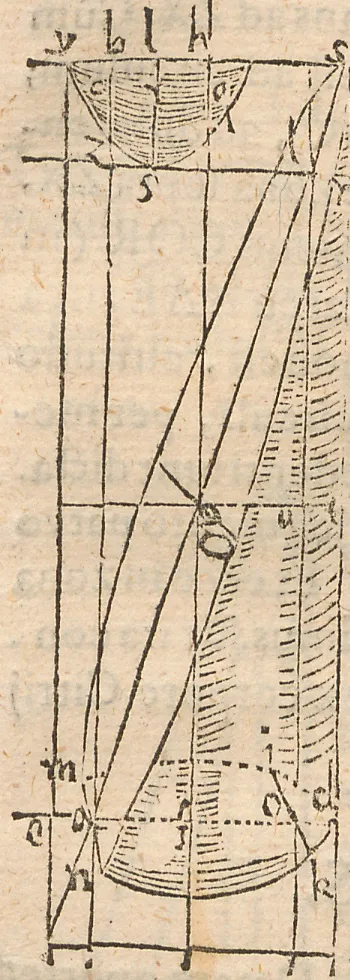
- BCY, on one side, a mixed-line triangle.
- Another beyond HQ on the other side, like the first.
- The rectangle BHQC, in the middle.
- The lesser segment of the circle, at the back, contained by the straight line CQ and the arc CRQ.
And since the solid is supposed equal to the whole greater lemon, RS, the height of the solid, will be equal to the circumference of the circle through the middle of the body of this lemon. And since YSH is the same plane in which the hypotenuses of the right angles BCZ and LRS lie, as LR is to RS, so is BC to CZ. But LR is to RS as the radius of a circle to its circumference; so BC is to CZ in the same way. So since BC is the radius of the cutting circle, CZ will be the circumference of the cutting circle.
Cum autem ponatur solidum æquale Citrio maiori toti, erit RS altitudo solidi, æqualis circumferentiæ circuli per medium huius Citrij corpus. Et quia planum YSH idem est, in quod incidunt hypotenusæ rectorum angulorum BCZ & LRS: quare vt LR ad RS, sic BC ad CZ. Sed LR est ad RS, vt radius circuli ad circumferentiam suam: ergo & BC ad CZ sic est. Itaque cum BC sit semidiameter truncantis; erit CZ circumferentia truncantis.
Johannes Kepler, “Supplement to Archimedes,” in Nova stereometria doliorum vinariorum, inprimis Austriaci, figurae omnium aptissimae; et usus in eo virgae cubicae compendiosissimus et plane singularis. Accessit stereometriae Archimedeae supplementum (Linz: Johannes Planck, 1615), 45, available online https://doi.org/10.3931/e-rara-11051.
On the four said parts of the base, then, stand as many solids:
- On BCY stands BYCZ, pyramid-like, contained by mixed surfaces and lines.
- One like it beyond HQX. And these two are equal to the two solid ends cut off from the lemon. (In the following Schema XVIII these ends are to be seen at the letters GEI and FNH.)
- On BHQC stands the prism or pentahedron BCZXHQ, contained namely by three quadrilaterals BCQH, CQXZ, XZBH, and two triangles CZB, QXH; its height is CZ, between the parallels QC, XZ. This solid is equal to the middle cylinder in the body of the cut lemon, having the cutting circles as its bases. (This cylinder is sketched in the following Schema XVIII with the letters EHFG, and lies wholly hidden within the zone FCG, HAE.)
- Finally, on the little segment CQR stands the solid SRQCZSX, like that into which the zone of the apple was laid out. And since the whole solid figure HYSR equals the whole body of the lemon, and the three parts listed equal as many parts of the lemon, it is necessary that this remainder of the cylindrical segment too equals the remaining part of the lemon; and this is the zone surrounding the cylinder just drawn, in the body of the cut lemon.
But just as this solid part is like the earlier one that equalled the zone of the apple, so too, like that one, it has two parts, distinguished from each other by plain marks: one is an upright segment of a cylinder contained by four surfaces, the plane parallelogram CQXZ, the cylindrical surface XZCRQ, and two small segments of a circle, one of which appears at the letters QCR while the other, at XZ, does not appear. And the height CZ of this segment, as has now been proved, equals the circumference of the cutting circle. The other part of this zone is the prism ZXS, standing on the same small segment at ZX. And since we said that LR is to RS as the radius to the circle, and BC is so to CZ as well, the difference of LR and BC will also be so to the difference of RS and CZ, which is the height of this second part of the zone above ZX. But the difference of LR and BC is the breadth, or versed sine, of the segment CQR (in Schema XVIII, AP, which is the radius of the smaller lemon described by the arc HAE about the axis HE). So the difference of RS and CL too, that is, the height of this cylindrical prism, is equal to the circumference of the circle through the middle of the body of the smaller lemon. By what was said in the previous theorem, then, this cylindrical prism ZXS is equal to the smaller lemon described by the small segment CQR (which is HAE in the following Schema XVIII). And see in the zone of the cut lemon the two parts such as we described in the theorem. So that the body of the cut lemon consists of three elements in all: the body of the smaller lemon, the cylinder, and the upright segment of the cylinder.
Atqui vt similis est ista pars solida priori, quæ Zonam æquabat Mali; sic etiam duas, vt illa, partes habet, manifestis signis ab invicem discretas: vna est segmentum cylindri rectum, contentum superficiebus quatuor, plano parallelogrammo CQXZ, superficie cylindrica XZCRQ, & duobus segmentis parvis circuli; quorum vnum apparet, literis QCR, alterum ad XZ non apparet, Et huius segmenti altitudo CZ, vt jam est demonstratum, æquat circumferentiam circuli Truncantis. Altera huius zonæ pars est Prisma ZXS, super eodem segmento parvo stans ad ZX. Cùm autem LR diximus sic se habere ad RS, vt semidiamr est ad circulum; & sit etiam BC sic ad CZ; erit etiam sic differentia LR & BC, ad differentiam RS & CZ: quæ est altitudo huius secundæ partis de zona supra ZX. Sed differentia LR & BC est latitudo, vel sinus versus segmenti CQR (in Schemate XVIII. AP, quæ est semidiameter Citrij minoris, arcu HAE circa axem HE descripti) Ergo etiam differentia RS & CL, hoc est, altitudo huius Prismatis Cylindracei, est æqualis circumferentiæ circuli, per medium corpus Citrij minoris. Per ea igitur, quæ Th. antecedenti sunt dicta. Prisma hoc Cylindraceum ZXS, est æquale Citrio minori, segmento parvo CQR descripti quod est in Schem. XVIII. seq. HAE.) Et ecce in zona Citrij truncati duas partes, quales in Theoremate descripsimus. Vt ita constet corpus Citrij truncati ex tribus omninò Elementis, ex corpore Citrij minoris, ex Cylindro, & ex segmento cylindri recto.
Johannes Kepler, “Supplement to Archimedes,” in Nova stereometria doliorum vinariorum, inprimis Austriaci, figurae omnium aptissimae; et usus in eo virgae cubicae compendiosissimus et plane singularis. Accessit stereometriae Archimedeae supplementum (Linz: Johannes Planck, 1615), 45–46, available online https://doi.org/10.3931/e-rara-11051.
Corollary and Practice.
To measure the body of a lemon cut off at both ends we shall proceed thus. The lengths of the diameters must be given, both of the great circle in the middle of the body and of the cutting circles; let the distance between the cutting circles also be given, all in the same measure. Then take the diameter of the cutting circles from the diameter of the greatest; let what remains divide the square of the distance between the cutting circles; to the quotient add the divisor. Then as this sum is to the divisor, so is 200000, the measure of the diameter used in the canon of sines, to the versed sine of the segment that creates I. the smaller lemon, II. the zone of the greater lemon, III. the zone of the globe, IV. the zone of the apple created by the greater segment of the same circle as the smaller lemon; and so too the same number 200000 is to the diameters and the distance of the cutting circles in the same measure.
Mensuri corpus Citrii vtrinque truncati, sic agemus. Datam oportet esse longitudinem diametrorum tam circuli maximi in corpore medio, quam circulorum truncantium: datum sit etiam intervallum inter circulos truncantes, omnia in eadem mensura. Tunc aufer diametrum truncantium à diametro maximi, quod remanet, dividat quadratum intervalli inter truncantes; quotienti adde divisorem. Vt ergo compositum hoc ad divisorem, sic 200000, mensura diametri usitata in Canone sinuum, ad sinum versum segmenti, quod creat, I Citrium minus, II Zonam Citrii maioris, III. Zonam Globi. IV. Zonam Mali, quod creatur eiusdem cum Citrio minori circuli segmento maiori: sic etiam idem numerus 200000 est ad diametros intervallumque Truncantium in eadem mensura.
Johannes Kepler, “Supplement to Archimedes,” in Nova stereometria doliorum vinariorum, inprimis Austriaci, figurae omnium aptissimae; et usus in eo virgae cubicae compendiosissimus et plane singularis. Accessit stereometriae Archimedeae supplementum (Linz: Johannes Planck, 1615), 46, available online https://doi.org/10.3931/e-rara-11051.
Now, then, by the corollary to XXI, find the body of the small lemon by means of the zone of the apple and the zone of the sphere; this body is one part of the cut lemon. Next, from the number of the diameter of the cutting circle, now found, find the length of its circumference in the same measure, and multiply it by the segment of the circle found: the second part of the cut lemon will result, and these two parts together will make up its zone. Third, multiply the plane of the cutting circle by the number of the distance between the cutting circles, now found: the third part of the cut lemon will result. All being put together in one sum, the whole body of the cut lemon will be composed.
Iam igitur per Corollarium ad XXI, quære corpus Citrii parvi, per Zonam Mali & per Zonam Sphæræ; hoc corpus est pars vna Citrii Truncati. Deinde per numerum diametri truncantis, iam inventum, quære longitudinem eius circumferentiæ in eadem mensura, eamque multiplica in segmentum circuli inventum; prodibit Citrii truncati pars altera, & iunctæ hæ duæ partes, constituent eius Zonam. Tertiò multiplica planum circuli truncantis in numerum intervalli truncantium, iam inventum, prodibit pars tertia Citrii truncati. Omnibus in unam summam coniectis, componetur totum corpus Citrii truncati.
Johannes Kepler, “Supplement to Archimedes,” in Nova stereometria doliorum vinariorum, inprimis Austriaci, figurae omnium aptissimae; et usus in eo virgae cubicae compendiosissimus et plane singularis. Accessit stereometriae Archimedeae supplementum (Linz: Johannes Planck, 1615), 46, available online https://doi.org/10.3931/e-rara-11051.
Corollary II.
The zone of a cut olive or elliptical plum is likewise made up of the body of a smaller olive or plum, created by the same segment of the ellipse, and of a segment of a pressed cylinder standing on the same segment of the ellipse, with a height equal to the circumference of the circle that cuts the olive or plum.
Zona Olivæ aut Pruni Elliptici truncati componitur similiter ex corpore Olivæ aut Pruni minoris, quod eodem Ellipseos segmento creatur; & ex segmento Cylindri pressi, quod eidem Ellipseos segmento superstat, altitudinem habens æqualem circumferentiæ circuli truncantis Olivam aut Prunum.
Johannes Kepler, “Supplement to Archimedes,” in Nova stereometria doliorum vinariorum, inprimis Austriaci, figurae omnium aptissimae; et usus in eo virgae cubicae compendiosissimus et plane singularis. Accessit stereometriae Archimedeae supplementum (Linz: Johannes Planck, 1615), 46–47, available online https://doi.org/10.3931/e-rara-11051.
Addendum.
To here I put off the proof of Theorem XVII on the zone or coat of a conical frustum about a cylinder, because it is akin to the proof of the present theorem.
Huc distuli demonstrationem Theorematis XVII. de Zona seu Tunica Trunci conici circa Cylindrum: propterea quod cognata est demonstrationi Theorematis præsentis.
Johannes Kepler, “Supplement to Archimedes,” in Nova stereometria doliorum vinariorum, inprimis Austriaci, figurae omnium aptissimae; et usus in eo virgae cubicae compendiosissimus et plane singularis. Accessit stereometriae Archimedeae supplementum (Linz: Johannes Planck, 1615), 47, available online https://doi.org/10.3931/e-rara-11051.
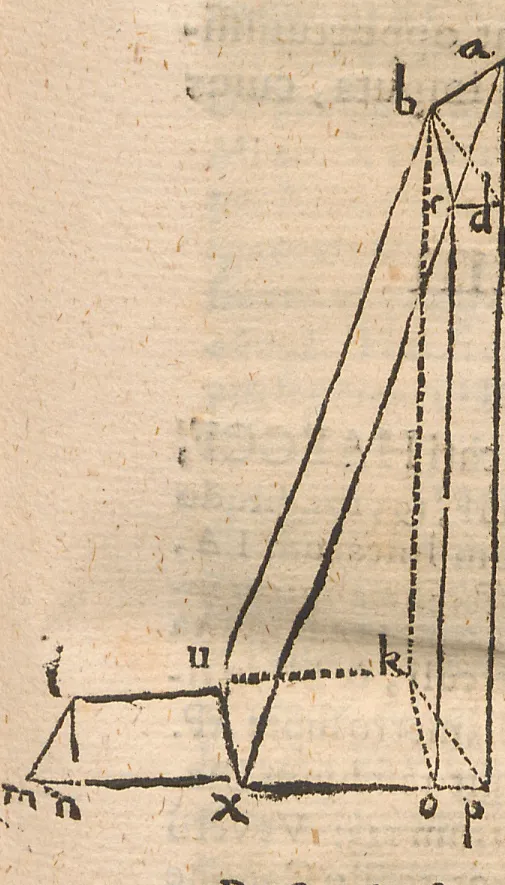
Let KLMP be the section of a right conical frustum through the axis VX, KO the diameter of the circular base PM, and KL the diameter of the cutting circle, to which KO, LN are parallel, so that KL and ON are equal, and the figure KOP is similar to the figure LNM, and the quadrilateral KVXO similar to LVXN. Let the solidity of the frustum be laid out straight by the same laws by which we have so far laid out figures of every kind bounded by surfaces curved in all directions. Since, then, the line PK of the conical surface is straight in these directions, the surface laid out will be plane, namely ABKP; and PA will be equal to the circumference of the base PM, and KB equal to the circumference of the cutting circle KL, to which OC will be equal; and let PD be made equal to the same, and let the points D, C, B be joined, which will form a triangle equal and similar to the triangle POK, with the sides of the one parallel to the sides of the other, as also plane to plane.
Sit KLMP Trunci Conici recti sectio per axem VX, KO diameter circularis basis PM, diameter circuli Truncantis KL, cui parallelæ sint KO, LN, vt sint æquales KL & ON, & KOP figura similis figuræ LNM, & KVXO quadrilateræ, similis LVXN. Explicetur autem trunci soliditas in rectum, ijsdem legibus, quibus hactenus omnis generis figuras, superficiebus, in omnes plagas curvis, terminatas explicavimus. Cum igitur linea PK conicæ superficiei sit in has plagas PK, recta, explicata igitur superficies erit plana, scilicet ABKP, & PA erit æqualis circumferentiæ baseos PM: KB verò æqualis circumferentiæ circuli KL truncantis, cui æqualis erit OC: fiat tantem eidem æqualis & PD, & puncta DCB connectantur; quæ formabunt triangulum æquale & simile triangulo POK, & latera vnius, lateribus alterius parallela, vt & planum plano.
Johannes Kepler, “Supplement to Archimedes,” in Nova stereometria doliorum vinariorum, inprimis Austriaci, figurae omnium aptissimae; et usus in eo virgae cubicae compendiosissimus et plane singularis. Accessit stereometriae Archimedeae supplementum (Linz: Johannes Planck, 1615), 47, available online https://doi.org/10.3931/e-rara-11051.
The two pentahedra or prisms BGVXOK and KOPDBC are therefore of equal height, being between parallel planes. But there is a difference between them, that the parallelepiped on the base KOXV with height OC is twice the prism CBVXOK, while the prism on the base PKO, with the same height, is itself the measure of its whole; yet it too is three times the pyramid POKD of equal height. Finally, on the base DCB stands the pyramid DCBA, whose height DA is the difference of the circumferences KL and PM, since the base DCB is equal to the base POK of the pyramid POKD. And since pyramids on equal bases are to each other as their heights, a third pyramid, on the base POK with height PA, made up of PD and DA (and this equals the circumference PM), will be equal to both pyramids POKD and DCBA. And the prism with the same base and height will be three times it; and with a height of a third of PA it will be equal to these two pyramids. And what remains of the lower prism KOPDBC, namely DOKBC, keeps two thirds of the prism. So the body of this remainder is created by multiplying two thirds of the height CO (that is, of the circumference of the circle KL or ON) by the base POK. These, then, are the parts of the body of the frustum that we call the zone or coat. The remaining part, namely the middle cylinder, equals the prism CBVXOK, which is like the triangle COX given a body, with a thickness OK, XV, CB everywhere equal; so it happens, as with triangles, that the base KOXV multiplied by half the height CO (half the circumference of KL or ON) creates the body of this cylinder. So much for the generation: the rest, by which our shortcut is reached, I shall give in a synopsis for brevity and clarity.
Duo igitur Pentaedra seu Prismata, BGVXOK & KOPDBC sunt æquealta, quippe sub parallelis planis: Sed discrimen est inter illa, quod parallelepipedum basi KOXV, altitudine OC, est duplum prismatis CBVXOK, at Prisma basi PKO, altitudine eadem, est ipsum sui totius mensura: est tamen & ipsum triplum Pyramidis æquealtæ POKD. Denique super DCB basi stat Pyramis DCBA, habens altitudinem DA, differentiam circumferentiarum KL, PM, cum basis DCB sit æqualis basi Pyramidis POK D. Cùm autem Pyramides super æqualibus basibus, sint inter se, vt earum altitudines; Pyramis ergo tertia, basi POK, altitudine PA, compositâ ex PD, DA, (hæc autem æquat circumferentiam PM) erit æqualis Pyramidi vtrique, POKD & DCBA. Et Prisma basi & altitudine ijsdem, erit illius triplum; altitudine verò, tertia parte ipsius PA, erit his 2 Pyramidibus æquale: Quod vero de Prismate humiliore KOPDBC reliquum est, puta DOKBC, duas tertias retinet Prismatis. Ergo huius reliqui corpus creatur, ductis duabus tertijs altitudinis CO (seu circumferentiæ circuli KL vel ON) in basin POK. Hæ sunt igitur partes corporis de Trunco, quod Zonam seu Tunicam appellamus. Reliqua pars, Cylinder sc. intermedius, æquat Prisma CBVXOK, quod est veluti triangulum COX corporatum, crassitie OK, XV, CB, ubique æquali; fit igitur vt cum triangulis, vt basis KOXV, ducta in dimidiam altitudinem CO (semicircumferentiam ipsius KL vel ON) creet corpus huius Cylindri. Hæc de genesi: reliqua quibus compendium nostrum initur, brevitatis & lucis causa, per Synopsin tradam.
Johannes Kepler, “Supplement to Archimedes,” in Nova stereometria doliorum vinariorum, inprimis Austriaci, figurae omnium aptissimae; et usus in eo virgae cubicae compendiosissimus et plane singularis. Accessit stereometriae Archimedeae supplementum (Linz: Johannes Planck, 1615), 47, available online https://doi.org/10.3931/e-rara-11051.
By what has so far been proved,

| For the coat | For the cylinder |
|---|---|
| KOP is multiplied Or equivalently half PO, or PO itself |
KOXV is multiplied Or OX, or its double ON |
| By a third of PA and two thirds of
OC Equivalently, by a third of PM and two thirds of ON Equivalently, by the whole PM and two ON |
By half OC By half ON, that is, by OX By ON, NX, that is, three OX |
So, the terms being exchanged, there is multiplied

| PO, or its double PO, NM, that is, the difference of the diameters KL, PM. | ON, NX, or its double, which is three times ON, the lesser diameter. |
| By the whole PM and two ON | By ON, the lesser diameter: which was to be proved. |
The most convenient shortcut that results from this proof, take from Theorems XVI and XVII, and credit it to this supplement, of which it is a singular ornament.
Compendium quod ex hac demonstratione resultat opportunissimum, pete ex Th. XVI. XVII. & huic supplemento imputa, cuius est ornamentum singulare.
Johannes Kepler, “Supplement to Archimedes,” in Nova stereometria doliorum vinariorum, inprimis Austriaci, figurae omnium aptissimae; et usus in eo virgae cubicae compendiosissimus et plane singularis. Accessit stereometriae Archimedeae supplementum (Linz: Johannes Planck, 1615), 48, available online https://doi.org/10.3931/e-rara-11051.
An example of some of the foregoing rules.
In the following Schema XVIII let there be the body of the cut lemon HAEGCF, and let the diameter AC of the great circle in it be 22, that of the cutting circles EG, HF 19, and the length between them, HE or MK or FG, 27. So the halves of these lines, LA, KE, KL, are also to each other in the same ratio, namely as 22, 19, 27. The difference between AL and LQ (equal to EK) is therefore 3. It must first be found what part of its circle the arc HAE is. Since AC is a portion of the diameter of this circle, and EP perpendicular to it, as AP is to PE, so is PE to the rest of the diameter beyond AP. Since PE is 27, its square is 729; divide this by AP, 3: the rest of the diameter comes out 243, to which AP, 3, being added, makes the diameter 246 and the radius 123. But so that we can use the canon of sines, all the lines must be given numbers used in that canon: if 123 is 100000, then AP, for 3, becomes 2439, and this is the versed sine of the arc AE sought. So, by the doctrine of the use of the canon of sines, taken from the radius 100000 it leaves 97561, the sine of the complement of this arc, namely 77° 19′ 9″. So the arc AE is 12° 40′ 51″, and its sine PE from the canon is 21951. The same by the rule of three: if you make as 123 to 100000, so 27, as great as PE was in the first measure, to the number in this measure, 21951 results. So the whole arc EAH is 25° 21′ 42″.
Sit, in Schemate XVIII. sequenti, corpus Citrij Truncati HAEGCF, & diameter circuli maximi in eo AC, sit 22, Truncantium EG, HF, 19, longitudo interjecta HE vel MK vel FG, sit 27. Ergò etiam dimidia harum linearum LA, KE, KL sunt inter se in eadem proportione, sc. ut 22. 19. 27. Differentia igitur inter AL, LQ (æqualem ipsi EK) est 3. Querendum est primò, arcus HAE quota pars sit sui circuli. Cum igitur AC sit portio de diametro hujus circuli, & EP in illam perpendicularis, vt igitur AP ad PE, sic PE ad residuum de diametro supra AP. Cùm ergo PE sit 27, qudm ejus 729. divide hoc per AP 3, provenit residuum Diametri 243, cuj addita AP 3 constituit diametrum 246, semidiametrum 123. Vt verò canone sinuum uti possimus, lineæ omnes debent nancisci numeros, in illo Canone usitatos: quod si 123 sit 1 00000, ergo AP pro 3 fiet 2439, & hic est sinus versus arcûs AE quæsiti. Quare secundum doctrinam de usu Canonis sinuum, ablatus à radio 100000, relinquit 97561, sinum complementi huius arcus. sc. G. 77. M. 19. S. 9. Ergo arcus AE est, G. 12. M. 40. S. 51, ejusque sinus PE ex Canone est 21951. Idem ex regula, si fiat vt 123 ad 1 00000, sic 27, quanta fuit PE in prima dimensione, ad numerum huius dimensionis, prodit enim 21951. Itaque totus arcus EAH est G. 25. M. 21. S. 42.
Johannes Kepler, “Supplement to Archimedes,” in Nova stereometria doliorum vinariorum, inprimis Austriaci, figurae omnium aptissimae; et usus in eo virgae cubicae compendiosissimus et plane singularis. Accessit stereometriae Archimedeae supplementum (Linz: Johannes Planck, 1615), 48, available online https://doi.org/10.3931/e-rara-11051.
And since, by Theorem XXII, we need to know the area of the segment EHA, we shall find it by Corollary II to Theorem II, in this way. The area of the whole circle is worth 3 14159 26536 parts of which there are 4 00000 00000 in the square of the diameter: understand square particles, one such unit long and broad, of which there are 2 00000 in the diameter. The part of the area of the circle, then, contained under the arc EH and the lines joining its ends E, H with the centre, namely the sector of the arc EH (which is always proportional to its arc), is worth 22132 22936. From this area of the sector must be taken the triangle whose vertex is at the centre and base the straight line EH. And since from A to the centre is 1 00000, but from A to P 2439, from P to the centre, that is, the height of the triangle, will be, as before, 97561. Multiply this height by PE, half the base, which was found to be 21951: it will make 21415 61511, the area of the triangle, which being deducted from the sector, 716 61425 will remain, the area of the segment EHA.
Et quia, per Th. XXII, opus nobis est cognitione areæ in segmento EHA, inquiremus illam per Corollarium II. ad Th. II. in hunc modum. Totius Circuli area valet talium particularem 3 14159 26536, qualium sunt in Quadrato diametri 4 00000 00000: intellige particulas quadratas, longas & latas vnam talem vnitatem, qualium sunt in diametro 2 00000 longæ. Pars igitur areæ circuli, contenta sub EH arcu & lineis, quæ E, H, terminos cum centro connectunt, sector scilicet arcus EH (qui semper est proportionalis suo arcui) valet 22132 22936. Ab hac area sectoris auferendum est triangulum, cujus vertex in centro, basis, recta EH. Cum autem ab A in centrum, sint 1 00000, sed ab A in P, 2439: Ergo à P in centrum, hoc est, perpendiculum Trianguli, erit, vt prius, 97561. Duc hoc perpendiculum in PE, dimidiam basin, quæ inventa est 21951: fiet 21415 61511, area Trianguli, qua deducta de sectore, restabit 716 61425, area segmenti EHA.
Johannes Kepler, “Supplement to Archimedes,” in Nova stereometria doliorum vinariorum, inprimis Austriaci, figurae omnium aptissimae; et usus in eo virgae cubicae compendiosissimus et plane singularis. Accessit stereometriae Archimedeae supplementum (Linz: Johannes Planck, 1615), 48, available online https://doi.org/10.3931/e-rara-11051.
From this area of the segment we come to know the upright segment of the cylinder whose base is this area of the segment of the circle, namely the lesser part of the zone of that apple which is described by the rest of the circle, the greater segment, after EAH is taken away, turned about the axis HE. For by Theorem XX this area must be multiplied by the circle that the centre of this greater segment describes. The length of this circumference, then, is found as follows. The height of the triangle is the distance of the centre from P, the midpoint of the axis EH, namely 97561; and this is the radius of the circle sought. And since circles have one and the same ratio to their radii, by Theorem I, as the radius 1 00000 is to 6 28318½, the circumference of the circle EAH, so the radius 97561 is to the circumference of its circle, 6 12994; which, multiplied by the area of the segment, makes 4392 80235 56450.
Ex hac area segmenti nobis innotescit segmentum rectum Cylindri, cujus basis, est hæc area segmenti circuli, nimirum pars minor de Zona illius Mali, quod describitur à segmento circuli, post ablatum EAH, residuo, & majore, circa axem HE circumacto. Nam per Th. XX, ducenda est hæc area in circulum, quem centrum huius segmenti majoris describit. Hujus igitur circumferentiæ longitudo inquiritur sic. Perpendiculum Trianguli, est distantia centri, ab axis EH, puncto P medio, sc. 97561: & hic est quæsiti circuli radius: cùm autem circulorum ad suos radios vna sit eademque proportio, per Th. I. Vt igitur 1 00000 radius, ad 6 28318 semis, circumferentiam circuli EAH, sic 97561 radius, ad sui circuli circumferentiam 6 12994, quæ ducta in aream segmenti, efficit 4392 80235 56450.
Johannes Kepler, “Supplement to Archimedes,” in Nova stereometria doliorum vinariorum, inprimis Austriaci, figurae omnium aptissimae; et usus in eo virgae cubicae compendiosissimus et plane singularis. Accessit stereometriae Archimedeae supplementum (Linz: Johannes Planck, 1615), 48–49, available online https://doi.org/10.3931/e-rara-11051.
So of the cubic parts, each a hundred-thousandth of the radius long, broad and high, of which the cube in which the globe made from the circle EAH is inscribed has 8 00000 00000 00000, and of which 4 18879 02047 86301 are in the body of the globe, the sum of such little cubes is expressed in the resulting sum; and just so many are in that part of the zone of the apple which the upright segment of the cylinder described in Theorem XX equals.
Igitur qualium cubus, in quem globus, ex circulo EAH factus inscribitur, habet 8 00000 00000 00000 partes cubicas, vnam centies millesimam semidiametri longas latas & altas, quarum 4 18879 02047 86301 sunt in corpore Globi; talium cubiscorum summa expressa est in prodeunte summa, & tot omnino existunt in parte illa Zonæ Mali, quam æquat segmentum Cylindri rectum, Th. XX. descriptum.
Johannes Kepler, “Supplement to Archimedes,” in Nova stereometria doliorum vinariorum, inprimis Austriaci, figurae omnium aptissimae; et usus in eo virgae cubicae compendiosissimus et plane singularis. Accessit stereometriae Archimedeae supplementum (Linz: Johannes Planck, 1615), 49, available online https://doi.org/10.3931/e-rara-11051.
The other part of this zone of the apple is the zone of the globe EAH described by the same segment EPHA about the rest of the body of the globe, by Theorem XX. So the zone of the globe whose great circle is EAH must be sought. Look back, then, at Schema VIII,1 in which let KCN be the same arc we have been dealing with. So the zone of the globe CDBL that passes through KDN and HBM must be sought. So by Theorem XV, Corollary II, let the body of the segment KHD of the globe be sought. Since NK is 25° 21′ 42″, and CK 12° 40′ 51″, KD will be 77° 19′ 9″, whose sine KI is 97561. And the circle through KIH is the base of the segment HKD, so that KI is its radius. Its area cannot then be unknown. For as the square of the radius CA, 1 00000 00000, is to the area of its circle, so the square of KI, which is 95181 48721, is to the area of the circle KIH, 2 99021 46098. This, multiplied by a third of IO, as the height of the cone, creates the body of the segment HKD. IO must therefore be found, by the rule of Theorem XIV. Since KC is known, and IA, its sine, was 21951 above, ID is 78049 and IL 1 21951. And as IL to LA, so ID to DO. Dividing ID, 78049 (increased by five zeros), by IL, 1 21951, DO comes out 64000. The whole IO, then, is 1 42049, and its third part 47350, which multiplied by the base KH creates 1 41586 66177 40300, the body of the segment HKD, to which the lower segment MNL is equal; while the body of the whole globe, by Theorem XII, is 4 18879 02047 86391. Taking away both segments, there remains in the frustum HKNM 1 35705 69693 05791. You could get this far even without knowing the area of the base, by the corollary to XIV. For IL is the height of the greater segment of the sphere, and ID its remainder to the diameter. So as ID is to DA, the radius, so is IL, the height of the greater segment, to LP; from which the whole IP is had for the greater segment, and IO was had for the lesser, so that the sum OP is equated with the whole sphere. For the same quantity of the segment HKD results as before.
Pars altera huius Zonæ Mali, est Zona globi EAH, per idem segmentum EPHA, circa reliquum corpus globi, descriptum, per Th. XX. Ergo quærenda est Zona globi, cujus maximus circulus sit EAH. Respiciatur igitur Schema VIII.1 in quo sit KCN arcus idem, de quo hactenus egimus. Ergo globi CDBL Zona, quæ per KDN & HBM transit, est inquirenda. Ergo per Th. XV. Coroll. II. quæratur corpus segmenti globi KHD. Cùm ergo sit NK. G. 25. M. 21. S. 42. & CK. G. 12. M. 40. S. 51. erit igitur KD. G. 77. M. 19. S. 9. cuius sinus KI est 97561. At circulus per KIH, est Basis segmenti HKD, sic ut KI sit eius semidiameter. Non potest igitur ignorari area. Nam ut quadratum CA radij, 1 00000 00000, ad aream circuli sui, sic etiam quadratum KI, quod est 95181 48721, ad aream circuli KIH, 2 99021 46098. Hæc si ducatur in tertiam partem ipsius IO, ut altitudinis Coni, creat corpus segmenti HKD. Invenienda est igitur IO, ex præscripto Theor. XIV. Cùm enim KC sit nota, & IA, ejus sinus, supra fuerit 21951: quare ID est 78049, & IL 1 21951. Vt autem IL ad LA, sic ID ad DO. Divisâ ID 78049 (auctâ quinque cyphris) per IL, 1 21951, prodit DO 64000. Tota igitur IO 1 42049, & pars ejus tertia 47350: quæ ducta in basin KH, creat 1 41586 66177 40300, corpus segmenti HKD, cui est æquale segmentum inferius MNL: cùm totius Globi corpus per Th. XII. sit 4 18879 02047 86391. Ablato vtroque segmento, restat in Trunco HKNM 1 35705 69693 05791. Posses hucusque pervenire etiam sine cognitione areæ in basi, per XIV. Corollarium. Nam IL est altitudo majoris segmenti de sphæra, & ID ejus residuum ad Diametrum. Vt ergo ID ad DA semidiametrum, sic IL altitudo majoris segmenti, ad LP: vnde habetur tota IP, pro segmento majori, & erat IO pro segmento minori, sicut composita OP æquiparetur Sphæræ toti: Prodit enim eadem segmenti HKD quantitas, quæ antea.
Sch. 8.↩︎
Johannes Kepler, “Supplement to Archimedes,” in Nova stereometria doliorum vinariorum, inprimis Austriaci, figurae omnium aptissimae; et usus in eo virgae cubicae compendiosissimus et plane singularis. Accessit stereometriae Archimedeae supplementum (Linz: Johannes Planck, 1615), 49, available online https://doi.org/10.3931/e-rara-11051.
Further, from the frustum HK NM the middle cylinder must still be taken away, whose base is the same as the segment’s, namely HIK, and height KM, or twice IA. And IA was 21951; so the whole height is 43902, which multiplied by the area of the circle HIK creates 1 31276 40179 94396, the cylinder clothed by the zone sought; and when this is taken from the frustum HK NM, the zone KCN, HBM remains, 4429 29513 11395.
Porrò de Trunco HK NM adhuc reiciendus est cylinder medius, cujus basis eadem quæ segmenti, sc. HIK, altitudo verò, KM, vel duplum ipsius IA. Erat autem IA 21951. tota igitur altitudo est 43902, quæ ducta in aream circuli HIK, creat 1 31276 40179 94396 Cylindrum, Zonâ quæsitâ amictum, quo ablato de Trunco HK NM, restat Zona KCN, HBM 4429 29513 11395.
Johannes Kepler, “Supplement to Archimedes,” in Nova stereometria doliorum vinariorum, inprimis Austriaci, figurae omnium aptissimae; et usus in eo virgae cubicae compendiosissimus et plane singularis. Accessit stereometriae Archimedeae supplementum (Linz: Johannes Planck, 1615), 49, available online https://doi.org/10.3931/e-rara-11051.
But to return to Schema XVIII:2 the height of this last cylinder is represented in it by EH, and the zone of the globe has the same segment EHA as was in the earlier upright segment of the cylinder. So of these two parts, that upright segment of the cylinder and this zone of the globe, the zone of the apple is made up.
Vt autem redeamus ad Schema XVIII.2 hujus ultimi cylindri altitudo in illo repræsentatur per EH, & Zona globi habet idem segmentum EHA, quod erat in priori segmento cylindri recto. Ex his ergo duabus partibus, ex illo segmento cylindri recto, & ex hac Zona globi, composita est Zona Mali.
Sch. 18.↩︎
Johannes Kepler, “Supplement to Archimedes,” in Nova stereometria doliorum vinariorum, inprimis Austriaci, figurae omnium aptissimae; et usus in eo virgae cubicae compendiosissimus et plane singularis. Accessit stereometriae Archimedeae supplementum (Linz: Johannes Planck, 1615), 49, available online https://doi.org/10.3931/e-rara-11051.
From here, by Theorem XXI, the body of the lemon described by the same segment EHA is easily had, by subtracting that segment of the cylinder, 4392 etc., from this zone of the globe, 4429 etc. For there remains 36 49277 54945, the body of the small lemon described by the segment EAH turned about the axis EH, the use of which will now become necessary.
Hinc verò, per Th. XXI. facile habetur corpus Citrij, quod eodem segmento EHA describitur, subducto illo segmento cylindri 4392 etc. ab hac Zona globi 4429 etc: Nam restat 36 49277 54945, corpus parvi Citrij, per segmentum EAH, circa axem EH circumactum, descripti: cujus usus jam fiet necessarius.
Johannes Kepler, “Supplement to Archimedes,” in Nova stereometria doliorum vinariorum, inprimis Austriaci, figurae omnium aptissimae; et usus in eo virgae cubicae compendiosissimus et plane singularis. Accessit stereometriae Archimedeae supplementum (Linz: Johannes Planck, 1615), 49, available online https://doi.org/10.3931/e-rara-11051.
Now at last to the greater lemon IANC and its middle frustum HAEGCF. For this frustum too consists of the cylinder FGEH and the zone clothing the cylinder, which is described by the segment HAEPH turned about the axis MLK, so that H passes through F, A through C, P through O, and E through G.
Iam tandem ad Citrium majus IANC, ejusque Truncum medium HAEGCF. Constat enim & hic Truncus, cylindro FGEH, & Zonâ cylindrum vestiente, quæ describitur segmento HAEPH, circa axem MLK circumacto, sic ut H per F transeat, A per C, P per O, & E per G.
Johannes Kepler, “Supplement to Archimedes,” in Nova stereometria doliorum vinariorum, inprimis Austriaci, figurae omnium aptissimae; et usus in eo virgae cubicae compendiosissimus et plane singularis. Accessit stereometriae Archimedeae supplementum (Linz: Johannes Planck, 1615), 49, available online https://doi.org/10.3931/e-rara-11051.
The cylinder FGEH, then, will be found thus. Of parts of which AL is 22, PL or HM was given as 19, and AP as 3. But to use the canon of sines, AP, 3, was made 2439, of parts of which the radius of the whole circle EAH is 1 00000. As 3 is to 2439, then, or as 123 to 1 00000 (as before), so 19 is to 15447. This now is the radius HM of the circle HF, whose area must be found. As the square of the radius 1 00000, which is 1 00000 00000, is to the area of the circle 3 14159 26536, so the square of the radius 15447, 23 86 09809, is to the area of its circle, 7496 14823. This is the area HF or EG, the base of the cylinder. And its height too is known from the foregoing: for it is (as before in the cylinder of the globe) 43902. This height, then, multiplied by the area of the base just found, creates the body of the cylinder FHEG, 3290 95899 59346. There remains the zone of the greater lemon. By Theorem XXII, this zone of the greater lemon NAIC, or of the frustum NAEGCF, is made up of the body found of the smaller lemon described by HAE, and of the segment of a cylinder standing on EHA and having a height equal to the circumference of the cutting circle HF. Again, then, as the radius 1 00000 is to the circumference 6 28318½, so is the radius HM to the circumference HF, 97056, which multiply by the segment of the circle EPHA found at the beginning, 716 etc.: and the upright segment of the cylinder is created, 695 51712 64800, part of the zone in the cut lemon. Add to it the body of the smaller lemon found above, 36 etc.: the whole zone about the cut lemon results, 732 00990 19745. Finally add the body of the cylinder hidden within the zone, 3290 etc., and you will put together the whole body of the cut lemon, 4022 96889 79091, of which more than a fifth and less than a sixth is packed into the zone.
Cylinder igitur FGEH sic investigabitur: qualium AL est 22, talium PL vel HM dabatur 19, & AP 3. Sed pro usu canonis sinuum, ex AP 3, facta est 2439, qualium scilicet totius circuli EAH radius, est 1 00000. Vt igitur 3 ad 2439, velut 123 ad 1 00000 (ut prius) sic 19 ad 15447. Tanta est jam semidiameter HM, circuli HF, cujus area est inquirenda. Vt autem quadratum radij 1 00000, quod est 1 00000 00000, ad aream circuli 3 14159 26536: sic etiam est radij 15447 quadratum 23 86 09809, ad aream sui circuli 7496 14823. Hæc est area HF vel EG, basis cylindri. Sed & altitudo eius ex antecedentibus constat: est enim (ut prius in Cylindro Globi) 43902. Ducta igitur hæc altitudo in aream Basis modò inventam, creat corpus cylindri FHEG 3290 95899 59346. Restat Zona Citrij majoris. Per Th. XXII. verò, Zona hæc Citrij majoris NAIC, vel Trunci NAEGCF, componitur ex corpore invento Citrij minoris, per HAE descripti, & ex segmento cylindri, stante super EHA, & habente altitudinem æqualem circumferentiæ circuli HF truncantis: Rursum igitur ut radius 1 00000 ad circumferentiam 6 28318 s. sic radius HM, ad circumferentiam HF 97056, quam duc in segmentum circuli EPHA initio investigati 716 etc: & creatur segmentum cylindri rectum 695 51712 64800, Pars Zonæ in Citrio Truncato. Cui adde corpus Citrij minoris supra inventum 36 etc: prodit Zona tota circa truncatum Citrium 732 00990 19745. Adde ultimò & Cylindri corpus, intra Zonam abditi 3290 etc: conflabisque totum corpus Citrij truncati 4022 96889 79091. cujus pars major quintâ, minor sextâ, infarcta est in Zonam.
Johannes Kepler, “Supplement to Archimedes,” in Nova stereometria doliorum vinariorum, inprimis Austriaci, figurae omnium aptissimae; et usus in eo virgae cubicae compendiosissimus et plane singularis. Accessit stereometriae Archimedeae supplementum (Linz: Johannes Planck, 1615), 49–50, available online https://doi.org/10.3931/e-rara-11051.
For comparison’s sake I should like to compute also the body, not of the lemon, but of the figure made up of two conical frustums ACFH and ACGE, as if AH, AE, CF, CG were straight. The body of the cone GBE and of the cone CBA must therefore be computed, by Theorem XVII. Let it be first the cone GBE: its base, the area of the circle GE, was already found above, 7496 etc. And its height KB is had thus. As AP, 3, to PE, 27, that is, as 1 to 9, so EK, 15447, to KB. And since for the body of a cone only a third of the height is to be multiplied by the base, by Theorem IV, three times EK, 46341, multiplied by the base, creates 3473 79005 12643, the body of the cone GBE. Now to the other cone, whose base AC has an area not yet known, but easily found from the area of the circle EG. For EK or PL is to LA as 19 to 22; so the squares are to each other as 361 to 484. And as the squares are to each other, so are the areas of the circles. The area of the circle AC, the base of the cone ABC, is therefore 10050 23661. And again, as AP, 3, to PE, 27, that is, 1 to 9, so is AL, 17886 (made up of AP and PL or HM found above), to LB, the height of the cone. So multiply a third part of this ninefold too, that is, three times AL, 53658, by the area found, and you will create the body of the cone ABC, 5392 75596 01938. From this take the cone GBE: there remains one frustum ACGE, 1918 96590 89295, to which the other, ACFH, is equal. The whole body made up of the conical frustums, then, will be 3837 93181 78590. See how we have less than before, by 145 03708 00501: so much, namely, is packed into the two oblique zones sketched by the arcs HA, AE and the straight lines HA, AE; say a little less than a twenty-eighth part of the double frustum. And if, using the other, shorter method, as with similar cones, you make as 10648, the cube of 22, or 6859, the cube of 19, to their difference, 3789, so the greater cone, 5392 etc. (or the lesser, if that were given first), to a fourth: the same frustum will result as before.
Lubet comparationis causa computare etiam corpus, non Citrij, sed compositum ex duobus truncis Conicis ACFH & ACGE, sicut AH, AE, CF, CG sint rectæ: computandum igitur est corpus Coni GBE, & Coni CBA, ex Th. XVII. Sit ergò Conus GBE, hujus basis, area circuli GE, jam in superioribus fuit inventa 7496 etc. Altitudo verò KB sic habetur. Nam ut AP 3, ad PE 27, hoc est ut 1. ad 9, sic EK 15447. ad KB. Cùm autem pro coni corpore tertia solum pars altitudinis sit multiplicanda in basim, per Th. IV. Ergò triplum EK, 46341 ductum in basin, creat 3473 79005 12643. corpus coni GBE. Iam ad Conum alterum, cujus basis AC, area nondum est nota, sed facile investigatur ex area circuli EG. Nam EK vel PL est ad LA, ut 19. ad 22, Ergo quadrata sunt ad invicem ut 361 ad 484. Vt verò quadrata ad invicem, sic sunt etiam areæ circulorum. Est igitur area circuli AC, qui basis est coni ABC, 10050 23661. Rursumque ut AP 3 ad PE 27, hoc est 1. ad 9; sic AL, 17886 (composita ex AP, & PL vel HM supra inventis) ad LB altitudinem coni. Quare etiam hujus noncupli partem tertiam, hoc est, triplum ipsius AL 53658 duc in aream inventam, creabisque corpus coni ABC 5392 75596 01938. Hinc aufer conum GBE, restat truncus unus ACGE, 1918 96590 89295, cui æqualis est alter ACFH. Totum igitur corpus ex truncis conicis compositum, erit 3837 93181 78590. Ecce ut minus habeamus quam antea, per 145 03708 00501 scilicet tantum est infarctum in duas Zonas obliquas, arcubus HA, AE, & rectis HA, AE, adumbratas: puta partem paulo minus Vicesimam octavam trunci duplicis. Quod si altera breviori methodo usus, ut in Conis similibus, feceris, ut 10648: cubum de 22, vel 6859, cubum de 19, ad eorum differentiam 3789, sic Conum majorem 5392 etc: (vel etiam minorem, si prior daretur) ad quartum: prodibit truncus idem, ut prius.
Johannes Kepler, “Supplement to Archimedes,” in Nova stereometria doliorum vinariorum, inprimis Austriaci, figurae omnium aptissimae; et usus in eo virgae cubicae compendiosissimus et plane singularis. Accessit stereometriae Archimedeae supplementum (Linz: Johannes Planck, 1615), 50, available online https://doi.org/10.3931/e-rara-11051.
But according to Theorem XVII and its proof given in the last addendum: since the cylinder FHCG has been found to be 3290 etc., its half is 1645 47949 79673. And let AC be known as 22 (in its own measure) and PO or HF as 19, whose double is 38, and with AC, 22, added, the sum is 60; and let the difference of the diameters be 3; then multiplying 3 by 60 creates the rectangle 180, representing the coat; and the square of 19, the lesser diameter HF, is 361, three times which, 1083, represents the cylinder inscribed in the frustum. As 1083 to 180, then, so the cylinder 1545 etc. to the coat. Or more briefly, by the shortcut of the corollary to XVII, we shall proceed thus.
At secundum Th. XVII. ejusque demonstrationem in proximo Episagmate præmissam; Cùm sit inventus Cylinder FHCG 3290 etc, quare dimidium ejus 1645 47949 79673: sciatur verò AC 22 (in sua propria mensura) & PO, vel HF 19, cujus duplum 38, & additâ AC 22. summa fiat 60, & differentia diametrorum sit 3, ductis ergo 3 in 60, creatur rectangulum 180, repræsentans Tunicam: quadratum verò 19 minoris diametri HF, id est quadratum de 19, est 361, cujus triplum 1083 repræsentat Cylindrum Trunco inscriptum. Vt ergo 1083 ad 180 sic Cylinder 1545 etc: ad Tunicam. Vel brevius, secundum compendium corollarij ad XVII. sic agemus.
Johannes Kepler, “Supplement to Archimedes,” in Nova stereometria doliorum vinariorum, inprimis Austriaci, figurae omnium aptissimae; et usus in eo virgae cubicae compendiosissimus et plane singularis. Accessit stereometriae Archimedeae supplementum (Linz: Johannes Planck, 1615), 50, available online https://doi.org/10.3931/e-rara-11051.
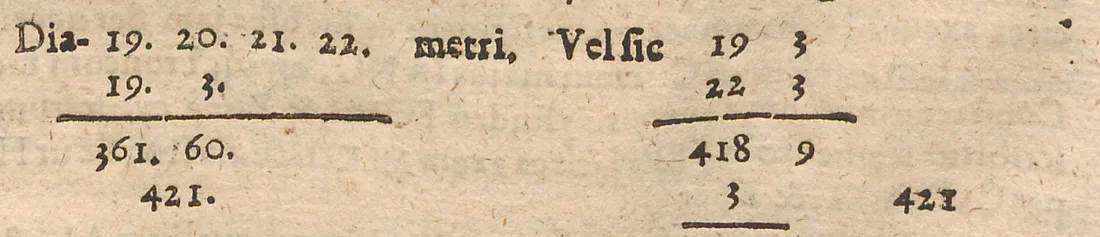
| Dia- 19. 20. 21. 22. meters. | Or thus |
|---|---|
| 19. 3. | 19 · 3 22 · 3 |
| 361. 60. | 418 · 9 3 |
| 421. | 421 |
As 361, then, to 421, so the cylinder found, 1645 etc., to 273 4868971691; and above, the cylinder being taken from the frustum, this body was 273 48641 09622. The tiny difference is made by the sines, which we used not wholly exact.
Vt igitur 361 ad 421, sic Cylinder inventus 1645 etc: ad 273 4868971691: supra verò, Cylindro ablato à trunco, erat hoc corpus 273 48641 09622: differentiam minutulam faciunt sinus quibus non penitus exactis usi sumus.
Johannes Kepler, “Supplement to Archimedes,” in Nova stereometria doliorum vinariorum, inprimis Austriaci, figurae omnium aptissimae; et usus in eo virgae cubicae compendiosissimus et plane singularis. Accessit stereometriae Archimedeae supplementum (Linz: Johannes Planck, 1615), 50, available online https://doi.org/10.3931/e-rara-11051.
On Spindles.
Thus far the cylinder and the globe, or in its place the spheroid, transformed into a segment of their cylinder, have come to our aid in giving the measures of apples, lemons, quinces, sitting melons, olives and elliptical plums. For when we could not find the laws of the whole bodies in the figures themselves, we found the measures of the parts of the body in the parts of cylinders. And since certain parts of a cylinder have a definite definition, but no knowledge or laws of bulk in themselves, or none yet brought to light, the globe and the spheroid came in, which, having their measure of bulk beforehand, when transformed into such a part of a cylinder brought the same laws of bulk into it. There remains now the more difficult consideration of parabolic and hyperbolic spindles, in which the method of proof used so far fails us again. For even if you transform a spindle in the same way as the lemon, the olive and the plum into a prism of a column that keeps the curvature of the conic line of the sections OCH, PCQ or MCN (in Schema X) along its whole upright back, the body of this figure can be proved no more than that of the spindle itself. For first, there is no whole here to which the prism can be compared, since the column, like the section itself, will be infinite towards the side MN or PQ; and second, neither the globe with its great circle nor the spheroid fits into such a conic column: for either the circle touches the conic line on the inside at a single point, if it is described from the focus A of the figure through its vertex C; or, if a slightly larger circle is described through C, it does touch the figures outside at C but at once cuts them at two points next to C, and otherwise wholly parts from the section.
Hactenus Cylinder & Globus, aut ejus loco Sphæroides, in segmentum cylindri sui transformata, nobis subsidio venerunt ad prodendas mensuras Malorum, Citriorum, Cotoneorum, Melonum sessilium, Olivarum, & Prunorum Ellipticorum. Cùm enim corporum totorum leges in ipsis figuris non inveniremus, partium corporis mensuras in Cylindrorum partibus invenimus. At cum partes quædam Cylindri definitionem quidem habeant certam, scientiam verò seu leges corpulentiæ in seipsis vel nullas, vel nondum in lucem prolatas; Globus & Sphæroides successerunt, quæ cum dimensionem corpulentiæ habeant antea, transformata in talem Cylindri partem, easdem leges corpulentiæ in illum intulerunt. Restat nunc difficilior de Fusis Parabolicis & Hyperbolicis contemplatio, in qua nos demonstrationis methodus hactenus adhibita rursum deficit. Nam etsi Fusum eodem modo quo Citrium & Olivam & Prunum, transformes in columnæ prisma, quod curvaturam lineæ conicæ (in Schemate X.) sectionum OCH, PCQ vel MCN, toto dorso erecto retineat; Huius tamen figuræ corpus nihilo magis demonstrari potest, quam Fusi ipsius. Primùm enim hic totum nullum est, ad quod prisma possit comparari; quippe columna, ut sectio ipsa, ad latus MN vel PQ infinita erit: deinde non congruit globus suo circulo maximo, non Sphæroides, in talem columnam conicam: aut enim tangit circulus conicam intus in puncto unico, si fuerit ex foco figuræ A, per ejus verticem C descriptus: aut si paulò amplior circulus per C fuerit descriptus, tangit quidem figuras exteriùs in C, secat verò easdem statim binis punctis ipsi C proximis, de reliquo penitus dissidet à sectione.
Johannes Kepler, “Supplement to Archimedes,” in Nova stereometria doliorum vinariorum, inprimis Austriaci, figurae omnium aptissimae; et usus in eo virgae cubicae compendiosissimus et plane singularis. Accessit stereometriae Archimedeae supplementum (Linz: Johannes Planck, 1615), 51, available online https://doi.org/10.3931/e-rara-11051.
It remains, then, that just as for bodies created from a segment of a circle we took refuge in the globe, and for elliptical ones in the spheroid, so for those from the parabola and hyperbola we take refuge in the conoids of the same kind; and if the attempt does not wholly succeed, we shall call on geometers to help with the rest.
Restat igitur, vt sicut in corporibus, à Circuli segmento creatis, ad globum confugimus, in Ellipticis ad Sphæroides; sic in ijs quæ à Parabola & Hyperbola, confugiamus ad Conoidea congenera: quod nisi succedat ex asse conatus, de reliquo Geometras in subsidium vocabimus.
Johannes Kepler, “Supplement to Archimedes,” in Nova stereometria doliorum vinariorum, inprimis Austriaci, figurae omnium aptissimae; et usus in eo virgae cubicae compendiosissimus et plane singularis. Accessit stereometriae Archimedeae supplementum (Linz: Johannes Planck, 1615), 51, available online https://doi.org/10.3931/e-rara-11051.
Theorem XXIII.
Two cones created from a scalene right-angled triangle, the one with the lesser, the other with the greater of the sides about the right angle set up as axis, are in the ratio of the sides that describe the bases of the cones.
Coni duo, creati à rectangulo scaleno, alter minori, alter majori latere eorum, quæ circa rectum, pro axe constitutis, sunt in proportione laterum, quæ bases ipsis Conis describunt.
Johannes Kepler, “Supplement to Archimedes,” in Nova stereometria doliorum vinariorum, inprimis Austriaci, figurae omnium aptissimae; et usus in eo virgae cubicae compendiosissimus et plane singularis. Accessit stereometriae Archimedeae supplementum (Linz: Johannes Planck, 1615), 51, available online https://doi.org/10.3931/e-rara-11051.
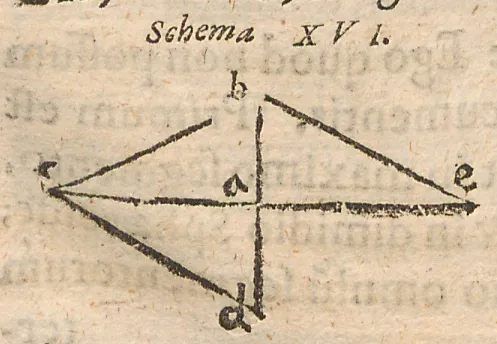
Let ABC be a right-angled triangle, of whose sides about the right angle the lesser, BA, is made the axis; and when the figure is turned, let the hypotenuse BC create the conical surface CBE, whose vertex is B and base CE. Again let the greater side AC be made the axis, and let the figure turned about the fixed AC create the cone BCD, with vertex C and the circle BD as base. I say that as BA is to AC, so is the body contained by the circle CE and the conical surface CEB to the body of the cone BDC.
Sit Rectangulum ABC, cujus laterum circa rectum angulum, minus BA, fiat axis, & figurâ circumactâ, subtensa BC creet superficiem Conicam CBE, cujus vertex B, basis CE. Rursum fiat maius latus AC, axis; & figura circa AC manentem circumacta creet Conum BCD, vertice C, basi BD circulo. Dico ut est BA ad AC, sic esse corpus, quod circulo CE, & superficie conica CEB, continetur, ad corpus Coni BDC.
Johannes Kepler, “Supplement to Archimedes,” in Nova stereometria doliorum vinariorum, inprimis Austriaci, figurae omnium aptissimae; et usus in eo virgae cubicae compendiosissimus et plane singularis. Accessit stereometriae Archimedeae supplementum (Linz: Johannes Planck, 1615), 51, available online https://doi.org/10.3931/e-rara-11051.
Proof. By what was cited in Theorem XVII, the ratio of the cone EBC to the cone BCD is compounded of the ratio of the circle EC to the circle BD and of the ratio of the height AB to the height AC; but the ratio of the circle EC to the circle BD is the square of the ratio of the radius AC to the radius AB. So the ratio of the cones EBC to BCD is compounded of the ratio of AC to AB, again of the same AC to AB, and third of AB to AC. But the ratio of AC to AB, compounded with the ratio of AB to AC, makes the ratio of equality, which is the least of ratios, that is, the limit, and an equality, which added to or taken from the other ratios changes nothing. So of the three elements of the ratio of the cones, the last two of which cancel each other, only the first remains, and the cone EBC is to the cone BCD as AC, the radius of the circle EC, to AB, the radius of the circle BD.
Demonstratio. Nam per allegata Theor. XVII. Proportio Coni EBC, ad Conum BCD, est composita ex proportione Circuli EC ad circulum BD, & ex proportione altitudinis AB, ad altitudinem AC, sed circuli EC ad circulum BD proportio, dupla est proportionis AC semidiametri ad AB semidiametrum. Ergò Conorum, EBC ad BCD, proportio est composita ex proportione AC ad AB, & iterum ex eadem AC ad AB, & tertiò ex AB ad AC. Sed proportio AC ad AB, composita cum proportione AB ad AC, conflat proportionem æqualitatis, quæ est proportionum minima, hoc est terminus, & æqualitas, quæ addita vel ablata à proportionibus reliquis, nihil mutat. Igitur ex tribus elementis proportionis Conorum, quorum duo ultima se mutuò tollunt, solum primum restat, & Conus EBC, ad Conum BCD, est ut AC, semidiamr circuli EC, ad AB, semidiametrum circuli BD.
Johannes Kepler, “Supplement to Archimedes,” in Nova stereometria doliorum vinariorum, inprimis Austriaci, figurae omnium aptissimae; et usus in eo virgae cubicae compendiosissimus et plane singularis. Accessit stereometriae Archimedeae supplementum (Linz: Johannes Planck, 1615), 52, available online https://doi.org/10.3931/e-rara-11051.
Theorem XXIV.
A long spheroid inscribed in a broad spheroid, so that they have the same diameters but their axes exchanged, is to the broad spheroid as the shorter diameter to the longer.
Sphæroides longum inscriptum sphæroidi lato, sic ut easdem habeant diametros, sed axes in iis permutatos, est ad Sphæroides latum, ut diameter brevior ad longiorem.
Johannes Kepler, “Supplement to Archimedes,” in Nova stereometria doliorum vinariorum, inprimis Austriaci, figurae omnium aptissimae; et usus in eo virgae cubicae compendiosissimus et plane singularis. Accessit stereometriae Archimedeae supplementum (Linz: Johannes Planck, 1615), 52, available online https://doi.org/10.3931/e-rara-11051.
In Schema XII let there be the long spheroid CEI on the right, whose vertices are C, I, and the broad one KCE on the left, with vertices K, E; and let the axis CI of the former be equal to the diameter CI of the latter, and the diameter KE of the former equal to the axis KE of the latter. I say that the long ellipsoid, or egg, on the right is to the broad one, or lens, on the left as KE, the shorter diameter, to CI, the longer. For let cones be described, in the half egg KCE, whose vertex is C and base the circle KE, and in the half lens CKI, whose vertex is K and base the circle CI. By the previous theorem, then, as KR, the radius of the circle EK, is to RC, the radius of the circle CI, so is the cone KCE to the cone IKC. But half a spheroid is always twice the cone inscribed in it on the same axis and the same circular base. So the halves of the spheroids too, and so the whole spheroids, are in the ratio of KR to RC, that is, of their doubles KD to CI.
Sit in Schemate XII. Sphæroides longum CEI, ad dextram, cuius vertices C, I, latum KCE ad sinistram, verticibus K, E, & sit illius axis CI, æqualis huius diametro CI, illius verò diameter KE, æqualis axi huius KE, dico Ellipsin longam, seu Ovum ad dextram esse ad latam seu Lentem ad sinistram, ut KE brevior diameter ad CI longiorem. Describantur enim Coni, in dimidio Ovo KCE, cuius vertex C, basis KE circulus; in dimidia verò Lente CKI, cuius vertex K, basis CI circulus, per præmissam igitur, vt KR semidiameter circuli EK, ad RC semidiametrum circuli CI, sic Conus KCE ad Conum IKC. Sed dimidium Sphæroides semper est duplum Coni sibi inscripti ad eundem axem, & super eadem basi circulari: Ergo etiam Sphæroidum dimidia, & sic Sphæroidea tota, sunt in proportione, vt KR ad RC, hoc est, vt eorum dupla KD ad CI.
Johannes Kepler, “Supplement to Archimedes,” in Nova stereometria doliorum vinariorum, inprimis Austriaci, figurae omnium aptissimae; et usus in eo virgae cubicae compendiosissimus et plane singularis. Accessit stereometriae Archimedeae supplementum (Linz: Johannes Planck, 1615), 52, available online https://doi.org/10.3931/e-rara-11051.
Theorem XXV.
A segment of a globe seems to have to the lemon described by the same segment of a circle the ratio that the radius of the base of the segment has to the axis or height of the segment.
Segmentum Globi ad Citrium, eodem segmento circuli descriptum, videtur eam habere proportionem, quam habet semidiameter basis segmenti, ad axem seu altitudinem segmenti.
Johannes Kepler, “Supplement to Archimedes,” in Nova stereometria doliorum vinariorum, inprimis Austriaci, figurae omnium aptissimae; et usus in eo virgae cubicae compendiosissimus et plane singularis. Accessit stereometriae Archimedeae supplementum (Linz: Johannes Planck, 1615), 52, available online https://doi.org/10.3931/e-rara-11051.
Let others seek a lawful proof: what I cannot prove apodictically I shall make good dictically, using four pieces of evidence. The first is from analogy. For what is true in the half globe, as in the greatest segment, which is the beginning of the segments, as also in the half spheroid, and likewise in the least segment, and as it were in the last limit of all segments, seems to have place also in the intermediate segments. And in the half globe the case is this: just as the sides of a quadrant about the right angle have the ratio of equality to each other, so what is created by turning the quadrant about the perpendicular is equal to what is created by turning the same quadrant about the base. And in the smallest ones this ratio likewise has place, because the smaller the segment of the globe and the lemon in it, the less the cones inscribed in the figures differ from them; and those cones have the said ratio, as Theorem XXIII has it; so the solids about them have it too. Though I admit that the inference from what is absolutely least to what is next to the least is not everywhere safe.
Demonstrationem legitimam quærant alij: Ego quod non possum apodicticè, comprobabo dicticè; quatuor usus documentis. Primum est ab Analogia. Quod enim in dimidio globo, velut in maximo segmento, quod est principium segmentorum, verum est, vt & in dimidio Sphæroide; quod item in minimo segmento, & veluti in vltimo omnium segmentorum termino, id videtur etiam in segmentis intermedijs locum habere. At in dimidio globo res ita habet: quemadmodum enim latera circa rectum angulum quadrantis, habent inter se proportionem æqualitatis, sic etiam quod creatur, quadrante circa perpendiculum voluto, æquale est ei, quod creatur, eodem quadrante circa basin voluto. In minimis verò similiter locum habet ista proportio: quia quo minus globi segmentum, & Citrium in eo, hoc minus ab hisce differunt Coni, figuris ipsis inscripti: Conorum verò istorum, vt habet Theor. XXIII. est dicta proportio: quare & circumscriptorum solidorum. Etsi fateor, ab eo quod est absolutè minimum, ad id quod minimo proximum, non ubique tutam esse collectionem.
Johannes Kepler, “Supplement to Archimedes,” in Nova stereometria doliorum vinariorum, inprimis Austriaci, figurae omnium aptissimae; et usus in eo virgae cubicae compendiosissimus et plane singularis. Accessit stereometriae Archimedeae supplementum (Linz: Johannes Planck, 1615), 52–53, available online https://doi.org/10.3931/e-rara-11051.
Second, the said ratio has place in the half spheroid, even though there the ratio of equality between the diameters does not reign, as in the globe; and indeed in infinitely many spheroids, and infinitely many ratios of diameters through them, as in the previous theorem. But just as the long spheroid is inscribed in the broad spheroid, so too the whole lemon is inscribed in the doubled segment of the hemisphere, and the generation is understood as similar in both; so, since the said ratio holds between the long and the broad spheroid, it will also hold, as it seems, between the whole lemon and the doubled segment of the half globe. Third, this stands in the place of a full proof: that in Schema XVIII following, the oblique segment of the circle contained under the straight line AE and the arc AE, which creates the excess both of the segment and of the half lemon over their cones, is of equal breadth above at A and below at E; so that the parts at E turned about PA make a motion in the same ratio to the motion of the parts at A turned about PE as PE is to PA. The body of the oblique zones, then, is heaped onto the inscribed cones in the same ratio as the cones themselves are to each other. Fourth, to these is added calculation and the testimony of numbers, which, though handled most laboriously and finely, dividing the diameter into 1 00000 particles, yet in the end prove unfit to refute this ratio.
Secundò, Proportio dicta locum habet in Sphæroide dimidio, etiamsi ibi non regnet æqualitatis proportio inter diametros, ut in globo, & quidem in infinitis Sphæroidibus, & infinitis diametrorum per illa proportionibus: vt est in Th. antecedenti. At sicut Sphæroides longum inscribitur Sphæroidi lato, sic etiam Citrium totum, segmento duplicato Hemisphærii inscriptum est, & generatio utrinque similis intelligitur; Ergo cum dicta proportio obtineat inter Sphæroides longum & latum, obtinebit etiam, ut videtur, inter Citrium totum & segmentum duplicatum semiglobi. Tertiò, vicem demonstrationis plenariæ sustinet hoc, quod, in Sch. XVIII. seq. segmentum Circuli obliquum, contentum sub AE recta & AE arcu, quod creat excessum tam segmenti, quam dimidij Citrij, supra suos Conos, supra apud A, & infra apud E æqualis est latitudinis: itaque quæ est proportio PE ad PA, ejusdem proportionis motum faciunt partes E circa PA circumactæ, ad motum partium A circa PE circumactarum. Corpus igitur obliquarum Zonarum in eâdem proportione accumulatur ad Conos inscriptos, in qua sunt ipsi Coni inter se. Quartò his accedit calculus & testimonium numerorum: qui licet operosissimè tractentur & subtilissimè, per divisionem diametri in particulas 1 00000, tandem tamen inepti fiunt ad refutandam hanc proportionem.
Johannes Kepler, “Supplement to Archimedes,” in Nova stereometria doliorum vinariorum, inprimis Austriaci, figurae omnium aptissimae; et usus in eo virgae cubicae compendiosissimus et plane singularis. Accessit stereometriae Archimedeae supplementum (Linz: Johannes Planck, 1615), 53, available online https://doi.org/10.3931/e-rara-11051.
In the example above PE was nine times PB; so let the segment HEA of the globe also be nine times the half lemon described by AEP about the fixed PE. Let the segment HEA be sought. AL was 22, LK or PE 27. So the squares are 484 and 729. And since the areas of circles are to each other as the squares of their radii, and the circle AC above had 10050 23661, there will come to the area HPE, which is the base of the proposed segment, 15137 64977 parts.
In superiori exemplo erat PE noncuplum ipsius PB, sit ergo etiam segmentum Globi HEA noncuplum dimidij Citrij, ab AEP circa PE immobilem descripti. Quæratur segmentum HEA. Erat AL 22, LK vel PE 27. Quadrata ergo sunt 484. & 729. Cum autem areæ circulorum sint vt radiorum quadtrata ad se invicem, & AC circulus supra habuerit 10050 23661: venient in aream HPE, quæ basis est segmenti propositi, partes 15137 64977,
Johannes Kepler, “Supplement to Archimedes,” in Nova stereometria doliorum vinariorum, inprimis Austriaci, figurae omnium aptissimae; et usus in eo virgae cubicae compendiosissimus et plane singularis. Accessit stereometriae Archimedeae supplementum (Linz: Johannes Planck, 1615), 53, available online https://doi.org/10.3931/e-rara-11051.
And since PA was 3, and the remainder to the diameter 243, and the radius 123: as 243 to 123, or in its place to 100000, so 3 to 1234½, the increase in the height of the segment for the height of the equal cone, and that in the measure used in the canon; and since the height of the segment PA in this measure is 2439, the height of the equal cone is 3673½, a third of which, 1224½, multiplied by the area of the base found above, creates the body of the segment, 185 28483 31848, the ninth part of which is 20 58720 36872. But above, the body of the whole lemon was 36 etc., and so its half is 18 24638 77472, which is indeed less than a ninth part of the segment, less even than a tenth of it; but this is in an untrustworthy handling of numbers about very small things. For it concerns the quantity of a body less than a twenty-thousandth of the globe. And the difference in this little body (much greater than the one we are disputing) arises from a single hundred-thousandth part of the radius: because the sine of the arc AE, that is, PE, was taken as 21951, which was a little too great, though less than 21952. And if you take 21952 and carry through the process with it, the body of the lemon will come out 42 47320 62579, whose half, 21 etc., is already greater than a ninth part of the segment found here, because 21952 too is greater than the true value. By these numbers, then, nothing can be brought against the ratio of the half lemon to its segment of the globe expressed in the theorem.
Et cum PA fuerit 3, & residuum ad diametrum 243, semidiamr 123. Vt ergò 243, ad 123, vel huius loco ad 100000, sic 3 ad 1234 semis, augmentum altitudinis segmenti, pro altitudine Coni æqualis, idque in dimensione usitata Canonis: cum sit altitudo segmenti PA. in hac dimensione, 2439, Ergo altitudo Coni æqualis, 3673 semis, cuius pars tertia 1224 semis, ducta in aream basis supra inventam, creat corpus segmenti 185 28483 31848. cujus pars nona est 20 58720 36872. Atqui supra corpus Citrij totius erat 36 &c, dimidium ergò 18 24638 77472, quod est quidem minus nona parte de segmento, minus etiam decimâ ejus, sed in hac infida, circa minima, numerorum tractatione. Nam agitur de quantitate corporis, quod minus est quàm vicies millesima Globi. Et oritur quidem differentia hujus corpusculi (multò major eo de quo controvertimus) ex vnica centies millesima particula semidiametri: quia sinus arcus AE, hoc est PE fuit assumptus 21951, qui paulo erat major, minor tamen quam 21952. Quod si assumseris 21952, & cum hoc reperieris processum, corpus Citrij prodibit 42 47320 62579, cujus dimidium 21 &c, jam est majus nonâ parte segmenti hic inventi, nimirum quia etiam 21952 est major justo. Per hos igitur numeros nihil depromi potest contra expressam in Theoremate proportionem dimidij Citrij ad suum globi segmentum.
Johannes Kepler, “Supplement to Archimedes,” in Nova stereometria doliorum vinariorum, inprimis Austriaci, figurae omnium aptissimae; et usus in eo virgae cubicae compendiosissimus et plane singularis. Accessit stereometriae Archimedeae supplementum (Linz: Johannes Planck, 1615), 53–54, available online https://doi.org/10.3931/e-rara-11051.
Theorem XXVI.
If a straight line touches a conic section, and the segment of a spheroid or the conoid generated by it, at the circumference of the base, meeting the axis; and if the lines, turned about the fixed diameter of the base, create solids, the tangent a cone and the conic sections a plum, olive or spindle, each of its own kind; and if the same tangent, turned about the fixed axis, creates another cone: then the ratio of the half plum or olive to the segment of the spheroid, and of the spindle to its conoid, will be very nearly equal to the ratio of the first cone to the second.
Si recta quædam sectionem conicam, & genitum ab illa segmentum Sphæroidis, aut Conoides, contigerit in circumferentia baseos, concurrens cum axe; & circumductæ lineæ circa diametrum baseos immobilem, creauerint solida, contingens quidem Conum, sectiones vero Conicæ, Prunum Olivam vel Fusum, quælibet suum congenere; eadem vero contingens, circumducta circa axem immobilem, creaverit Conum alium: proportio dimidij Pruni vel Olivæ ad Segmentum Sphæroidis, Fusi vero ad suum Conoides, proxime erit æqualis proportioni prioris Coni, ad Conum posteriorem.
Johannes Kepler, “Supplement to Archimedes,” in Nova stereometria doliorum vinariorum, inprimis Austriaci, figurae omnium aptissimae; et usus in eo virgae cubicae compendiosissimus et plane singularis. Accessit stereometriae Archimedeae supplementum (Linz: Johannes Planck, 1615), 54, available online https://doi.org/10.3931/e-rara-11051.
In Schema XII let there be the conic section OCN, a parabola above, a hyperbola in the middle and an ellipse below, whose axis is CI; and by turning half the section OCN, namely CN, about the fixed ON, so that the point N of the section stays fixed and C passes through I, let the half body CIN of the plum, olive or spindle OCNI be understood to be created. By turning the same half CN of the section about the fixed CI, so that, C staying fixed, N passes through O, let the segment of the spheroid or the conoid OCN be understood to be created, with vertex C and the circle ON as base. I say that if some line touches the section or solid at the ends N or O, two cones are created by that line, by the same turnings as just described, very nearly such that in those cones lies the ratio of the half body of the plum, olive or spindle CIN to the segment of the spheroid or conoid OCN. Thus far we needed Schema XII to explain the theorem. Now the rest will be taken from Schema XVIII.
In Schemate XII. sit sectio Conica OCN, superius Parabole, in medio Hyperbole, infra Ellipsis, cuius axis CI, & sectionis OCN dimidio CN circa ON immobilē circumacto, sic ut punctum sectionis N maneat, C verò per I transeat, creatum intelligatur, Pruni, Olivæ vel Fusi OCNI corpus dimidium CIN, Eodem sectionis dimidio CN, circa CI immobilem circumacto, sic, ut C manente, N per O transeat, creatum intelligatur segmentum Sphæroidis, aut Conoides OCN, verice C, basi circulo ON. Dico, si qua linea tangat sectionem vel solidum in N vel O terminis, illa lineâ, Conos duos proxime tales creari, circumactibus ijsdem, qui jam sunt dicti, ut in ijs conis insit proportio dimidij corporis Pruni, Olivæ, vel Fusi CIN, ad segmentum Sphæroidis, aut Conoides OCN. Hactenus ad declarationem Theorematis opus nobis fuit Schemate XII. Nunc reliqua ex Schemate XVIII. petentur.
Johannes Kepler, “Supplement to Archimedes,” in Nova stereometria doliorum vinariorum, inprimis Austriaci, figurae omnium aptissimae; et usus in eo virgae cubicae compendiosissimus et plane singularis. Accessit stereometriae Archimedeae supplementum (Linz: Johannes Planck, 1615), 54, available online https://doi.org/10.3931/e-rara-11051.
For the theorem concerns the segment of the spheroid and the two conoids, parabolic and hyperbolic; and it has potentially three parts in it. The first and second are certain: that this ratio is less than that of the previous theorem; and second, that some ratio is proved greater; the third is not yet quite certain, that the ratio is exactly the one expressed in this theorem. And since everything is clearer in the hyperbolic case, in Schema XVIII let there be the conic section called the hyperbola, FCG, the line marked with dots; and an arc of a circle is also described through FCG. The hyperbola, then, cuts it at F; from there the circle goes on towards S and the hyperbola towards R, always inside the circle, until at the vertex C it touches the circle on the inside, as is proved in Apollonius, Conics IV, Props. XXV, XXVI. Let a conoid be made from FCG, whose vertex is C, axis VCO, base the circle FG, and its radius FO; and let V be the centre of the figure, and VX, VZ the asymptotes, whose intersections with FG extended are X and Z. And let the straight line EY touch the figure at F, on the circumference of the base, meeting the axis between the centre V and the vertex C; let it meet it at Y. And let the triangle FCG be inscribed in the figure on the same base FG. So, whereas before the body of the half lemon described by the arc of the circle FSC about the fixed FO had to the body of the spherical segment FCG, described by the same arc FSC but turned about the fixed CO, the ratio of CO to OF: now this theorem asserts of the half spindle described by half the hyperbola, FRC, about the fixed FO, and of the conoid described by the same FRC but about the fixed CO, another ratio, namely that of YO to OF; for this is the ratio of the cone described by the tangent FY about FO to the cone described by the same FY about YO. And it is plain that the ratio of YO to OF is less, that is, nearer to equality, than that of CO to OF; and since VX and YF meet towards X, the ratio of VO to OX is again less than that of YO to OF.
Est enim Theorema, de segmento Sphæroidis, deque binis Conoidibus, Parabolico & Hyperbolico; habetque potestate in se partes tres, prima & secunda sunt certæ, quod ista proportio sit minor illâ Theorematis præmissi; & secunda, quod aliqua proportio demonstratur major; tertia nondum est certissima, quod præcisè sit ista proportio, quæ in Theoremate hoc exprimitur. Cum autem evidentiora sint omnia in Hyperbolico, sit ergo in Schemate XVIII. sectio Conica quæ Hyperbola dicitur, FCG, linea punctis signata; est autem & arcus circuli per FCG descriptus; illum igitur Hyperbola secat in F; vnde circulus quidem versus S, Hyperbola verò versus R pergit, semper interior circulo, donec in C vertice tangat circulum interius; vt demonstratum est in IV. Conicorum Apoll. Pr. XXV. XXVI. Fiat autem ex FCG Conoides, cujus vertex C, axis VCO, basis FG circulus, ejusque semidiameter FO: & sit V centrum figuræ, & VX, VZ asymptoti, quarum sectiones cum FG continuata, sint X. Z. contingat autem figuram in F, circumferentiâ basis, recta EY, quæ cum axe concurret inter V centrum & C verticem, concurrat in Y. Inscribatur autem figuræ super eadem basi FG, triangulum FCG. Itaque cùm antea dimidij Citrij corpus, descriptum arcu circuli FSC, circa FO immobilem, ad segmenti sphærici FCG corpus, descriptum eodem arcu FSC, sed circa CO immobilem circumacto, proportionem eam habuerit, quæ est ipsius CO ad OF: jam hoc theorema de Fuso dimidio, quod describitur Hyperboles dimidio FRC, circa FO immobilem, deque Conoide, quod eâdem FRC, sed circa CO immobilem, describitur, affirmat proportionem aliam, scilicet eam, quæ est YO ad OF; hæc enim est proportio Coni, ab FY contingente, circa FO descripti, ad Conum ab eadem FY, sed circa YO, descriptum. Manifestum autem est YO proportionem minorem esse ad OF, hoc est, æqualitati viciniorem, quam CO ad OF, cumque concurrant VX & YF versus partes X, rursum igitur & ipsius VO ad OX minor est proportio, quàm ipsius YO ad OF.
Johannes Kepler, “Supplement to Archimedes,” in Nova stereometria doliorum vinariorum, inprimis Austriaci, figurae omnium aptissimae; et usus in eo virgae cubicae compendiosissimus et plane singularis. Accessit stereometriae Archimedeae supplementum (Linz: Johannes Planck, 1615), 54–55, available online https://doi.org/10.3931/e-rara-11051.
Just as YO to OF, then, is midway in quantity between CO to OF and VO to OX, so it can be proved that the body of the half spindle is to the body of the conoid in a ratio midway in quantity between CO to OF and VO to OX.
Quemadmodum igitur YO ad OF est quantitate media inter CO, ad OF, & inter VO ad OX, ita demonstrari potest, & Fusi dimidij corpus ad Conoidis corpus, esse quantitate mediam proportionem inter CO ad OF & inter VO ad OX,
Johannes Kepler, “Supplement to Archimedes,” in Nova stereometria doliorum vinariorum, inprimis Austriaci, figurae omnium aptissimae; et usus in eo virgae cubicae compendiosissimus et plane singularis. Accessit stereometriae Archimedeae supplementum (Linz: Johannes Planck, 1615), 55, available online https://doi.org/10.3931/e-rara-11051.
Let it be proved first of CO to OF; and the proof will hold of the parabolic conoid too. It is plain, then, that the spindle of the line FRC is less than the lemon of the arc FSC, and likewise the conoid FRCG less than the spherical segment FSCG. And since the plane figure contained between the arc of the circle FSC and the hyperbola FRC is of unequal breadth at the parts F and C, being wider about F, where the lines cut each other, and narrower about C, where they touch each other: the coat that the segment of the globe has put round the conoid is therefore thicker towards the base FG and thinner towards the vertex C. Conversely, the coat that the lemon has put round the spindle is thinner towards its base at C than towards its vertex F. The conoid and the spindle do not, then, lose proportionally, but the conoid loses more and the spindle less. For although about the vertex, in turn, the conoid loses less than the spindle about its vertex F, there is still no full compensation, because the motion of the parts at the vertex ends within a short space, while the motion of the parts about the base spreads into a wider circuit. The spindle, then, is nearer to the conoid than the lemon to the segment of the sphere, or CO (by the previous theorem) to OF; just as YO too is nearer to OF than CO to OF.
Probetur primùm de CO ad OF, valebit autem demonstratio etiam de Parabolico Conoide. Igitur manifestum est, Fusum lineæ FRC, minus esse Citrio arcus FSC: sic etiam Conoides FRCG, minus esse Segmento Sphærico FSCG. Cùm autem figura plana, contenta inter arcū circuli FSC & Hyperbolam FRC, ad partes F & C, sit inæqualis latitudinis, circa F enim latior est, ubi lineæ se mutuò secant, circa C angustior, ubi se mutuò tangunt: tunica igitur, quam segmentum globi circumiecit Conoidi, crassior est versus basin FG, tenuior versus verticem C. Contra, tunica quam Citrium circumiecit Fuso, tenuius est versus basin ad C, quam versus verticem F. Non amittunt igitur proportionalia, Conoides & Fusum, sed plus Conoides, minus Fusum. Etsi enim circa verticem vicissim minus amittit Conoides, quam Fusum circa verticem F: non fit tamen omnimoda compensatio, quia partium ad verticem motus brevi spacio finitur, partium circa basin motus, in ampliorem diffunditur ambitum. Fusum igitur propius est Conoidi, quam Citrium Segmento Sphæræ, vel CO (per Th. præcedens) ipsi OF: quemadmodum etiam YO propior est ipsi OF, quàm CO ipsi OF.
Johannes Kepler, “Supplement to Archimedes,” in Nova stereometria doliorum vinariorum, inprimis Austriaci, figurae omnium aptissimae; et usus in eo virgae cubicae compendiosissimus et plane singularis. Accessit stereometriae Archimedeae supplementum (Linz: Johannes Planck, 1615), 55, available online https://doi.org/10.3931/e-rara-11051.
Here we have used the previous theorem, which has as yet no lawful proof. But the same method holds even if we put the cones FCG in place of the segment FSCG and the lemon. For the cone made by the line CF about FO has to the cone made by the same line FC about CO the ratio of CO to OF. And the plane figure contained by the hyperbola FRC and the straight line FC, which creates the excess of the conoid and the spindle over their cones, is wider towards C, because the hyperbola is more curved there, and narrower towards F, where the hyperbola gradually degenerates into a straight line. So again, proportional amounts are not added to these cones; for more is added to the cone of the spindle to make the spindle, in its ratio, than to the cone of the conoid to make the conoid; so the body of the spindle is greater, relative to the conoid, than CO relative to OF; that is, the ratio of the lesser (the spindle) to the greater (the conoid) is less and nearer to equality.
Hic sumus usi Theoremate antecedenti, quod nondum habet demonstrationem legitimam. Sed valet eadem methodus etiam tunc, si pro segmento FSCG, & citrio, Conos FCG substituamus. Conus enim à linea CF circa FO factus, ad Conum à linea eadem FC, circa CO factum, proportionem habet eam, quam CO ad OF. Iam verò figura plana, quæ continetur Hyperbola FRC & rectâ FC, creans excessum Conoidis & Fusi, supra illorum Conos, latior est versus C, quia ibi Hyperbola est curvior; angustior versus F, ubi Hyperbola paulatim degenerat in rectum. Rursum igitur Conis hisce non adijciuntur proportionalia; plus enim accedit Cono Fusi, ut fiat Fusum in sua proportione, quam Cono Conoidis, ut fiat Conoides: majus igitur est corpus Fusi, respectu Coniodis, quam CO respectu OF, id est, minor & æqualitati propior est minoris (Fusi) ad majus (Conoides) proportio.
Johannes Kepler, “Supplement to Archimedes,” in Nova stereometria doliorum vinariorum, inprimis Austriaci, figurae omnium aptissimae; et usus in eo virgae cubicae compendiosissimus et plane singularis. Accessit stereometriae Archimedeae supplementum (Linz: Johannes Planck, 1615), 55, available online https://doi.org/10.3931/e-rara-11051.
Now it must also be proved of VO to OX that this ratio is less than the ratio of the half spindle to the conoid. And the proof is peculiar to the hyperbola, since the parabola lacks asymptotes. Again, then, as before, the figure contained by the three straight lines FX, XV, VC and the hyperbola CRF is wider towards V than towards X: so the body or matrix in which the conoid lies hidden is thicker at the vertex V than at the base XZ; in turn, the matrix in which the spindle lies hidden is thinner at its vertex FX than at its base about VC. So more is added to the cone whose axis is XV, in its ratio, than to the cone whose axis is VO, in its. That cone, then, is greater relative to this one than the spindle relative to OX, and so the ratio of VO to OX is less and nearer to equality than that of the half spindle to the conoid.
Iam etiam de VO ad OX demonstrandum, quod hæc proportio minor sit proportione Fusi dimidij ad Conoides, Est autem demonstratio propria Hyperboles, cùm Parabola careat Asymptotis. Rursum igitur ut prius, figura contenta tribus rectis FX, XV, VC, & Hyperbolâ CRF, latior est versus V, quàm versus X: corpus igitur seu matrix, in qua latet Conoides, crassior est in vertice V, quàm ad basin XZ; vicissim matrix, in qua latet Fusum, est tenuior ad verticem FX, quam ad basin circa VC: plus igitur accedit Cono, cujus axis XV, in sua proportione, quàm Cono cujus axis VO, in sua. Maior igitur ille Conus est, respectu huius, quàm Fusum respectu OX, minor igitur proportio VO ad OX, & æqualitati propior, quàm dimidij Fusi ad Conoides.
Johannes Kepler, “Supplement to Archimedes,” in Nova stereometria doliorum vinariorum, inprimis Austriaci, figurae omnium aptissimae; et usus in eo virgae cubicae compendiosissimus et plane singularis. Accessit stereometriae Archimedeae supplementum (Linz: Johannes Planck, 1615), 56, available online https://doi.org/10.3931/e-rara-11051.
But since between the ratios CO to OF and VO to CX there are infinitely many other intermediate ratios, not only the one ratio YO to OF, the inference is not necessary, but at most probable, an affirmative conclusion in the third figure of argument from mere particulars.
Cùm autem inter proportiones, CO ad OF, & VO ad CX, infinitæ aliæ sint proportiones intermediæ, non vna sola quæ est YO ad OF: non igitur necessaria, sed verisimilis saltem est collectio in tertia figura argumentationis, affirmatoria ex puris particularibus.
Johannes Kepler, “Supplement to Archimedes,” in Nova stereometria doliorum vinariorum, inprimis Austriaci, figurae omnium aptissimae; et usus in eo virgae cubicae compendiosissimus et plane singularis. Accessit stereometriae Archimedeae supplementum (Linz: Johannes Planck, 1615), 56, available online https://doi.org/10.3931/e-rara-11051.
Analogy.
Consider whether, while in the segments of the globe the ratio of the inscribed cones always holds, in those of the spheroid the cones that have the true ratio of the solids (here, say, of the plum to the segment of the broad spheroid, or of the olive to that of the long one) push out, one its vertex and the other the end of its base, beyond the vertex of the ellipse, but inside the tangent; in the parabolic conoid this very tangent creates the cones of the ratio sought, so that the height of one cone is exactly twice the height of the segment of the conoid; and finally in the hyperbolic conoid the vertex and base of these cones run out beyond the tangent towards the centre of the figure. The force of this analogy is great, and almost demonstrative.
Cogita num in Globi quidem segmentis semper valeat proportio Conorum inscriptorum: in Sphæroidis verò, jam Coni illi, qui genuinam habent proportionem solidorum (puta hîc Pruni ad Sphæroidis lati, aut Olivæ, ad longi segmentum) alter verticem alter baseos extremum supra verticem Ellipsis proferant, intra contingentem tamen; in Parabolico Conoide, hæc ipsa contingens creet Conos proportionis quæsitæ, sic ut altitudo Coni unius, sit præcisè dupla altitudinis segmenti Conoidis; in Conoide denique Hyperbolico, Vertex & Basis Conorum horum, excurrant supra contingentem, versus figuræ centrum. Magna quidem & prope demonstrativa vis est huius Analogiæ.
Johannes Kepler, “Supplement to Archimedes,” in Nova stereometria doliorum vinariorum, inprimis Austriaci, figurae omnium aptissimae; et usus in eo virgae cubicae compendiosissimus et plane singularis. Accessit stereometriae Archimedeae supplementum (Linz: Johannes Planck, 1615), 56, available online https://doi.org/10.3931/e-rara-11051.
Yet it is not enough to have proved this; the very points must also be shown, between the tangents and the vertex of the ellipse or the centre of the hyperbola.
Neque tamen sufficit hoc habere demonstratum, oportet etiam ipsissima puncta indicare, inter contingentes & Verticem Ellipsis, aut Centrum Hyperboles.
Johannes Kepler, “Supplement to Archimedes,” in Nova stereometria doliorum vinariorum, inprimis Austriaci, figurae omnium aptissimae; et usus in eo virgae cubicae compendiosissimus et plane singularis. Accessit stereometriae Archimedeae supplementum (Linz: Johannes Planck, 1615), 56, available online https://doi.org/10.3931/e-rara-11051.
Theorem XXVII.
If one of the sides about the right angle of any right-angled triangle is cut both into two equal parts and in the ratio of the other sides; and if various conic sections meet at the opposite angle, touching one another and the side opposite the right angle, and having their primary vertices on the side that was cut: those from the top to the midpoint will all be hyperbolas; the one falling on the midpoint itself a parabola; those from there to the proportional section upright ellipses of every kind; the one falling on the proportional section itself a circle; and finally those from there to the right angle will be transverse ellipses of every kind, in which the vertex is spoken of improperly, for the end of the shorter axis.
Si cuiuslibet Trianguli latus alterum circa rectum angulum, secetur & in duo æqualia, & in proportione laterum reliquorum: in angulo vero opposito concurrant sectiones Conicæ variæ, communiter seipsas, & latus recto angulo oppositum, tangentes, Vertices primarios in latere secto habentes: quæ sunt à summo ad medietatem, omnes erunt Hyperbolæ: quæ in ipsam bisectionem incidit, Parabole, quæ hinc usque ad sectionem proportionalem, omnis generis Ellipses rectæ; quæ in ipsam proportionalem incidit, circulus; quæ denique hinc usque ad rectum angulum, omnis generis Ellipses transversæ erunt, in quibus vertex impropriè dicitur, pro extremo axis brevioris.
Johannes Kepler, “Supplement to Archimedes,” in Nova stereometria doliorum vinariorum, inprimis Austriaci, figurae omnium aptissimae; et usus in eo virgae cubicae compendiosissimus et plane singularis. Accessit stereometriae Archimedeae supplementum (Linz: Johannes Planck, 1615), 56–57, available online https://doi.org/10.3931/e-rara-11051.
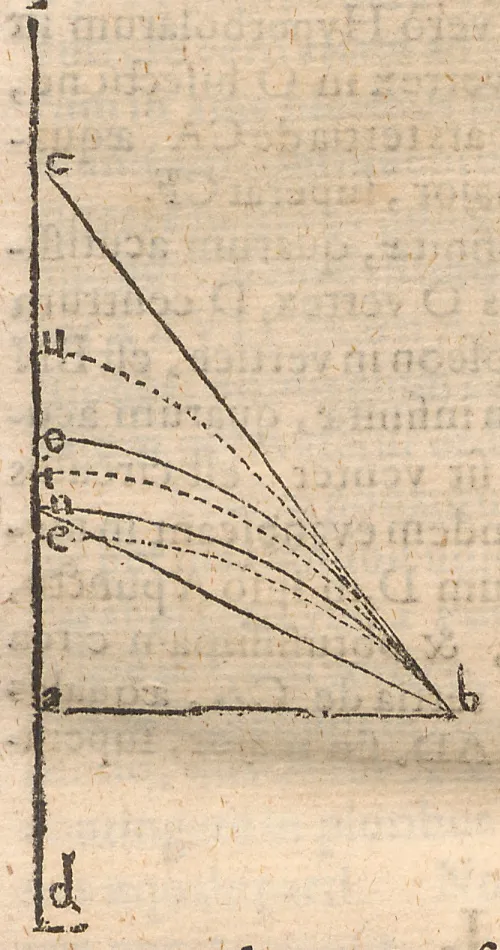
Let BAC be a right-angled triangle, whose side AC is cut into equal parts at O; and let the angle CBA be bisected by the line BN, so that as AB is to BC, so is AN to NC. AN will therefore be shorter than AO. Then let there be a point V between C and O, a point I between O and N, and a point E between N and A; and let various conic sections touch each other and the straight line BC at the point B, whose vertices are, in this order, V, O, I, N, E. I say that BV are hyperbolas, BO a parabola, BI upright ellipses, BN a circle, BE transverse ellipses.
Sit Rectangulum BAC, cuius latus AC sectum sit in æqualia in O, bisecetur etiam angulus CBA, lineâ BN, ut sicut est AB ad BC, sic sit AN ad NC. Erit propterea AN brevior ipsa AO. Tunc inter CO sit punctum V; inter ON punctum I; inter NA punctum E: tangant autem se invicem, & rectam BC, in puncto B, variæ sectiones Conicæ, quarū vertices sint hoc ordine, V. O. I. N. E: dico BV esse Hyperbolas, BO Parabolen, BI Ellipses rectas, BN circulum, BE Ellipses transversas.
Johannes Kepler, “Supplement to Archimedes,” in Nova stereometria doliorum vinariorum, inprimis Austriaci, figurae omnium aptissimae; et usus in eo virgae cubicae compendiosissimus et plane singularis. Accessit stereometriae Archimedeae supplementum (Linz: Johannes Planck, 1615), 57, available online https://doi.org/10.3931/e-rara-11051.
First of BO. Since the straight line BC touches the conic section BO, whose axis or diameter is CA and vertex O, at B, meeting the diameter outside the section at C, and BA is drawn ordinatewise from the point of contact B to the diameter, being perpendicular to the axis CA; and since CO is equal to OA: BO will be a parabola, by the converse of Apollonius I, 37.
Primò de BO. Cùm igitur sectionem Conicam BO, cuius axis seu diameter CA, vertex O, tangat recta BC in B, conveniens cum diametro extra sectionem in C, sitque à tactu B, ad diametrum ordinatim applicata BA, quippe perpendicularis axi CA; & cùm sit CO, æqualis ipsi OA: quare BO erit Parabole, per 37. Imi Apoll. conversam.
Johannes Kepler, “Supplement to Archimedes,” in Nova stereometria doliorum vinariorum, inprimis Austriaci, figurae omnium aptissimae; et usus in eo virgae cubicae compendiosissimus et plane singularis. Accessit stereometriae Archimedeae supplementum (Linz: Johannes Planck, 1615), 57, available online https://doi.org/10.3931/e-rara-11051.
Second of BV. The rest remaining, since V is the vertex and CV less than half of CA, let twice CV be taken from CA, and let it be made, as this remainder to CV, so CV to CF, outwards. Since, then, what is made from CF and the said remainder equals the square of CV, let common quantities be added to both, the square of CF and two rectangles VCF: so that on one side the rectangle CFA is put together, on the other the square of FV. And since these are equal, the section BV will be a hyperbola, by the converse of Apollonius I, 37, whose centre is F.
Secundò de BV. Manentibus cæteris, cùm sit V vertex, & CV minor dimidio ipsius CA, dupla igitur ipsius CV auferatur à CA; & fiat ut residuum hoc ad CV, sic CV ad CF in partes exteriores. Cùm igitur, quod ex CF & residuo dicto, æquet quadratum ipsius CV: addantur utrique communia, quadratum à CF, & bina rectangula VCF: ut ex vna parte conflectur rectangulum CFA; ex altera parte quadratum ab FV: quæ cùm sint æqualia; quare per 37. I. Apollon. conversam, sectio BV erit Hyperbole, cuius centrum F.
Johannes Kepler, “Supplement to Archimedes,” in Nova stereometria doliorum vinariorum, inprimis Austriaci, figurae omnium aptissimae; et usus in eo virgae cubicae compendiosissimus et plane singularis. Accessit stereometriae Archimedeae supplementum (Linz: Johannes Planck, 1615), 57, available online https://doi.org/10.3931/e-rara-11051.
Third of BI, BN and BE. The foregoing remaining, since I, N, E are vertices and IA, NA, EA less than half of CA, let twice IA etc. be taken from CA, and let it be made, as these remainders to IA etc., so these to AD, inwards. For the rest it will be proved by the same method as before that the squares of FI etc. are equal to the rectangles CDA; and therefore by the same converse of Apollonius the conic sections BI, BN, BE will be finite, with their centres D inside the figures, and so ellipses or a circle.
Tertiò de BI, BN, & BE. Manentibus superioribus, cum sint I. N. E. vertices, & IA, NA, EA minores quàm dimidium ipsius CA: duplæ igitur ipsarum IA, &c: auferantur à CA; fiantque ut residua hæc ad IA &c: sic hæc ad AD, in partes interiores: de reliquo demonstrabitur eadem methodo, ut priùs, quadrata ab FI &c. æqualia esse rectangulis CDA, ac proinde per eandem Apollonij conversam, sectiones Conicæ BI, BN, BE erunt finitæ, quarum centra D, intra figuras, eoque Ellipses, aut circulus.
Johannes Kepler, “Supplement to Archimedes,” in Nova stereometria doliorum vinariorum, inprimis Austriaci, figurae omnium aptissimae; et usus in eo virgae cubicae compendiosissimus et plane singularis. Accessit stereometriae Archimedeae supplementum (Linz: Johannes Planck, 1615), 57, available online https://doi.org/10.3931/e-rara-11051.
Fourth of BN, presupposing what was just proved of it in the third place. Since moreover AN is to NC as AB to BC, which is a unique ratio in any one triangle, while hyperbolas and ellipses have various ratios, and the parabola indeed a single one, but the ratio of equality: BN cannot be any other of the conic sections than a circle. And so indeed it happens in the circle. For let BN be a circle, and F its centre, which is joined to the point of contact B; then CBD will be a right angle; but CAB too was a right angle; so as CA to DB, so is DB, that is, DN, to DA. But DN is to DA as CB to BA, and as CN to NA. The arc of the circle, then, cuts the side on which, extended, it has its centre, in the ratio of the sides AB, BC.
Quartò de BN, præsuppositis quæ iam tertio loco de ea sunt demonstrata; cùm insuper AN sit ad NC, ut AB ad BC, quæ est proportio unica in vno quolibet triangulo, cùm Hyperbolæ & Ellipses varias habeant proportiones, Parabole unicam quidem, sed proportionem æqualitatis: non poterit igitur BN esse ulla alia sectionum conicarum, præterquam circulus. Et sanè ita fit in circulo, Sit enim BN circulus, eiusque centrum F, quod connectatur cum puncto B contactus; erit ergo CBD rectus, sed & CAB rectus erat; ergo ut CA ad DB, sic DB, hoc est DN ad DA. Atqui DN est ad DA, ut CB, ad BA, & ut CN ad NA. Circuli igitur arcus secat latus, in quo continuato centrum habet, in proportione laterum AB, BC.
Johannes Kepler, “Supplement to Archimedes,” in Nova stereometria doliorum vinariorum, inprimis Austriaci, figurae omnium aptissimae; et usus in eo virgae cubicae compendiosissimus et plane singularis. Accessit stereometriae Archimedeae supplementum (Linz: Johannes Planck, 1615), 57–58, available online https://doi.org/10.3931/e-rara-11051.
Corollary and Analogy.
In this triangle, then, there can be infinitely many hyperbolas, of which the most obtuse, to speak by analogy, is BC, whose vertex V and centre F coincide at C itself, the angle of the asymptotes, and the section itself degenerates entirely into two straight lines (the cone, that is, being cut through its vertex); and the most acute of the hyperbolas in this triangle is, by analogy, the parabola itself, whose vertex is at the midpoint O and centre F at an infinite distance. And if CV is a third part of CA, CF and CV will be equal; if CV is less, it exceeds CV; if greater, it exceeds CF.
Hyperbolæ igitur in hoc triangulo possunt esse infinitæ, quarum obtusissima, ut loquar analogicè, est BC, cuius vertex V, & centrum F, in ipsum C, angulum Asymptôton coincidunt; ipsaque sectio planè in duas rectas degenerat (cono sc. per verticem secto) acutissima verò Hyperbolarum in hoc triangulo, est analogicè ipsa Parabola, cuius vertex in O bisectione, centrum F. in infinita distantia. Quod si CV sit pars tertia de CA, æquales fient CF, CV; si CV minor, superat CV, sin major, superat CF.
Johannes Kepler, “Supplement to Archimedes,” in Nova stereometria doliorum vinariorum, inprimis Austriaci, figurae omnium aptissimae; et usus in eo virgae cubicae compendiosissimus et plane singularis. Accessit stereometriae Archimedeae supplementum (Linz: Johannes Planck, 1615), 58, available online https://doi.org/10.3931/e-rara-11051.
So the upright ellipses BI pass between O and N, infinitely many, of which the most acute at the vertex is, by analogy, the parabola BO itself, whose vertex is O and centre D at an infinite distance, and the most obtuse of these ellipses at the vertex is the circle BN. From this the transverse ellipses begin, again infinitely many, of which the most acute about the vertex (improperly so called, since it is the belly) is the circle ON itself, and from it the ever more obtuse BE, until at last they vanish into the mere straight line BA, having its improper vertex E and centre D at the point A itself, but its vertex properly so called at B, and most obtuse about A, being merely straight. And if AE is a third part of CA, EA and AD will be equal; if EA is less, it exceeds AD; if greater, it is exceeded by it.
Sic Ellipses rectæ BI, inter ON transeunt infinitæ, quarum acutissima in vertice, est analogicè ipsa Parabole BO, cuius O vertex, D centrum in infinito intervallo, obtusissima verò harum Ellipseon in vertice, est BN circulus. A quo incipiunt Ellipses tranversæ rursum infinitæ, quarum acutissima circa verticem (impropriè dictum, cum sit venter) est circulus ipse ON, ex eo obtusiores BE, semper, donec tandem evanescant in meram rectam BA, verticem inproprium E, & centrum D, in ipso A puncto, verticem verò propriè dictum in B habentem, & obtusissimam circa A, quippe merè rectam. Quod si AE sit pars tertia de CA, æquales fient EA, AD; si verò EA minor, superat ipsam AD, sin major, superatur ab illa.
Johannes Kepler, “Supplement to Archimedes,” in Nova stereometria doliorum vinariorum, inprimis Austriaci, figurae omnium aptissimae; et usus in eo virgae cubicae compendiosissimus et plane singularis. Accessit stereometriae Archimedeae supplementum (Linz: Johannes Planck, 1615), 58, available online https://doi.org/10.3931/e-rara-11051.
Corollary II.
From this, namely from the tangents, it is easy to judge the kind of a cut solid.3 For if two straight lines FY, GY, touching the cut solid at points of the circumferences of the cutting circles, in Schema XVIII at G and F, make their mutual intersection Y such that YC is equal to CO, half the difference of the circles, the middle and the cutting one: it will be the frustum of a parabolic spindle; if CY is less, it will be the frustum of a hyperbolic spindle; if greater, of the kind first of plums, then of lemons (if YF is to FO as YC to CO), and finally of elliptical olives, as when CY is twice CO.
Hinc, nimirum ex contingentibus, facile fit judicium de specie Truncati.3 Nam si duæ truncatum contingentes in punctis circumferentiarum truncantium, in Schemate XVIII. in G F. rectæ FY, GY; mutuam sectionem Y fecerint talem, ut YC sit æqua ipsi CO dimidiæ differentiæ circulorum, medij & truncantis: erit Fusi Parabolici truncus, sin CY minor, Truncus erit Hyperbolico Fuso, sin major, ex Prunorum primò, dein ex Citriorum (si fuerit YF ad FO, sic ut YC ad CO) denique ex Olivarum Ellipticarum genere: ut si sit CY dupla ipsius CO.
Schema 18.↩︎
Johannes Kepler, “Supplement to Archimedes,” in Nova stereometria doliorum vinariorum, inprimis Austriaci, figurae omnium aptissimae; et usus in eo virgae cubicae compendiosissimus et plane singularis. Accessit stereometriae Archimedeae supplementum (Linz: Johannes Planck, 1615), 58, available online https://doi.org/10.3931/e-rara-11051.
Theorem XXVIII.
If the four kinds of conic section, the circle, ellipses, the parabola and hyperbolas, touch one another at a common vertex, and besides meet at two other points equally distant from the vertex, all are cut by all at those two points, and the circumference of the circle within the intersections is outermost and contains the elliptical ones, these the parabolic; innermost are the hyperbolic, and of these the more obtuse are further in, and nearer to their asymptotes.
Si quatuor species sectionum Conicarum, Circulus, Ellipses, Parabola, Hyperbolæ, sese in communi vertice contingunt, prætereaque in duobus alijs punctis, æqualiter à vertice remotis, concurrunt; omnes in iis duobus punctis secantur ab omnibus, & circumferentia circuli intra sectiones est exterius, continetque Ellipticas, hæ Parabolicam; intimæ sunt Hyperbolicæ, & ex iis interiores, quæ obtusiores, eædemque suis Asymptotis propiores.
Johannes Kepler, “Supplement to Archimedes,” in Nova stereometria doliorum vinariorum, inprimis Austriaci, figurae omnium aptissimae; et usus in eo virgae cubicae compendiosissimus et plane singularis. Accessit stereometriae Archimedeae supplementum (Linz: Johannes Planck, 1615), 58–59, available online https://doi.org/10.3931/e-rara-11051.
For since the sections are supposed to be of different kinds, and dissimilar even within one kind, they cannot have the same parts; but they will either touch each other at a single point, or cut each other, and the arcs between the points will lie apart from each other, wholly from wholly, by Apollonius IV, 24. And since they are all supposed to touch each other at the vertex of the cone, and also to meet at two other points, none of them, then, will meet any of the others at more points, even if the parabola and hyperbolas are continued to infinity, by Apollonius IV, 26. And since they are supposed to meet at three points, they will not touch each other at two of these points; for if they touched at two, they would not meet at the third, by Apollonius IV, 27. It follows, then, that the two remaining meetings are intersections; for every meeting is either a contact or an intersection. And at intersections the order is reversed.
Cùm enim ponantur sectiones diversæ speciei, & dissimiles etiam unius speciei, non poterunt igitur habere partes easdem; sed aut contingent se mutuò in vnico puncto, aut secabunt sese mutuò, arcus verò inter puncta interjecti distabunt ab invicem toti à totis, per XXIV. quarti Apollonij. Et cùm ponatur, omnes sese mutuò contingere in Coni vertice, concurrere verò etiam ad alia duo puncta: nulla igitur earum cum ulla reliquarum in aliis pluribus punctis concurret, etiamsi Parabola & Hyperbolæ in infinitum continuentur, per XXVI. quarti Ap. Cùmque ponantur concurrere in tribus punctis: non igitur sese contingent in eorum punctorum duobus; Nam si in duobus sese contingerent, in tertio non concurrerent, per XXVII. quarti Ap. Sequitur ergò, ut concursus duo reliqui sint sectiones; omnis enim concursus aut contactus est, aut sectio. In sectionibus autem permutatur ordo.
Johannes Kepler, “Supplement to Archimedes,” in Nova stereometria doliorum vinariorum, inprimis Austriaci, figurae omnium aptissimae; et usus in eo virgae cubicae compendiosissimus et plane singularis. Accessit stereometriae Archimedeae supplementum (Linz: Johannes Planck, 1615), 59, available online https://doi.org/10.3931/e-rara-11051.
And since the three points are supposed on the circumference of a circle, a single circle will pass through them, by what is proved in Euclid, Book III. Likewise the parabola will be single. For suppose there are different ones; since it is supposed that they touch at the vertex of the cone, if they are different and cut each other, they will also have different tangents at their common intersection; so by the same method of proof that Apollonius IV, 28 uses in proving that two parabolas do not touch at more than one point, the matter will come down to an impossibility, and the whole will become equal to the part. So there are not different parabolas, but one only, passing through the three points.
Et cùm ponantur puncta tria in circumferentia circuli, circulus igitur per illa transibit unicus, per demonstrata lib. III. Euclidis. Similiter & Parabola erit vnica Pone enim diversas esse; & cùm positum sit, contingere sese in Coni vertice, si diversæ sunt, & sese secant, diversas etiam contingentes habebunt in communi sectione: quare eadem demonstrationis methodo, qua utitur XXVIII. quarti Ap. probans, duas parabolas sese non contingere in pluribus uno punctis, res ad impossibile recidet, & totum fiet æquale parti. Non sunt ergò diversæ Parabolæ, sed vnica, quæ per tria puncta transit.
Johannes Kepler, “Supplement to Archimedes,” in Nova stereometria doliorum vinariorum, inprimis Austriaci, figurae omnium aptissimae; et usus in eo virgae cubicae compendiosissimus et plane singularis. Accessit stereometriae Archimedeae supplementum (Linz: Johannes Planck, 1615), 59, available online https://doi.org/10.3931/e-rara-11051.
And since hyperbolas, the more obtuse they are, run out the further outside beyond the intersections, as is plain of itself, within the intersections they must be by so much further in. And since among similar hyperbolas, that is, those made with the same angle of asymptotes, the one formed with greater sides is held to be greater, the obtuse ones here are smaller in their kind than the more acute in theirs. On two counts, then, the inner one has nearer asymptotes: both because it is smaller in its kind, and because it is more obtuse than its companion; for the more obtuse, as was said in the previous theorem, come nearer and nearer to their asymptotes and at last coincide with them. Indeed it was also proved in the previous theorem that in one series, that of the more obtuse, the centre is nearer to the tangent than the tangent is to the vertex, and in the other, that of the more acute, further away. And the tangent to the inner one is itself inner too. This can also be proved absolutely by Apollonius I, 37. So since the hyperbolas outside embrace the parabola, within the intersections the parabola in turn will embrace them; for the same reason, since the parabola outside the intersections embraces the ellipses, within the intersections the ellipses will in turn enclose the parabola. Finally, since the circle touching the ellipses at the vertex is supposed to cut them in two places, elliptical crescents will be cut off by the circle and will lie outside the circle; before the intersections, then, the arcs of the ellipses will be within the arc of the circle.
Cùmque Hyperbolæ, quo obtusiores, hoc magis exteriùs procurrant ultra sectiones, ut est per se manifestum; ergo intra sectiones necesse est esse tanto interiores: Et quia ex similibus Hyperbolis, sc. eodem angulo Asymptôton factis, illa maior censetur, quæ maioribus lateribus formatur: Obtusæ igitur hic sunt minores in sua specie, quam acutiores in sua: duobus igitur nominibus, interior habet Asymptotos viciniores, & quia minor in sua specie, & quia respectu sociæ obtusior: obtusiores enim, ut præcedenti Theo: dictum, magis magisque appropinquant suis Asymptotis, tandemque cum iis coincidunt. Quin etiam hoc demonstratum est Theoremate præcedenti, centrum in obtusiorum aliquâ serie, propius esse contingenti, quam hæc est vertici, in reliqua acutiorum, remotius. Et verò contingens, interiori est ipsa etiam interior. Potest hoc etiam absolutè demonstrari per 37. I. Apoll. Sic cum Hyperbolæ exterius complectantur Parabolam: intra sectiones igitur, Parabola vicissim complectetur illas; eâdem de causa, cùm Parabola extra sectiones complectatur Ellipses, intra igitur sectiones, Ellipses vicissim includent Parabolam. Denique cùm circulus Ellipses tangens in vertice, ponatur eas secare duobus locis: Lunulæ igitur Ellipticæ resecabuntur à circulo, & consistent extra circulum: ante sectiones igitur, arcus Ellipseon erunt intra arcum circuli.
Johannes Kepler, “Supplement to Archimedes,” in Nova stereometria doliorum vinariorum, inprimis Austriaci, figurae omnium aptissimae; et usus in eo virgae cubicae compendiosissimus et plane singularis. Accessit stereometriae Archimedeae supplementum (Linz: Johannes Planck, 1615), 59, available online https://doi.org/10.3931/e-rara-11051.
Theorem XXIX.
If a lemon, plums, a parabolic spindle, hyperbolic spindles and a doubled cone, all cut off, have the same circles, both the cutting circles and the middle circle of the bodies, the lemon will be the greatest, and the rest in the same order of size of body in which they are listed here.
Si Citrium, Pruna, Fusum Parabolicum, Fusa Hyperbolica, & Conus duplicatus, omnia truncata, habuerint eosdem circulos, tam truncantes, quam medium corporum: Citrium erit maximum, reliqua eodem ordine magnitudinis corporum, quo hic sunt recensita.
Johannes Kepler, “Supplement to Archimedes,” in Nova stereometria doliorum vinariorum, inprimis Austriaci, figurae omnium aptissimae; et usus in eo virgae cubicae compendiosissimus et plane singularis. Accessit stereometriae Archimedeae supplementum (Linz: Johannes Planck, 1615), 60, available online https://doi.org/10.3931/e-rara-11051.
This is easily proved from the previous theorem. For the lemon is created from a segment of a circle, plums from vertical segments of ellipses, spindles from vertical segments of the parabola and of hyperbolas, and the doubled cone from an isosceles triangle. And since the bodies are supposed to have the same cutting circles, the arcs of all the generating lines will cut each other at the two points through which the cutting circles pass. And since the same great circle in the middle of the body is given to all the bodies, all the generating lines touch each other at a common vertex, which by the turning of each figure creates that circle in the middle of the whole body. And since the conic sections embrace one another in the order given here, the segments too will exceed one another in the same order. The doubled and cut cone (contained in Schema XVIII by the straight lines HAE GCF) will therefore be the least. First the hyperbolas will each put a coat round it, to make cut hyperbolic spindles; the parabola will put on one more, to make the parabolic spindle; then the ellipses will each add one again, to make cut elliptical plums. Finally the circle, with the arc FSQCG, will put on it the last coat and make the cut lemon.
Demonstratur facile ex antecedenti. Nam Citrium creatur segmento circuli, Pruna ex segmentis verticalibus Ellipseon, Fusa ex segmentis verticalibus Paraboles, & Hyperbolarum, Conus duplicatus ex Triangulo Isoscele. Cùm autem corpora statuantur habere eosdem circulos truncantes: arcus igitur omnium linearum creatricum sese mutuò secabunt in punctis duobus, per quæ circuli truncantes transeunt. Et cùm idem omnibus corporibus tribuatur circulus maximus corporis medius: ergò lineæ creatices omnes sese mutuò tangunt in communi vertice, qui ex circumductu figuræ cujusque creat illum circulum totius corporis medium. Cùm autem sectiones Conicæ sese mutuò amplectantur ordine hic attributo: segmenta etiam sese mutuò excedent eodem ordine. Conus igitur duplicatus & truncatus (in Schemate XVIII, rectis lineis HAE GCF contentus) erit minimus: Ei primùm Hyperbolæ singulæ singulas tunicas circumducent, ut fiant Fusa Hyperbolica truncata; superinducet & Parabole unam, ut fiat Fusum Parabolicum: tum Ellipses singulæ rursus addent singulas, ut fiant Pruna Elliptica truncata. Tandem Circulus, arcu FSQCG ultimam induet ei tunicam, facietque Citrium truncatum.
Johannes Kepler, “Supplement to Archimedes,” in Nova stereometria doliorum vinariorum, inprimis Austriaci, figurae omnium aptissimae; et usus in eo virgae cubicae compendiosissimus et plane singularis. Accessit stereometriae Archimedeae supplementum (Linz: Johannes Planck, 1615), 60, available online https://doi.org/10.3931/e-rara-11051.
Theorem XXX. A problem put to geometers.
To find the ratio of the segments of a lemon, olive, plum or spindle made by a plane parallel to the axis.
Proportionem indagare segmentorum Citrij, Olivæ, Pruni aut fusi, factorum plano axi parallelo.
Johannes Kepler, “Supplement to Archimedes,” in Nova stereometria doliorum vinariorum, inprimis Austriaci, figurae omnium aptissimae; et usus in eo virgae cubicae compendiosissimus et plane singularis. Accessit stereometriae Archimedeae supplementum (Linz: Johannes Planck, 1615), 60, available online https://doi.org/10.3931/e-rara-11051.
Its use cannot be obscure; the knowledge is lacking. In laying out the solidity of the lemon straight, that is, into a portion of a cylindrical prism, there corresponds to such a segment of the lemon a segment of that cylindrical portion made by a surface like a cylindrical one, or rather in a way like part of a rolled sheet of paper: for in one direction it is straight, and parallel to a straight line in the base of the cylindrical portion; but upwards it is curved, yet with the curvature neither of a circle, that is certain, nor of a conic section, as far as I know, though among the conic sections it is most like the elliptical, because it bends more at the top. And even if the line of this curvature were known, the solidity of such a portion would not yet be given by it, at least by what has been established so far.
Vsus ejus non potest esse obscurus, scientia deest. In extensione verò soliditatis Citrii in rectum, sc. in Prismatis cylindrici portionem, respondet tali segmento Citrij, segmentum portionis illius cylindricæ, factum superficie, quæ similis est cylindraceæ, seu potius parti involutæ chartæ quodammodo: nam in unam plagam est recta, & rectæ in basi portionis Cylindraceæ parallela; sursum verò est curva, non tamen curvitate neque circuli, quod certum est, neque sectionis conicæ, quantum mihi constat: etsi inter conicas, Ellipticæ sit similior, quia superius magis flectitur. Et si de huius curvitatis lineâ constaret; nondum tamen ex ea, per hactenus quidem constituta, daretur soliditas talis portionis.
Johannes Kepler, “Supplement to Archimedes,” in Nova stereometria doliorum vinariorum, inprimis Austriaci, figurae omnium aptissimae; et usus in eo virgae cubicae compendiosissimus et plane singularis. Accessit stereometriae Archimedeae supplementum (Linz: Johannes Planck, 1615), 60, available online https://doi.org/10.3931/e-rara-11051.
Conclusion of this Supplement.
Come now, Snellius, glory of the geometers of our age, give us the lawful proof of this problem and of the others that are wanting here. This discovery is kept, unless I am mistaken, for you; so that some Maecenas may arise who, considering the splendour of your fortune and moved by shame, may reward this skill with something worthy of it, by which some notable addition may be made to your estate, and in return for a lemon of numbers pay you back a golden apple.
Age nunc, Snelli, Geometrarum nostri sæculi decus, legitimam hujus Problematis, cæterorumque quæ hic desiderantur demonstrationem nobis expedi: reservatur, ni fallor, hæc inventio Tibi, ut existat Mecœnatum aliquis, qui tuæ fortunæ splendorem reputans, & verecundiâ instigatus, dignum aliquid hac sollertia, quo scilicet notabilis aliqua tuæ rei fiat accessio, remuneretur, proque Citrio numerico, Malum aureum rependat.
Johannes Kepler, “Supplement to Archimedes,” in Nova stereometria doliorum vinariorum, inprimis Austriaci, figurae omnium aptissimae; et usus in eo virgae cubicae compendiosissimus et plane singularis. Accessit stereometriae Archimedeae supplementum (Linz: Johannes Planck, 1615), 60, available online https://doi.org/10.3931/e-rara-11051.