Part I: The Solid Geometry of Regular Curved Figures
Nova stereometria doliorum vinariorum 1615, p. 10–31
Part of Nova stereometria doliorum vinariorum
Johannes Kepler, “Part I: The Solid Geometry of Regular Curved Figures,” in Nova stereometria doliorum vinariorum, inprimis Austriaci, figurae omnium aptissimae; et usus in eo virgae cubicae compendiosissimus et plane singularis. Accessit stereometriae Archimedeae supplementum (Linz: Johannes Planck, 1615), 10–31, available online https://doi.org/10.3931/e-rara-11051.
Kepler restates Archimedes on the circle, cone, cylinder and sphere, proving his results by cutting figures into infinitely many thin triangles, cones and slices, and adds rules of his own for the conical frustum. He ends with an address to his patrons on the book's long delay at an Augsburg printer. [This is an automatically generated summary]
Source: The first part of Kepler's Nova stereometria doliorum vinariorum (Linz: Johannes Planck, at the author's expense, 1615), with Kepler's address to his patrons dated 15 July 1615 at its end.
Transcribed from: the page images of the copy in the ETH-Bibliothek, Zürich (Rar 356: 1 q), on e-rara.
Spelling, accents and italics as printed, including v for u. Long s is given as s, ligatures other than æ and œ are resolved, the abbreviation q; is written out as que, and a tilde for a following m or n is written out. Line-end hyphens are rejoined; running heads, signatures and catchwords are not marked. Words in small capitals, and those following a large initial, are given in ordinary type. Kepler’s marginal notes are given as footnotes. Each diagram is shown as a photograph of the printed woodcut, from the same scan, where it stands on the page. The book has no printed page numbers; the page numbers given here count from the title page.
English translation of the 1615 Linz printing, made for Plain Old Text. Each paragraph translates the corresponding paragraph of the original. Kepler’s letters in the diagrams and his figures are kept as printed, including his slips; his marginal notes are given as footnotes. Kepler’s ratio terms are rendered by their meaning: sesquialtera as 3 : 2, sesquitertia as 4 : 3, a “half” ratio (semi-, subsemi-) as its square root, and a “double” or “triple” ratio as its square or cube.
Source
-
Go to source
Text
- View as markdown
- View on GitHub
-
Submit a correction
Email your correction to plainoldtext@vjbe.net.
This English translation was machine translated and has not been checked by a Latinist.
Stereometria I. Pars. Curvorum regularium stereometria.
Solid Geometry, Part I. The solid geometry of regular curved figures.
Theorema I.
Theorem I.
Principiò requirebatur cognitio proportionis Circumferentiæ ad Diametrum. Et docuit Archimedes,
First of all, knowledge of the ratio of the circumference to the diameter was required. And Archimedes taught
Rationem circumferentiæ ad diametrum, esse proxime eam, quæ est Numeri 22, ad 7.
that the ratio of the circumference to the diameter is very nearly that of the number 22 to 7.
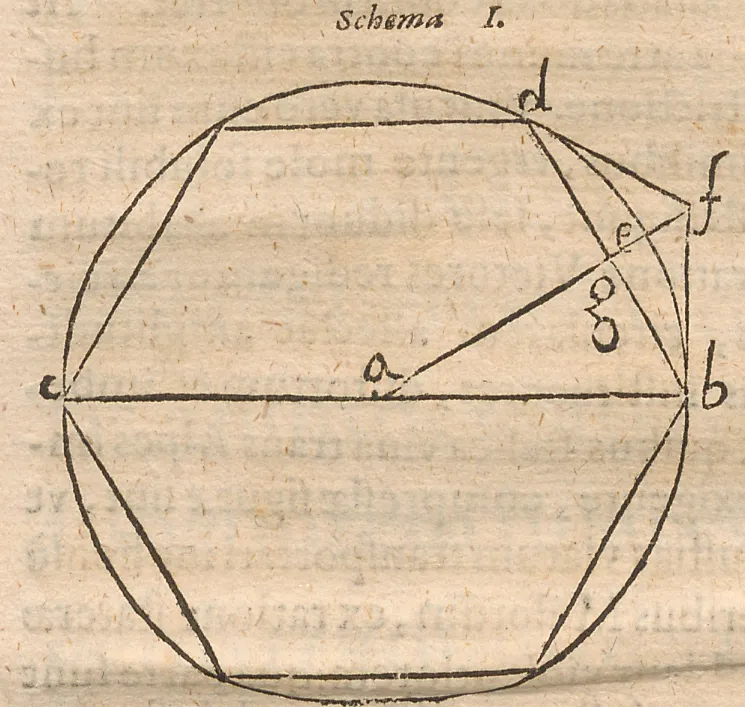
Ad hoc demonstrandum vsus est figuris circulo inscriptis & circumscriptis; quæ cum sint infinitæ; nos facilitatis causa vtemur sexangula. Sit enim in circulo CBD, regulare sexangulum, cuius anguli C, D, B, latus DB, & tangant circulum duæ rectæ in D & B, coeantque ad communem sectionem F: & centrum A cum F connectatur lineâ AF, quæ secet rectam DB in G, arcum DB in E. Cum igitur DGB sit recta, i. e. ductus à D in B brevissimus, DEB vero arcus, id est ductus à D in B non brevissimus, longior igitur est DEB, quam DGB.
To prove this he used figures inscribed in and circumscribed about the circle; and since these are infinite in number, for ease we shall use the hexagon. Let there be in the circle CBD a regular hexagon, whose angles are C, D, B and side DB, and let two straight lines touch the circle at D and B and meet at their common intersection F; and let the centre A be joined to F by the line AF, which cuts the straight line DB at G and the arc DB at E. Since, then, DGB is straight, that is, the shortest path from D to B, while DEB is an arc, that is, a path from D to B that is not the shortest, DEB is longer than DGB.
E contra cum recta BF tangat circulum, omnes igitur partes arcus EB sunt intra FB versus GB: quòd si EB esset recta, omnino brevior esset, quàm FB, Nam AEB, FEB anguli sunt æquipollentes Recto, cum EFB sit acutus. Ergo EB subtensa minori angulo EFB, minor est, quam FB, quippe quæ maiori est subtensa. Licet autem argumentari de EB ut de recta, quia vis demonstrationis secat circulum in arcus minimos, qui æquiparantur rectis.
Conversely, since the straight line BF touches the circle, all parts of the arc EB lie inside FB, towards GB: so that if EB were straight it would certainly be shorter than FB. For the angles AEB, FEB are together equal to a right angle, since EFB is acute. So EB, subtending the smaller angle EFB, is less than FB, which subtends the greater. And we may argue about EB as about a straight line, because the force of the proof cuts the circle into the smallest arcs, which are equated with straight lines.
Quanquàm interea quæ communi sensu sunt nota, recipi potest, arcum DEB, intra triangulum DBF, minorem esse lineis DF, FB, quippe qui cum flectatur versus angulum DFB, nullam tamen particulam habet extra lineas DF, FB: comprehendens autem, sensu communi majus est comprehenso. Secus haberet, si arcus DEB esset linea flexuosa & inordinata.
Meanwhile, from what is known to common sense, it may be accepted that the arc DEB, within the triangle DBF, is less than the lines DF, FB, since, though it bends towards the angle DFB, it has no particle outside the lines DF, FB; and by common sense what contains is greater than what is contained. It would be otherwise if the arc DEB were a winding and irregular line.
Cum igitur DB sit latus inscripti sexanguli, & DF, FB sint duæ medietates circumscripti sexanguli; arcus DEB erit circuli pars sexta: major verò erat quàm DB, minor quàm DF, FB. Sex igitur lineæ DB, minores sunt quàm circumferentia circuli, & duodecim lineæ DF, vel FB, sunt maiores quàm circumferentia.
Since, then, DB is the side of the inscribed hexagon, and DF, FB are two halves of sides of the circumscribed hexagon, the arc DEB will be the sixth part of the circle; and it was greater than DB and less than DF, FB. Six lines DB, therefore, are less than the circumference of the circle, and twelve lines DF or FB are greater than the circumference.
Est autem DB latus sexanguli regularis, æquale ipsi AB semidiametro. Sex igitur diametri AB, hoc est tres diametri CB, vel (diametro in septem æqualia divisa) Viginti & vna septimæ, sunt breviores circumferentia.
Now DB, the side of the regular hexagon, is equal to the radius AB. Six radii AB, that is, three diameters CB, or (the diameter being divided into seven equal parts) twenty-one sevenths, are shorter than the circumference.
Vicissim cum DG, GB
sint æquales, erit GB dimidium ipsius AB. Quadratum verò AB æquale est
junctis AG, GB quadratis, & est quadruplum quadrati GB, ergo AG est
triplum quadrati GB. Proportio igitur quadratorum AB & AG est
sesquitertia: linearum igitur AB & AG proportio est
semi-sesquitertia, scilicet ea quæ numerorum 100000 & 86603. Vt vero
est AG ad AB, sic est GB ad BF. Ergo etiam inter GB & BF est
proportio semi-sesquitertia; vt quia GB est dimidium ipsius AB, scilicet
50000; BF talium particularum habeat 57737 proximè. Duodecies igitur
sumptus numerus iste, maior erit quam circumferentia circuli. Colligitur
numerus 477974, qualium diameter habet 200000. Et qualium diameter habet
7, talium sunt in BD duodecies sumpta 24, minus vna decima. Maior igitur
est hic numerus ipsa circumferentia; Minor autem eadem erat numerus 21.
Et patet ad oculum, arcum BE propiorem esse ipsi BG, quam BF lineæ.
Circumferentia igitur propior est numero 21, quam numero 24, minus vna
decima. Ponitur igitur ab 21 recessisse per 1, ab altero verò per 2,
minus vna decima, vt sit nimirum 22. Hæc autem longè accuratius
demonstrat Archimedes in figuris multilateris, vt sunt figuræ 12, 24, 48
laterum: vbi etiam apparet, paulum quid deesse circumferentiæ, quo minus
sit 22. Adrianus Romanus eadem Methodo demonstravit, si diameter circuli
secetur in partes — — — 20000000000000000
tunc talium partium 62831853071795862 ferè esse in circumferentia.
Again, since DG, GB
are equal, GB will be half of AB. And the square of AB is equal to the
squares of AG and GB together, and is four times the square of GB; so
the square of AG is three times the square of GB. The ratio of the
squares of AB and AG is therefore 4 : 3, and the ratio of the lines AB
and AG is the square root of 4 : 3, namely that of the numbers 100000
and 86603. And as AG is to AB, so is GB to BF. So between GB and BF too
the ratio is the square root of 4 : 3; so that, since GB is half of AB,
namely 50000, BF has very nearly 57737 such parts. This number, then,
taken twelve times, will be greater than the circumference of the
circle. The sum is 477974, of parts of which the diameter has 200000.
And of parts of which the diameter has 7, BD taken twelve times has 24
less one tenth. This number is therefore greater than the circumference
itself; and the number 21 was less than it. And it is plain to the eye
that the arc BE is nearer to BG than to the line BF. The circumference
is therefore nearer to the number 21 than to 24 less one tenth. It is
supposed, then, to depart from 21 by 1, and from the other by 2 less one
tenth, so as to be, namely, 22. Archimedes proves this far more exactly
with polygons, such as figures of 12, 24 and 48 sides, where it also
appears that the circumference falls a little short of 22. Adriaan van
Roomen proved by the same method that if the diameter of a circle is
divided into 20000000000000000 parts,
there are about 62831853071795862 such parts in the circumference.
Episagma.
Addendum.
Ex tribus lineis sectionum Conicarum, quæ Parabole, Hyperbole, Ellipsis dicuntur, Ellipsis est circuli æmula, & demonstravi in Com. de Motibus Martis, longitudinem Ellipticæ lineæ sese habere ad medium arithmeticum inter duas ejus diametros, quæ axis rectus & transversus dicuntur, similiter vt 22. ad 7. fere.
Of the three lines of the conic sections, called the parabola, hyperbola and ellipse, the ellipse is the rival of the circle; and I have proved in my commentaries on the motions of Mars that the length of the elliptical line is to the arithmetic mean between its two diameters, called the minor and major axes, likewise about as 22 to 7.
Theorema II.
Theorem II.
Circuli area ad aream quadratam diametri comparata, rationem habet eam quam 11. ad 14. fere.
The area of a circle compared with the area of the square on its diameter has the ratio of about 11 to 14.
Archimedes vtitur demonstratione indirecta, quæ ad impossibile ducit: de qua multi multa: Mihi sensus hic esse videtur.
Archimedes uses an indirect proof, leading to an impossibility, about which many have said much. Its meaning seems to me to be this.
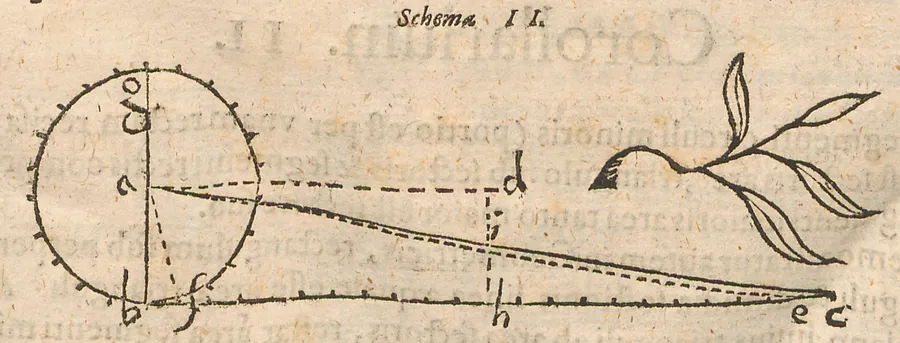
Circuli BG circumferentia partes habet totidem, quod puncta, puta infinitas; quarum quælibet consideratur vt basis alicuius trianguli æquicruri, cruribus AB: vti ita Triangula in area circuli insint infinita, omnia verticibus in centro A coeuntia. Extendatur igitur circumferentia circuli BG in rectum, & sit BC æqualis illi, & AB ad illam perpendicularis. Erunt igitur infinitorum illorum Triangulorum, seu Sectorum, bases imaginatæ omnes in vna recta BC, juxta invicem ordinatæ: sit vna talium basium BF quantulacunque, eique æqualis CE, connectantur autem puncta F, E, C, cum A. Quia igitur triangula ABF, AEC totidem sunt super recta BC, quot sectores in area circuli, & bases BF, EC æquales illis, & omnium communis altitudo BA, quæ etiam est sectorum; Triangula igitur EAC, BAF erunt æqualia, & quodlibet æquabit vnum sectorem circuli; & omnia simul in linea BC bases habentia, id est Triangulum BAC, ex omnibus illis constans, æquabit sectores circuli omnes, id est aream circuli ex omnibus constantem. Hoc sibi vult illa Archimedea ad impossibile deductio.
The circumference of the circle BG has as many parts as it has points, that is, infinitely many; each of which is considered as the base of an isosceles triangle with sides AB, so that there are infinitely many triangles in the area of the circle, all meeting with their vertices at the centre A. Let the circumference of the circle BG, then, be stretched out straight, and let BC be equal to it, and AB perpendicular to it. The bases of those infinitely many triangles or sectors will then all be imagined set side by side in the one straight line BC. Let one such base be BF, however small, and CE equal to it, and let the points F, E, C be joined to A. Since, then, there are as many triangles ABF, AEC on the straight line BC as there are sectors in the area of the circle, and the bases BF, EC are equal to theirs, and the height BA, which is also that of the sectors, is common to all, the triangles EAC, BAF will be equal, and each will equal one sector of the circle; and all of them together, having their bases on the line BC, that is, the triangle BAC made up of them all, will equal all the sectors of the circle, that is, the area of the circle made up of them all. This is what Archimedes’ reduction to an impossibility means.
Divisa igitur BC bifariam in H, fiat ABHD parallelogrammum, vt DH secet AC in I. Erit hoc parallelogrammum Rectangulum æquale areæ circuli. Nam vt CB tota ad CH dimidiam, ita & AB, id est DH tota, ad IH dimidiam. Igitur HI æquat ID, & HC æquat DA, id est HB: & anguli ad I æquales, D vero & H recti. Triangulum igitur ICH, quod est extra parallelogrammum, æquale est triangulo IAD, quo parallelogrammum excedit trapezium AIHB.
Then, BC being bisected at H, let the parallelogram ABHD be made, so that DH cuts AC at I. This parallelogram, a rectangle, will be equal to the area of the circle. For as the whole CB is to its half CH, so AB, that is, the whole DH, is to its half IH. So HI equals ID, and HC equals DA, that is, HB; and the angles at I are equal, and those at D and H right. The triangle ICH, which lies outside the parallelogram, is therefore equal to the triangle IAD, by which the parallelogram exceeds the trapezium AIHB.
Cum igitur diameter GB ponatur esse partium 7, quadratum diametri erit 49. Et cum harum partium 22 sint in circumferentia, sc: in BC, dimidia BH habebit earum 11, paulo minus, vt supra. Duc 11 in semidiametrum 3 semis, sc: in AB: fiet Rectangulum AH 38 semis.
Since, then, the diameter GB is supposed to be 7 parts, the square of the diameter will be 49. And since there are 22 of these parts in the circumference, that is, in BC, its half BH will have 11 of them, a little less, as above. Multiply 11 by the radius 3½, that is, by AB: the rectangle AH will be 38½.
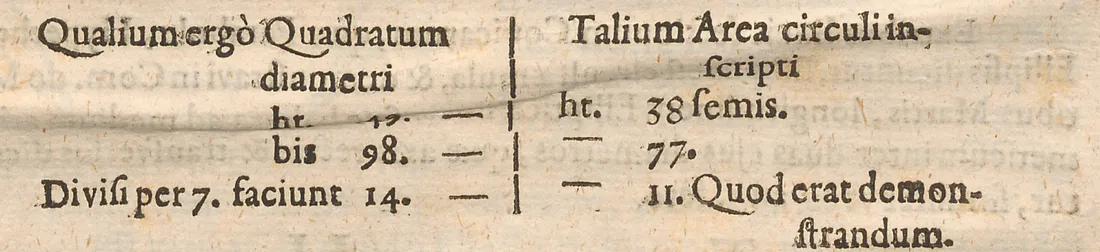
| Qualium ergò Quadratum diametri | Talium Area circuli inscripti |
|---|---|
| ht. 49. — | ht. 38 semis. |
| bis 98. — | — 77. |
| Divisi per 7. faciunt 14. — | — 11. Quod erat demonstrandum. |
| Of such parts, then, as the square on the diameter | The area of the inscribed circle has |
|---|---|
| has 49 — | 38½. |
| twice, 98 — | — 77. |
| Divided by 7 they make 14 — | — 11. Which was to be proved. |
Corollarium. I.
Corollary I.
Sectoris in circulo (constituitur rectis ex centro, & ex arcu intercepto) area est æqualis rectangulo sub semidiametro & dimidio arcu.
The area of a sector of a circle (it is formed by straight lines from the centre and the arc they cut off) is equal to the rectangle under the radius and half the arc.
Corollarium. II.
Corollary II.
Segmenti circuli minoris (portio est per vnam rectam recisa) area minor est sectoris areâ, triangulo sub sectoris & segmenti rectis comprehenso: Segmenti maioris area tanto maior est sectore suo.
The area of a lesser segment of a circle (a part cut off by one straight line) is less than the area of the sector by the triangle contained by the straight lines of the sector and of the segment; the area of the greater segment is greater than its sector by the same amount.
Demonstratur autem in Geometricis, rectangulum sub perpendiculo trianguli & dimidia sectionis linea æquale esse areæ trianguli. Ablato igitur plano huius trianguli ab area sectoris, restat area segmenti minoris, sed addito, maioris segmenti area constituitur.
For it is proved in geometry that the rectangle under the height of a triangle and half its base is equal to the area of the triangle. When the area of this triangle is taken from the area of the sector, therefore, the area of the lesser segment remains; when it is added, the area of the greater segment is formed.
In Schemate I. DABE est sector minor, DABCD maior; DGBE segmentum minus, DGBC maius; DBA triangulum, quo sector à segmento differt. Id habet duas partes æquales & congruas, AGB, AGD. Apposito igitur angulo DAG ad GBA, sic ADG ad GAB, fit rectangulum altitudine AG, latitudine GB. Et dicitur in Triangulorum doctrina, GB sinus arcus EB dimidij, GA sinus eius complementi.
In Schema I, DABE is the lesser sector, DABCD the greater; DGBE the lesser segment, DGBC the greater; DBA the triangle by which sector and segment differ. It has two equal and congruent parts, AGB and AGD. So when the angle DAG is placed against GBA, and ADG against GAB, a rectangle is made of height AG and width GB. And in the doctrine of triangles GB is called the sine of half the arc EB, and GA the sine of its complement.
Episagma I.
Addendum I.
Circulo commune hoc est cum Parabola; quod in vtraque, portiones quomodocunque per vnam rectam abscissæ, si æquales habuerint diametros, & ipsæ inter se in qualibet figura sint æquales. Arch. de Conoid. IV.
The circle has this in common with the parabola, that in both, portions cut off in any way by one straight line, if they have equal diameters, are also equal to each other in any one figure. Archimedes, On Conoids, IV.
Episagma II.
Addendum II.
Paraboles area est sesquitertia areæ Trianguli, habentis eandem cum Parabola basin rectam, & eandem altitudinem. Arch. de Quadr. Parabolæ Prop. XVII. & XXIV.
The area of a parabola is four thirds of the area of a triangle having the same straight base as the parabola and the same height. Archimedes, Quadrature of the Parabola, Props. XVII and XXIV.
Episagma III.
Addendum III.
Ellipsis area, ad aream circuli est, vt minor Ellipsis Diameter ad maiorem: Et vt circulus ad quadratum diametri, sic Ellipsis ad Rectangulum diametrorum, scilicet etiam vt 11. ad 14. feré. Arch: Sphæroid.
The area of an ellipse is to the area of a circle as the minor diameter of the ellipse to the major; and as the circle is to the square on the diameter, so is the ellipse to the rectangle of its diameters, that is, again about as 11 to 14. Archimedes, On Spheroids.
Theorema. III.
Theorem III.
Cylindri vero ad Parallelepipedum columnare rectangulum æquealtum, quod Cylindri corpus stringit quadratis suis basibus & parallelis lateribus, ratio est eadem, quæ circuli ad quadratum circumscriptum, hoc est eadem quæ 11. ad 14.
The ratio of a cylinder to the rectangular column of equal height that encloses its body with its square bases and parallel sides is the same as that of the circle to the circumscribed square, that is, the same as 11 to 14.
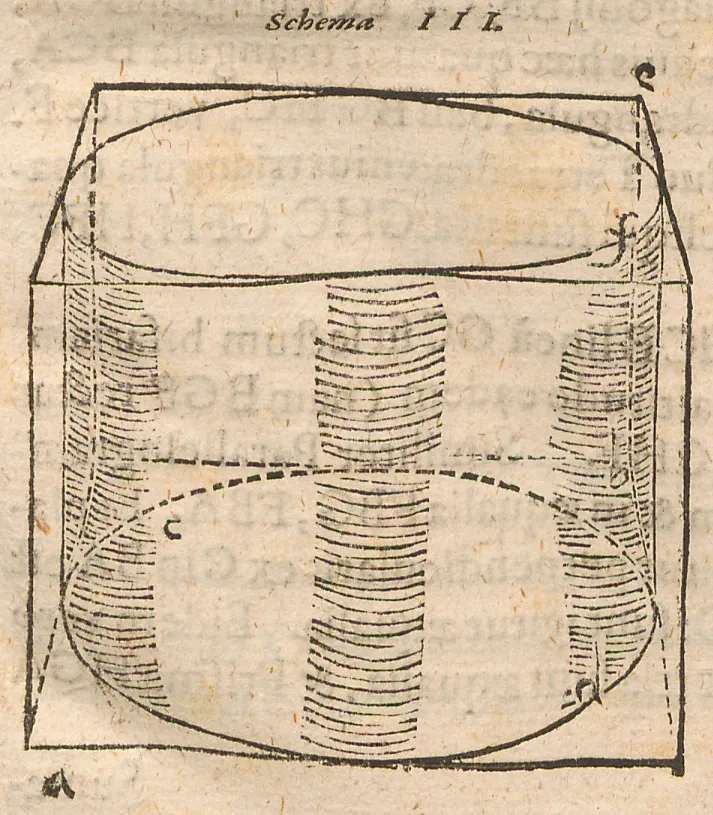
Vt enim CD Cylindrica basis circularis ad AB quadratum circumscriptum, ita CF corpus Cylindri, ad AE corpus parallelepipedi rectanguli, seu columnæ.
For as the cylinder’s circular base CD is to the circumscribed square AB, so is CF, the body of the cylinder, to AE, the body of the rectangular parallelepiped or column.
Arch: de Sphæra & Cylindro.
Archimedes, On the Sphere and Cylinder.
Cylinder enim & columna æquealta sunt hic veluti quædam plana corporata: accidunt igitur illis eadem quæ planis.
For a cylinder and a column of equal height are here like plane figures given a body; the same things therefore happen to them as to the plane figures.
Theorema IV.
Theorem IV.
Si Columna recta parallelarum Basium cum Pyramide, si Cylinder cum Cono eandem basin habuerit eandemque altitudinem, Triplum erit illius.
If a right column with parallel bases and a pyramid, or a cylinder and a cone, have the same base and the same height, the first will be three times the second.
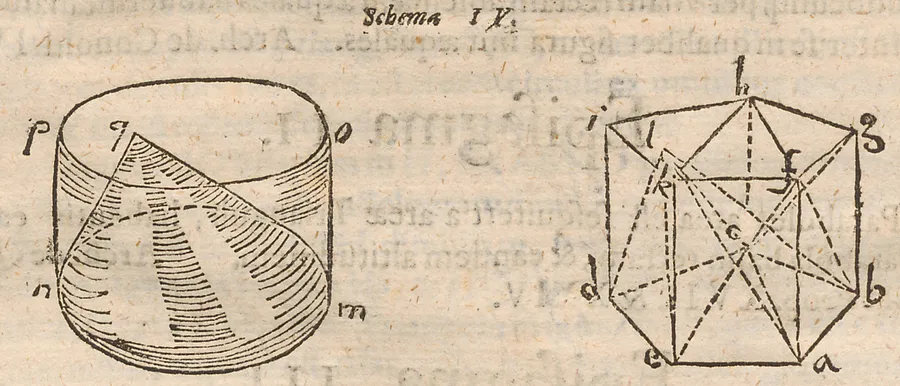
Nam omnis Columna, vt hic quinquangularis BI, bases ABCDE & FGHIK parallelas habens, & BAF, AEK cæterosque angulos rectos, solvitur in sua Pentaedra seu Prismata, vt hic quinquangularis in tria GHF, FHK, KHI, Trinis parallelogrammis & binis triangulis oppositis clausa.
For every column, such as this pentagonal one BI, with parallel bases ABCDE and FGHIK and right angles BAF, AEK and the rest, can be resolved into its pentahedra or prisms: this pentagonal one into three, GHF, FHK, KHI, each enclosed by three parallelograms and two opposite triangles.
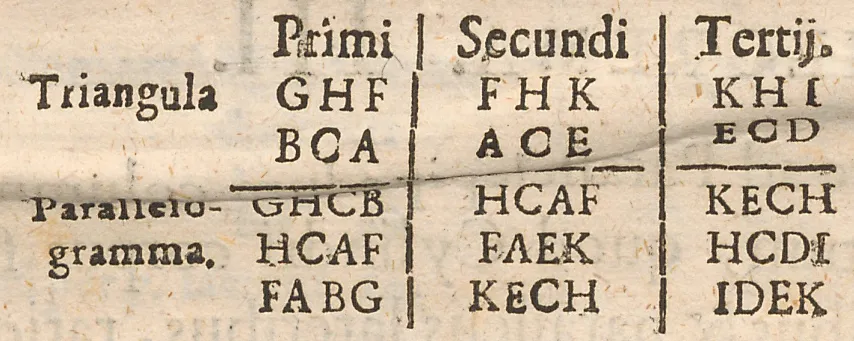
| Primi | Secundi | Tertij. | |
|---|---|---|---|
| Triangula | GHF | FHK | KHI |
| BCA | ACE | ECD | |
| Parallelogramma. | GHCB | HCAF | KECH |
| HCAF | FAEK | HCDI | |
| FABG | KECH | IDEK |
| First | Second | Third | |
|---|---|---|---|
| Triangles | GHF | FHK | KHI |
| BCA | ACE | ECD | |
| Parallelograms | GHCB | HCAF | KECH |
| HCAF | FAEK | HCDI | |
| FABG | KECH | IDEK |
Pentaedron vero in tria Tetraedra solvitur, quorum bina semper, quæ vnum Planum Parallelogrammum ex æquo dividunt, æquealta sunt
And a pentahedron is resolved into three tetrahedra, of which any two that divide one parallelogram face equally are of equal height.
Sit verbi gratia Prisma primum sub GHF, BCA triangulis. Ducantur in Parallelogrammis BGFA & AFHC diagonij BF, CF, ex trianguli BCA, angulis B, C. Iis resecatur Tetraedron, cuius hæc quatuor triangula BCA, BFC, BFA, AFC. Restat Pyramis quadrangula, basi BGHC, vertice F. Ducta igitur diagonios GC secat eam in duo Tetraedra: vnius triangula quatuor sunt ista BGC, GFB, GFC, CFB: reliqui sunt ista, GHC, GFH, HFC, CFG
Let the first prism, for example, be that under the triangles GHF, BCA. In the parallelograms BGFA and AFHC let the diagonals BF, CF be drawn from the angles B, C of the triangle BCA. These cut off a tetrahedron whose four triangles are BCA, BFC, BFA, AFC. There remains a four-sided pyramid with base BGHC and vertex F. The diagonal GC, then, cuts it into two tetrahedra: the four triangles of one are BGC, GFB, GFC, CFB; those of the other GHC, GFH, HFC, CFG.
Cùm igitur Parallelogrammum GHCB lineà GC sit sectum bifariam, & triangula GCH, GCB æqualia, & GF altitudo eadem (nam BGF rectus est) æqualia erunt Tetraedra GCBF, GCHF. Similiter Parallelogrammum GFAB lineà BF sectum est bifariam & in æqualia FBG, FBA. Et planum BCA rectum est ad planum GA, igitur perpendicularis ex C in BA est altitudo Tetraedorum GBFC, & ABFC: sunt igitur æqualia. Eidem verò GBFC fuit æquale GCFH. Omnia igitur tria sunt æqualia, & Prisma HGA habet tria æqualia Tetraedra.
Since, then, the parallelogram GHCB is bisected by the line GC, and the triangles GCH, GCB are equal, and the height GF the same (for BGF is a right angle), the tetrahedra GCBF, GCHF will be equal. Likewise the parallelogram GFAB is bisected by the line BF into the equal triangles FBG, FBA. And the plane BCA is at right angles to the plane GA; so the perpendicular from C to BA is the height of the tetrahedra GBFC and ABFC, and they are therefore equal. And GCFH was equal to the same GBFC. All three are therefore equal, and the prism HGA has three equal tetrahedra.
Sumatur jam in basi supera FGHIK, punctum L, quod connectatur cum angulis basis inferæ ABCDE, vt creetur Pyramis quinquangula: Dico illam esse tertiam partem columnæ GAD. Nam basis ABCDE, lineis AC, EC in triangula tria est divisa vt prius, super quæ stant & tria Pentaedra, & tres partes Pyramidis, sc. ABCL, ACEL, ECDL, & perpendicularis ex L demissa in planum ED, æquat recta latera KE, FA & cætera. Est igitur eadem altitudo Tetraedrorum ABCF, ABCL; sunt igitur æqualia. Sed ABCF est tertia pars Prismatis ABC FGH: Ergo & ABCL ejusdem tertia pars est. Similiter verò secunda Pyramidis pars ACEL, secundi Prismatis; & tertia ECDL, tertij prismatis tertiæ sunt Partes: Tota igitur Pyramis totius Columnæ tertia pars est; & hæc illius ergò Triplum.
Now let a point L be taken in the upper base FGHIK and joined to the angles of the lower base ABCDE, so as to make a pentagonal pyramid. I say it is the third part of the column GAD. For the base ABCDE is divided by the lines AC, EC into three triangles as before, on which stand both the three pentahedra and the three parts of the pyramid, namely ABCL, ACEL, ECDL; and the perpendicular let fall from L to the plane ED equals the upright sides KE, FA and the rest. The height of the tetrahedra ABCF and ABCL is therefore the same, and they are equal. But ABCF is the third part of the prism ABC FGH; so ABCL is a third part of it too. Likewise the second part of the pyramid, ACEL, is a third of the second prism, and the third, ECDL, of the third. The whole pyramid, therefore, is the third part of the whole column, and the column three times the pyramid.
Eodem verò modo & MNOP Cylinder, cuius bases MN & OP parallelæ, æquat tres conos MNQ, vertice Q ad superioris basis planum pertingentes, & eandem basin MN habentes. Demonstratio enim analogicè applicari eadem potest, si perpendas, circulum, qui basis est Cylindri & Coni, in infinita triangula ex centro dividi, quibus totidem Prismata, totidemque partes Coni superstent, illa in axe Cylindri, hæ in axe Coni convenientes.
In the same way the cylinder MNOP, with parallel bases MN and OP, equals three cones MNQ, reaching with their vertex Q to the plane of the upper base and having the same base MN. For the same proof can be applied by analogy if you consider the circle, which is the base of the cylinder and the cone, to be divided from the centre into infinitely many triangles, on which stand as many prisms and as many parts of the cone, the former meeting in the axis of the cylinder, the latter in the axis of the cone.
Theorema V.
Theorem V.
Superficies curva Coni Rectanguli inscripti Hemisphærio, est semidupla Baseos, seu circuli maximi in sphæra, dimidia Baseos Coni rectanguli circa Hemisphærium.
The curved surface of the right-angled cone inscribed in a hemisphere is to its base, the great circle of the sphere, as √2 to 1, and is half of the base of the right-angled cone about the hemisphere.
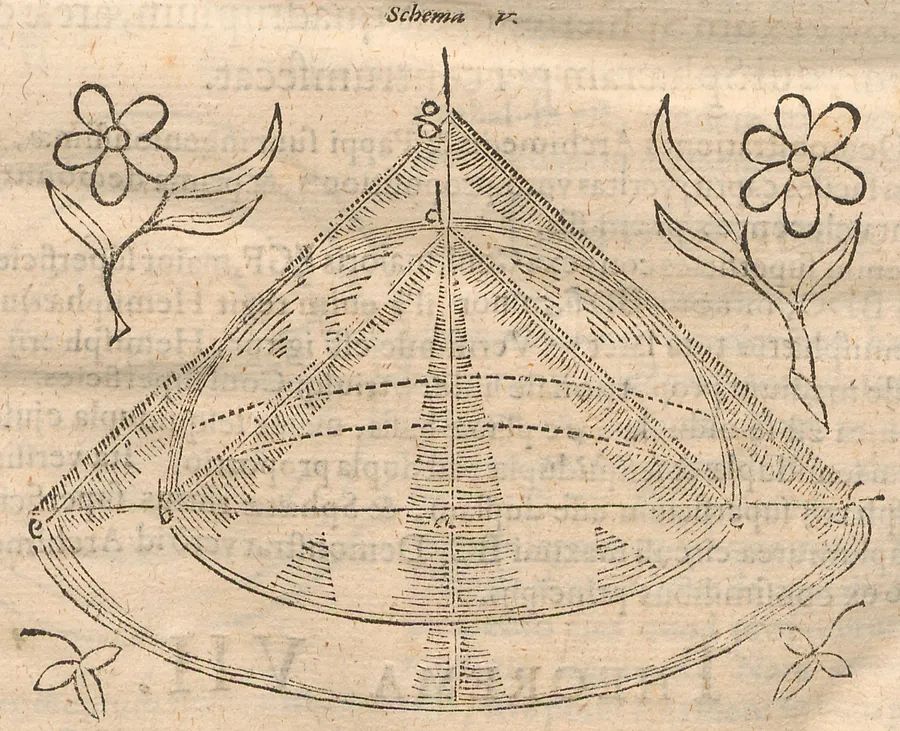
Sphæra BDC secetur plano per centrum A, & sectio BC continuetur fiantque duo Coni Rectanguli, alter totus intra Hemisphærium BDC, cujus axis recta AD, ex centro A, diametro perpendicularis: sitque BDC, basin BC & verticem D eundem habens cum Hemisphærio; alter totus extra Hemisphærium, stringens illud mediæ suæ superficiei lateribus, quæ sint EG, FG, parallela ipsis BD, CD, habens verticem G, in axe prioris AD continuato, basin vero EF in plano sphæram secante. Cum igitur BA & AD sint æquales; erunt etiam EA semidiameter basis maioris, & AD altitudo Coni exterioris æquales: Et quia EGF rectus, erit igitur EG quadrati circulo circumscripti latus, eoque equalis diametro GC. Sed EF quadratum, æquale est duobus quadratis EG & GF, æqualibus diametro BC: Ergo quadratum EF duplum est quadrati BC: circulus igitur EF duplus est circuli BC. Dico etiam superficierum conicarum inter se proportionem esse duplam, & minoris conicæ curvæ superficiei proportionem ad aream basis BC esse semiduplam.
Let the sphere BDC be cut by a plane through the centre A, and let the section BC be extended, and let two right-angled cones be made: one wholly inside the hemisphere BDC, whose axis is the straight line AD from the centre A, perpendicular to the diameter; let this be BDC, having the base BC and the vertex D in common with the hemisphere; the other wholly outside the hemisphere, touching it with the middles of its sides EG, FG, parallel to BD, CD, having its vertex G on the axis AD of the first extended, and its base EF in the plane that cuts the sphere. Since, then, BA and AD are equal, EA, the radius of the greater base, and AD, the height of the outer cone, will also be equal. And because EGF is a right angle, EG will be the side of the square circumscribed about the circle, and so equal to the diameter GC. But the square on EF is equal to the two squares on EG and GF, which are equal to the diameter BC; so the square on EF is twice the square on BC, and the circle EF twice the circle BC. I say too that the ratio of the conical surfaces to each other is 2 : 1, and the ratio of the curved surface of the lesser cone to the area of the base BC is √2 : 1.
Nam per ea quæ dicta sunt Theor. II, rectangulum sub semidiametro AB, & circumferentia tota BC, duplum est areæ circuli BC. Eodem verò modo, eademque demonstrationis vi, rectangulum sub tota BD & tota circumferentia BC, est duplum conicæ curvæ superficiei BDC. Quare vt AB ad BD, sic superficies plana circuli BC, ad curvam Coni BDC. Sed proportio AB ad BD est semidupla, quia quadratorum proportio est dupla; ergo & superficierum dictarum proportio est semidupla. Et quia sunt Coni similes; vt igitur basis BC plana ad Curvam BDC: sic plana EF ad curvam EGC & permutatim, vt basis ad basin, ita conica ad conicam curvam: dupla verò est proportio inter bases; dupla igitur & inter conicas curvas.
For by what was said in Theorem II, the rectangle under the radius AB and the whole circumference BC is twice the area of the circle BC. And in the same way, by the same force of proof, the rectangle under the whole BD and the whole circumference BC is twice the curved surface of the cone BDC. So as AB is to BD, so is the plane surface of the circle BC to the curved surface of the cone BDC. But the ratio of AB to BD is 1 : √2, since the ratio of the squares is 1 : 2; so the ratio of the said surfaces is also 1 : √2. And since the cones are similar, as the plane base BC is to the curved BDC, so is the plane EF to the curved EGC; and alternately, as base to base, so curved cone to curved cone. The ratio between the bases is 2 : 1; so the ratio between the curved cones is 2 : 1.
Theorema VI.
Theorem VI.
Convexum Sphæricum est quadruplum, areæ circuli maximi, qui Sphæram per centrum secat.
The convex surface of a sphere is four times the area of the great circle that cuts the sphere through its centre.
Demonstrationes Archimedis & Pappi sunt ingeniosissimæ, nec admodum faciles captu: veritas verò propositionis, & prima demonstrationis elementa elucent ex præmissis.
The proofs of Archimedes and Pappus are most ingenious, and not very easy to grasp; but the truth of the proposition and the first elements of a proof shine out from what has gone before.
Est enim superficies convexa Coni, maioris EGF, maior superficie Hemisphærij BDC, minoris BDC minor illa enim tegit Hemisphærium hæc sub Hemisphærio tota latet. Verisimile est igitur, Hemisphærij superficiem esse medium proportionale inter vtriusque Coni superficies. Sed minor conica est semidupla areæ planæ basis, maior sesquidupla ejusdem; & medium semiduplæ & sesquiduplæ, est dupla proportio. Ita verisimile fit, Hemisphærij superficiem esse duplam, & Sphæræ totius superficiem esse quadruplum areæ circuli maximi BC. Demonstrat verò id Archimedes necessariò ex consimilibus principijs.
For the convex surface of the greater cone EGF is greater than the surface of the hemisphere BDC, and that of the lesser BDC is less: the former covers the hemisphere, the latter lies wholly hidden beneath it. It is likely, then, that the surface of the hemisphere is the mean proportional between the surfaces of the two cones. But the lesser cone’s surface is √2 times the area of the plane base, the greater’s 2√2 times it; and the mean between √2 and 2√2 is 2. So it becomes likely that the surface of the hemisphere is twice, and that of the whole sphere four times, the area of the great circle BC. Archimedes proves it necessarily from similar principles.
Theorema VII.
Theorem VII.
Convexum cuiuslibet segmenti sphæræ est æquale plano circuli, cujus semidiameter subtendit segmenti latitudinem à Polo ad basin.
The convex surface of any segment of a sphere is equal to the plane circle whose radius is the chord of the segment’s breadth from the pole to the base.
Segmenta sphæræ hic reputantur non quælibet portiones, sed illæ tantum, cùm Sphæra ab vno plano tota secatur in partes duas, sic vt quælibet pars habeat suum polum; Talis enim sectio efficit, vt basis segmentorum sit circulus planus.
Segments of a sphere are here taken to be not any portions whatever, but only those made when the whole sphere is cut by one plane into two parts, so that each part has its own pole; for such a section makes the base of the segments a plane circle.
Centro A sit superficies Sphæræ BDCL, & hic sit eius circulus maximus, & assumantur extrema diametri DAL pro polis segmentorum futurorum, sintque D. L. & per punctum I, perque AE centrum, transeant duæ perpendiculares HIK, & BAD, repræsentantes sectiones, seu circulos ad planum DBL rectos. Sicut igitur tota DL subtensa dimidio circuli LCDB à polo D ad L imum, (quod punctum jam in comparatione totius Sphæræ cum suis segmentis sustinet vicem basis) fit semidiameter circuli plani, æqualis toti curvæ superficiei sphæræ, per VI: Sic etiam DC subtensa ipsi DKC dimidio arcui segmenti BCD a polo D ad basin C, fit semidiameter circuli plani, æqualis curvæ superficiei segmenti seu hemisphærij BDC, per V: Sic etiam in genere quocunque segmento sumpto, vt HKD, linea DK subtensa latitudini segmenti a D polo ad basin K, fit semidiameter circuli plani, æquantis superficiem curvam segmenti KDH: Et sumpto segmento HKL, cuius polus L, basis circularis HK, subtensa KL, fit semidiameter circuli plani, qui æqualis sit superficiei curvæ segmenti KLH.
About the centre A let there be the surface of the sphere BDCL, and let this be its great circle; let the ends of the diameter DAL, namely D and L, be taken as the poles of the segments to come; and through the point I and through the centre A let two perpendiculars HIK and BAD pass, representing sections or circles at right angles to the plane DBL. Just as the whole DL, the chord of the semicircle LCDB from the pole D to the lowest point L (which point, in comparing the whole sphere with its segments, now stands in place of a base), becomes the radius of a plane circle equal to the whole curved surface of the sphere, by VI; so too DC, the chord of the half arc DKC of the segment BCD from the pole D to the base C, becomes the radius of a plane circle equal to the curved surface of the segment or hemisphere BDC, by V. So too, taking any segment whatever, such as HKD, the line DK, the chord of the segment’s breadth from the pole D to the base K, becomes the radius of a plane circle equal to the curved surface of the segment KDH; and taking the segment HKL, whose pole is L and circular base HK, the chord KL becomes the radius of a plane circle equal to the curved surface of the segment KLH.
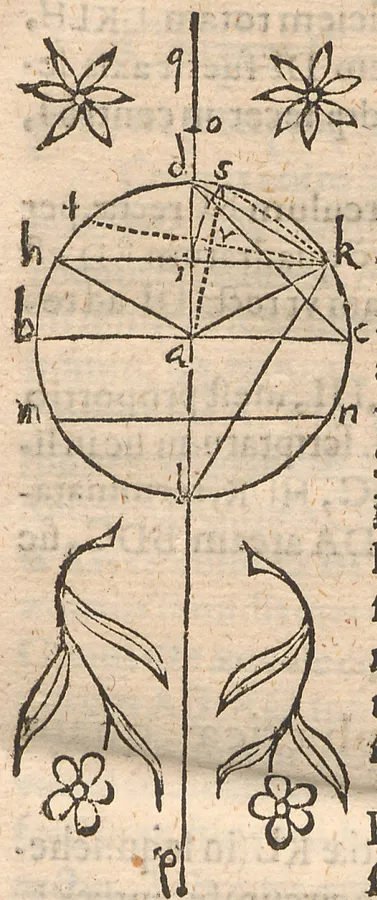
Demonstrationem vide apud Archimedem. Primam verò fidem tibi faciet analogia. Nam cum sic sit comparatum cum tota superficie & cum dimidia: probabile est, eandem rationem obtinere etiam in segmentis cæteris.
See the proof in Archimedes. Analogy will give you your first belief in it. For since this is so with the whole surface and with the half, it is probable that the same rule holds in the other segments too.
Corollarium.
Corollary.
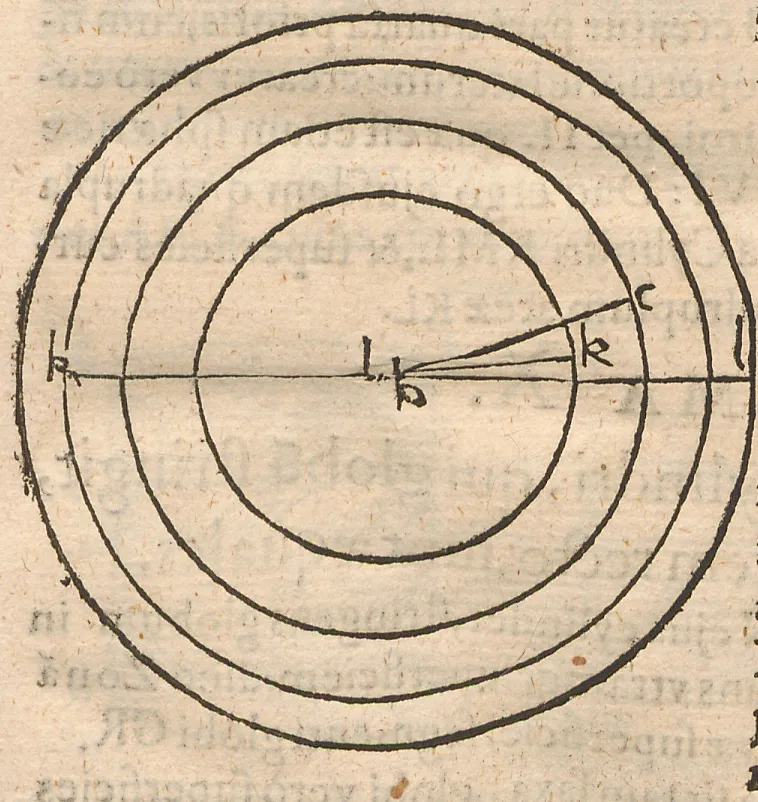
Segmenta segmentorum, quæ quidem vtrinque circularibus basibus terminantur, ijsdem principijs facile in planum explicantur. Nam sit BHKC segmentum segmenti BDC, cuius bases circuli HK, BC. primò fit circulus æqualis segmento sphæræ maiori BCD Deinde alius circulus fit æqualis complemento ejus quod proponitur segmentum segmenti, Nam complementum hoc, est segmentum sphæræ minus HKD, sive polus ejus idem sit cum priori sive alius. Ergò circulorum planorum DK, DC differentia æquabit Zonam BHKC.
Segments of segments, at least those bounded on both sides by circular bases, are easily laid out flat by the same principles. Let BHKC be a segment of the segment BDC, whose bases are the circles HK, BC. First a circle is made equal to the greater spherical segment BCD; then another circle is made equal to the complement of the proposed segment of a segment. For this complement is the lesser spherical segment HKD, whether its pole is the same as before or another. So the difference of the plane circles DK, DC will equal the zone BHKC.
Alia vero segmenta segmentorum, quæ non integris circulis planis, sed eorum partibus terminantur; nisi polus D & axis DI totius segmenti HKI fuerit constitutus in concursu sectionum, nondum habent notum æquationis vel computationis suæ methodum.
But other segments of segments, bounded not by whole plane circles but by parts of them, have as yet no known method of being equated or computed, unless the pole D and the axis DI of the whole segment HKI are placed at the meeting of the sections.
Theorema VIII.
Theorem VIII.
Sphæricum Convexum & ejus axis secantur à plano ad axem recto in eadem proportione.
The convex surface of a sphere and its axis are cut by a plane at right angles to the axis in the same ratio.
Septimum Theorema servit Geometricæ delineationi, hoc octavum arithmeticis est vtilius & compendium jucundissimum. Illud planum prodit æquale curvæ superficiei; hoc lineas ostendit æquivalentes segmentis.
The seventh theorem serves geometrical construction; this eighth is more useful for arithmetic, and a most pleasant shortcut. That one produces a plane equal to the curved surface; this one shows lines equivalent to the segments.
In Sch. præcedenti, si axis totus DL valet superficiem totam DKLH, pars axis DI valet partem superficiei HDK, siquidem DI fuerit axis sectionis, id est, si fuerit rectus ad planum BK secans, idque secet in centro I, Sic pars axis IL valet partem superficiei HLK.
In the preceding schema, if the whole axis DL is worth the whole surface DKLH, the part DI of the axis is worth the part HDK of the surface, provided DI is the axis of the section, that is, if it is at right angles to the cutting plane BK and cuts it at its centre I. So the part IL of the axis is worth the part HLK of the surface.
Nam quia HDK est ad KLH, vt circulus DK ad circulum KL rectæ, per VII. id est quadratum KD ad quadratum KL: At verò quadratum KD est ad quadratum KL, vt recta DI ad rectam IL: Ergò etiam vt recta DI ad rectam IL, sic HDK superficies ad KLH superficiem.
For HDK is to KLH as the circle on the straight line DK to the circle on KL, by VII, that is, as the square on KD to the square on KL. But the square on KD is to the square on KL as the straight line DI to the straight line IL. So as the line DI is to the line IL, so is the surface HDK to the surface KLH.
Analogia. Quemadmodum igitur in lineis BA, HI, inest proportio circularium circumferentiarum BC, HK, centris A. I. scriptarum; sic in lineis transversis DA, DI, inest proportio arearum BDC, HDK, terminatarum ad illos circulos: Et sicut DI valet aream HDK, & DA aream BDC, sic IA valet aream Zonæ BHKC.
Analogy. Just as in the lines BA, HI lies the ratio of the circumferences BC, HK described about the centres A and I, so in the transverse lines DA, DI lies the ratio of the areas BDC, HDK bounded at those circles. And as DI is worth the area HDK, and DA the area BDC, so IA is worth the area of the zone BHKC.
Theorema IX.
Theorem IX.
Cylindri recti superficies est æqualis Sphæricæ, quam stringit.
The surface of a right cylinder is equal to that of the sphere it encloses.
Creatur enim Cylindrica ductu totius circumferentiæ KL (in sequ: schemate) in totam diametrum KN vel GB: at ductu dimidiæ circumferentiæ KL, in dimidiam diametrum AB creatur pars quarta prioris, cum figuræ similes, sint in dupla proportione laterum:1 creatur verò eodem ductu area circuli maximi, per II. quæ est etiam sphæricæ superficiei pars quarta, per VI: Duo ergo ejusdem quadrupla sunt inter se æqualia, superficies sc. curva Cylindri KML, & superficies curva globi seu sphæræ suæ GB, vtraque quadruplum areæ KL.
For the cylindrical surface is produced by multiplying the whole circumference KL (in the following schema) by the whole diameter KN or GB; and multiplying half the circumference KL by half the diameter AB produces a quarter of this, since similar figures are in the squared ratio of their sides.1 But the same multiplication produces the area of the great circle, by II, which is also a quarter of the spherical surface, by VI. So two fourfold multiples of the same thing are equal to each other, namely the curved surface of the cylinder KML and the curved surface of its globe or sphere GB, each four times the area KL.
Theorema X.
Theorem X.
Superficies, globi, & ejus cylindri, qui globum stringit, resectæ ab eodem plano ad axem recto, sunt æquales.
The surfaces of a globe and of the cylinder that encloses it, cut off by the same plane at right angles to the axis, are equal.
In figura sequenti sit GB globus, LN ejus cylinder, stringens globum in medio, & in GB. Et sit planum PST secans vtramque superficiem: dico Zonam KPSTL cylindricam, esse æqualem curvæ superficiei segmenti globi GR.
In the following figure let GB be the globe and LN its cylinder, touching the globe in the middle and at G and B. And let the plane PST cut both surfaces: I say that the cylindrical zone KPSTL is equal to the curved surface of the segment GR of the globe.
Videtur falsum esse, cum Cylindrica sit tam laxa, globi verò superficies sursum in angustum coeat. Sed memineris, quanto illa laxior, tanto hanc esse latiorem, cùm per obliquum ad eandem tendat altitudinem. Sed facilis est demonstratio. Cùm enim KP & GR sint æquales & creetur Zona KRSTL ductu KP vel GR in totam circumferentiam KOL, & sic etiam Zona PSTMN creetur ductu PN vel RB in eandem circumferentiam totam: ergo vt rectæ GR ad RB, & BG, sic superficies cylindrica KT, ad TN & NL. At vt rectæ GR ad RB & BG, sic superficies segmenti globi GR ad RB segmentum & BG totam globi superficiem, per VIII. Ergo & vt Cylindrica KT ad TN & NL, sic sphærica GR ad RB, & BG. Est autem tota Cylindrica NL æqualis toti Sphæricæ GB, per IX. Ergo & pars Cylindricæ KOL PST parti Sphæricæ in segmento GR erit æqualis.
It seems false, since the cylindrical surface is so loose and the surface of the globe draws in narrowly towards the top. But remember that by as much as the one is looser, by so much the other is broader, since it runs slantwise to the same height. And the proof is easy. Since KP and GR are equal, and the zone KRSTL is made by multiplying KP or GR into the whole circumference KOL, and likewise the zone PSTMN is made by multiplying PN or RB into the same whole circumference, then as the straight lines GR to RB and BG, so is the cylindrical surface KT to TN and NL. But as the straight lines GR to RB and BG, so is the surface of the segment GR of the globe to the segment RB and to the whole surface BG of the globe, by VIII. So as the cylindrical KT is to TN and NL, so is the spherical GR to RB and BG. But the whole cylindrical surface NL is equal to the whole spherical surface GB, by IX. So the part KOL PST of the cylindrical surface will be equal to the part of the spherical surface in the segment GR.
Theorema XI.
Theorem XI.
Corpus Cylindri est ad corpus Sphæræ, quam stringit, in proportione sesquialtera.
The body of a cylinder is to the body of the sphere it encloses in the ratio 3 : 2.
Corpus enim Sphæræ ad Analogiam eorum quæ dicta sunt Theor. II. potestate in se continet infinitos veluti conos, verticibus in centro sphæræ coeuntes, basibus, quarum vicem sustinent puncta, in superficie stantibus. Sit igitur in schemate II. BG Sphæra, A centrum, coni AB, AG & similes infiniti, ijque minimi, id est, quorum Bases sint puncta B. G. vertex omnium communis A. Fiat novum Schema, in quo extendatur curva superficies sphæræ in planum circulare, cuius diameter sit BC, dupla ad diametrum Sphæræ BG, quia Circulorum proportio est quadrupla per VI. præmissum: & fiat circulus ex BC, ex cuius medio puncto H, surgat perpendicularis HD æqualis semidiametro AB. Sit autem Conus BDC, basi BC, vertice D: Conus iste æquale corpus habebit corpori Sphæræ BG. Omnium enim conorum AB, AG, infinitorum in sphæra, bases B. G. minimæ, cum sphærica superficie ipsa in qua insunt, in planum circulum BC extensæ & juxta invicem ordinatæ sunt, & pro eo quod erant in Sphæra Coni recti ABB, AGG, facti sunt hic coni scaleni DCC, DBB, excepto medio DHH, qui manet rectus, habentque omnes eandem altitudinem DH, & bases æquales, quippe minimas, omnes igitur & inter se & conis rectis in Sphæra æquales sunt: & totus conus BDC ex omnibus compositus, æqualis erit toti sphæræ BG ex omnibus compositæ.
For the body of the sphere, by analogy with what was said in Theorem II, contains potentially within it infinitely many cones, as it were, meeting with their vertices at the centre of the sphere and standing with their bases, whose place is taken by points, on the surface. In Schema II, then, let BG be the sphere, A the centre, and AB, AG and infinitely many like them the cones, and these the smallest, that is, whose bases are the points B, G, and whose common vertex is A. Let a new schema be made, in which the curved surface of the sphere is stretched out into a plane circle whose diameter BC is twice the sphere’s diameter BG, because the ratio of the circles is 4 : 1 by VI above; and let the circle be made on BC, and from its midpoint H let the perpendicular HD rise, equal to the radius AB. Let there be the cone BDC with base BC and vertex D: this cone will have a body equal to the body of the sphere BG. For the smallest bases B, G of all the infinitely many cones AB, AG in the sphere, together with the spherical surface in which they lie, are stretched out into the plane circle BC and set side by side; and where in the sphere they were right cones ABB, AGG, they have here become oblique cones DCC, DBB, except the middle one DHH, which stays upright; and they all have the same height DH and equal bases, being smallest ones; they are all therefore equal both to each other and to the right cones in the sphere; and the whole cone BDC, made up of them all, will be equal to the whole sphere BG made up of them all.
Ductâ igitur areâ circuli BC in semidiametrum HD, creatur Cylinder AICB, cuius corpus est coni BCD triplum, per IV: Est verò cylindri sphæram stringentis duplum, quia basin BC habet, basis KL quadruplam, altitudinem verò HD, altitudinis BG dimidiam. Duo enim AICB cylindri invicem impositi, efficerent altitudinem æqualem ipsi BG altitudini cylindri KLB, essentque illius quadruplum, propter basin BG quadruplam baseos KL: vnus igitur AICB est cylindri KLB duplum: erat verò triplum coni BDC, id est corporis Sphæræ BG, æqualis cono BDC. Ergo diviso cylindro AICB in 6: dimidium huius, scilicet 3, venit Cylindro KLB; tertia verò pars de 6, scilicet 2, venit sphæræ GB. Cylinder igitur KLB, ad sphæram suam GB, est vt 3. ad 2. quæ est proportio sesquialtera.
Multiplying the area of the circle BC by the radius HD, then, we produce the cylinder AICB, whose body is three times the cone BCD, by IV. But it is twice the cylinder that encloses the sphere, because it has the base BC, four times the base KL, and the height HD, half the height BG. For two cylinders AICB set one on the other would make a height equal to BG, the height of the cylinder KLB, and would be four times it, because of the base BG, four times the base KL; one AICB is therefore twice the cylinder KLB. And it was three times the cone BDC, that is, the body of the sphere BG, equal to the cone BDC. So if the cylinder AICB is divided into 6, half of it, namely 3, goes to the cylinder KLB, and a third of 6, namely 2, to the sphere GB. The cylinder KLB, therefore, is to its sphere GB as 3 to 2, which is the ratio 3 : 2.
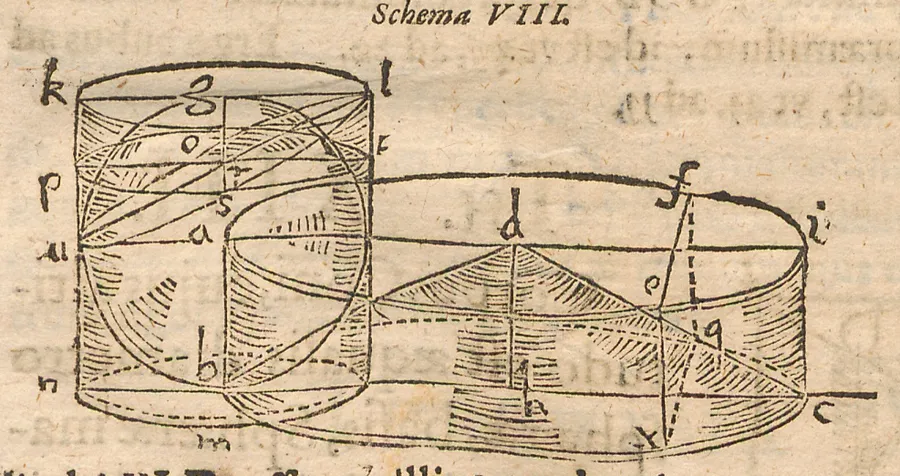
Potest idem etiam per IX. probari, si fingamus Cylindrum secari in infinita prismata, in axe cylindri coeuntia; pro basibus verò, quas habent prismata, quadrangulis, habentia lineas rectas æquales axi; quæ bases prismatum omnes juxta invicem ordinentur in curva Cylindri superficie, vt supra Theor. II. de circumferentia circuli similia sumus imaginati. In illo enim Schemate II. sit circulus BG vtraque basis Cylindri: & circumferentia BG, repræsentet curvam Cylindri superficiem, punctum verò A repræsentet axem Cylindri, æqualem ipsi BG diametro, & extendatur curva superficies Cylindri in planum, sitque BC, quæ repræsentet rectangulum, cuius longitudo BC, latitudo BG; & connectatur axis Cylindri AA, cum recta CC, ipsi parallela, rectangulo AACC: vt sit Prisma AABBCC, æquale corpori Cylindri. Erunt enim omnium Cylindri Prismatum minimorum bases rectangulæ minimæ (hoc est lineæ) juxta invicem ordinatæ in superficie rectangula BC, & Prismata in Cylindro recta, fient hic scalena; omnium tamen acies pertingent ad communis altitudinis BA terminum AA erunt igitur æquealta & invicem & cum rectis Prismatibus ipsius cylindri. Ducto igitur rectangulo BBCC in altitudinem BA, creabitur Parallelepipedum, cujus corpus est duplum corporis prismatis AABBCC, duplum igitur corporis cylindri. At supra etiam ducebatur circulus æqualis rectangulo BBCC superficiei curvæ cylindri (sc. quadruplus circuli maximi, per VI) in altitudinem æqualem ipsi BA semidiametro, & creabatur triplum coni, æqualis Sphæræ. Idem ergo est triplum sphæræ & duplum cylindri: Ergo vt supra, Cylindri ad sphæram proportio est sesquialtera.
The same can also be proved by IX, if we imagine the cylinder cut into infinitely many prisms meeting in the axis of the cylinder, having for their bases, which are quadrilateral, straight lines equal to the axis; and let all these bases of the prisms be set side by side in the curved surface of the cylinder, as we imagined something similar for the circumference of the circle above in Theorem II. In that Schema II, then, let the circle BG be each base of the cylinder, and let the circumference BG represent the curved surface of the cylinder, and the point A represent the axis of the cylinder, equal to the diameter BG; and let the curved surface of the cylinder be stretched out flat, and let it be BC, representing a rectangle whose length is BC and breadth BG; and let the axis of the cylinder AA be joined to the line CC, parallel to it, by the rectangle AACC, so that the prism AABBCC is equal to the body of the cylinder. For the smallest rectangular bases (that is, lines) of all the smallest prisms of the cylinder will be set side by side in the rectangular surface BC, and the prisms that were upright in the cylinder will here become slanting; but the edges of all of them will reach the end AA of the common height BA; they will therefore be of equal height both with one another and with the upright prisms of the cylinder itself. Multiplying the rectangle BBCC by the height BA, then, will produce a parallelepiped whose body is twice the body of the prism AABBCC, and so twice the body of the cylinder. But above, too, a circle equal to the rectangle BBCC, the curved surface of the cylinder (that is, four times the great circle, by VI), was multiplied by a height equal to the radius BA, and produced three times the cone equal to the sphere. So the same thing is three times the sphere and twice the cylinder; so, as above, the ratio of the cylinder to the sphere is 3 : 2.
Theorema XII.
Theorem XII.
Cubi corpus ad corpus Sphæræ quam stringit, est duplum paulo minus, nimirum vt 21. ad 11. proxime.
The body of a cube is to the body of the sphere it encloses as a little less than double, namely very nearly as 21 to 11.
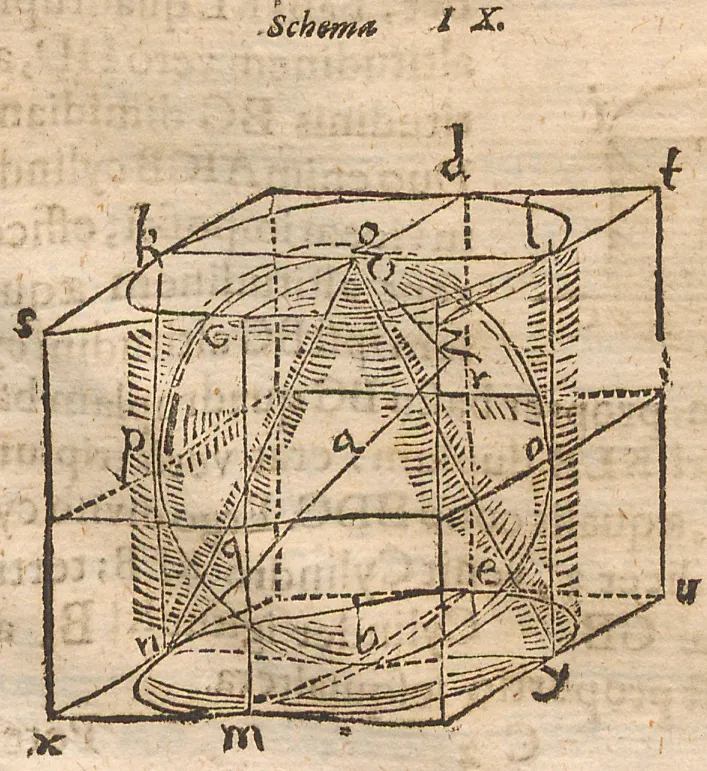
Nam Cubus STVX, in figura sequenti, est ad Cylindrum suum KLN quem stringit, vt 14 ad 11 proximè, per III. præmissum, id est vt 42 ad 33. At Cylinder KLN est ad sphæram PGOB quam communiter cum cubo stringit, vt 3. ad 2, per XI. præmissum, id est vt 33, ad 22. Ergo cubus ad sphæram est vt 42. ad 22, id est, vt 21. ad 11.
For the cube STVX, in the following figure, is to its cylinder KLN which it encloses very nearly as 14 to 11, by III above, that is, as 42 to 33. And the cylinder KLN is to the sphere PGOB, which it encloses together with the cube, as 3 to 2, by XI above, that is, as 33 to 22. So the cube is to the sphere as 42 to 22, that is, as 21 to 11.
Th. XIII.
Theorem XIII.
Corpus Coni, cujus altitudo est æqualis diametro sphæræ, basis, Sphæræ maximus circulus, est dimidium corporis sphæræ.
The body of a cone whose height is equal to the diameter of a sphere, and whose base is the great circle of the sphere, is half the body of the sphere.
Cylinder enim KLN eadem basi & altitudine, est triplum coni sui NGI, vel vt 3. ad 1. Idem verò Cylinder est ad sphæram suam, vt 3 ad 2, per XI. præmissum: Ergo Conus ad Sphæram est vt 1. ad 2.
For the cylinder KLN with the same base and height is three times its cone NGI, or as 3 to 1. And the same cylinder is to its sphere as 3 to 2, by XI above. So the cone is to the sphere as 1 to 2.
Summa præmissorum.
Summary of the foregoing.

| Conus Cylindri NGY. KLYN | Sphæra Cylindri PGOB KLYN | Cylinder KLYN | Cubus STVX Cylindrum stringens in KN, CM, LY, & DE. |
|---|---|---|---|
| Est vt 11. — | 22 — | 33 — | 42 Sphæram vero in |
| Vel vt 1 — | 2 — | 3 — | 4 minus G. O. B. P. Q. R. |
| The cone of the cylinder NGY. KLYN | The sphere of the cylinder PGOB KLYN | The cylinder KLYN | The cube STVX, enclosing the cylinder at KN, CM, LY and DE, |
|---|---|---|---|
| Are as 11 — | 22 — | 33 — | 42 and the sphere at |
| Or as 1 — | 2 — | 3 — | 4 less G, O, B, P, Q, R. |
Corollarium.
Corollary.
Porrò indidem etiam patet, Conum priorem in Hemisphærio (vt Theor. V. Conum BDC) esse ad Cylindrum qui sphæram stringit, vt Octaedron in sphæra ad Cubum circa sphæram, sextam scilicet partem Cylindri, quartam sphæræ, & sic dimidium Hemisphærij sui, dimidiumque coni Theor. XIII. descripti, quippe cujus basin habet integram, altitudinis verò saltem dimidium.
It is also clear from the same, further, that the first cone in the hemisphere (as the cone BDC of Theorem V) is to the cylinder enclosing the sphere as the octahedron in the sphere is to the cube about the sphere, namely a sixth part of the cylinder and a quarter of the sphere, and so half of its hemisphere and half of the cone described in Theorem XIII, since it has its whole base but only half its height.
Ille verò conus major EFG, in quo est Hemisphærium (Theor. V.) corpus habet irrationale seu ineffabile. Similes enim Coni, vt EFG, & BDC sunt in tripla proportione altitudinum AG, & AD. Est autem proportio AG ad AD semidupla: ergo proportio conorum est triplex semidupla, hoc est, sesquidupla. At sesquiduplæ termino vno pronunciato (quod scilicet conus BDC dimidium Hemisphærij BGD dicitur) terminus alter fit ineffabilis, nisi de propinquo.
But the greater cone EFG, in which the hemisphere lies (Theorem V), has an irrational or inexpressible body. For similar cones such as EFG and BDC are in the cubed ratio of their heights AG and AD. And the ratio of AG to AD is √2 : 1; so the ratio of the cones is (√2)³, that is, 2√2 : 1. And when one term of a ratio of 2√2 is stated (as when the cone BDC is called half the hemisphere BGD), the other term becomes inexpressible, except approximately.
Episagma I.
Addendum I.
Eadem est etiam proportio corporis ab Ellipsi generati, quod Sphæroides dicitur, ad conum æquealtum. Arch. Sphæroid. prop. XXIX. XXX.
The same is also the ratio of the body generated from an ellipse, called a spheroid, to the cone of equal height. Archimedes, On Spheroids, Props. XXIX, XXX.
Episagma II.
Addendum II.
Sicut sphæroides est coni sui duplum: sic Conoides Parabolicum est coni sui sesquialterum. Vide in eodem libro prop. XXIII. XXIV.
As the spheroid is twice its cone, so the parabolic conoid is one and a half times its cone. See Props. XXIII and XXIV of the same book.
Conoides verò Hyperbolicum (qualis est ferè figura hulceris, montis, aut acervi frugum ordinati) sesquialteram proportionem magis ad æqualitatem adducit. Nam ad lineas sesquialteram proportionem continentes (quæ habent duplum & triplum eius quæ inter verticem & centrum figuræ) addit vtrinque diametrum.
But the hyperbolic conoid (roughly the shape of a sore, a mountain, or an orderly heap of grain) brings the ratio 3 : 2 closer to equality. For to the lines that contain the ratio 3 : 2 (which are two and three times the line between the vertex and the centre of the figure) it adds the diameter on both sides.
Theorema XIV.
Theorem XIV.
Segmento sphæræ æqualis est conus super eadem basi, habens altitudinem tanto majorem, vt sit ejus excessus ad semidiametrum Globi, sicut est altitudo ipsa segmenti ad residuum diametri.
A segment of a sphere is equal to a cone on the same base whose height is greater by so much that its excess is to the radius of the globe as the height of the segment itself is to the rest of the diameter.
Sit sphæra CLB, ejusque segmenta duo HKD & HKL, eorumque axes DI, IL, partes diametri per A centrum ductæ, quæ continuetur à D versus O. P. Quæritur conus æqualis segmento minori. HKD. cuius axis DI, residuumque diametri IL. Fac ergò vt IL ad LA, sic ID ad DO: erit IO altitudo, & HK basis, coni, cujus corpus est æquale corpori segmenti HKD minoris. Sit deinde segmentum HKL, ejus axis LI, residuumque diametri ID. Fac iterum vt ID ad DA, sic IL ad LP: erit IP altitudo, & HK basis coni, qui æqualis est segmento HKL maiori.
Let there be the sphere CLB and its two segments HKD and HKL, and their axes DI, IL, parts of the diameter drawn through the centre A, which is extended from D towards O and P. A cone is sought equal to the lesser segment HKD, whose axis is DI and the rest of the diameter IL. Make, then, as IL to LA, so ID to DO: IO will be the height, and HK the base, of a cone whose body is equal to the body of the lesser segment HKD. Next let the segment be HKL, its axis LI and the rest of the diameter ID. Make again as ID to DA, so IL to LP: IP will be the height, and HK the base, of a cone equal to the greater segment HKL.
Demonstratio non est popularis, ideò petat illam, qui vult, ex secunda secundi libri Archimedis de sphæra & cylindro: non est enim mihi consilium, totum Archimedem hic transcribere. Veritas autem ejus circa Hemisphærium sic patet; sit Hemisphærium BCD, cujus axis AD, residuum Diametri AL. Quod si facio vt residuum diametri AL ad semidiametrum LA, sic AD axem, ad DQ, facio igitur DQ æqualem ipsi DA, & altitudo AQ erit dupla ad altitudinem segmenti AD. Conum igitur qui habet basin BL, altitudinem diametri DL, pono esse æqualem Hemisphærio. Id autem verum esse, priori Theoremate vidisti, vbi conus iste erat dimidium sphæræ.
The proof is not for the general reader, so let anyone who wants it seek it from the second proposition of the second book of Archimedes On the Sphere and Cylinder; for it is not my plan to copy out the whole of Archimedes here. Its truth for the hemisphere, though, is plain as follows. Let there be the hemisphere BCD, whose axis is AD and the rest of the diameter AL. If I make as the rest of the diameter AL to the radius LA, so the axis AD to DQ, I make DQ equal to DA, and the height AQ will be twice the height AD of the segment. So I set the cone with base BL and height the diameter DL equal to the hemisphere. And that this is true you saw in the previous theorem, where this cone was half the sphere.
Archimedes etiam comparat proportionem segmentorum solidorum, cum proportione segmentorum superficiei, demonstrans solidorum proportionem esse minorem dupla proportione superficierum, maiorem sesquialterâ. Constituitur autem proportio dupla in numeris, ducto vtroque proportionis termino in seipsum; sesquialtera verò, ducta eiusdem termini radice in terminum ipsum. Vt si superficies essent inter se segmentorum, vt 4. ad 9. quadrati numeri; corpora sub illis superficiebus tecta, essent inter se propiora quam 16. & 81. ducto vtroque quadrato in seipsum; remotiora quàm 8. à 27. (ductis quadratorum radicibus 2. & 3. in ipsos quadratos) vel 16. à 54. Itaque si minus segmentum ponderaret 16: Majus esset inter 54 & 81 pondo.
Archimedes also compares the ratio of solid segments with the ratio of the segments of the surface, proving that the ratio of the solids is less than the squared ratio of the surfaces and greater than its 3/2 power. In numbers a squared ratio is formed by multiplying each term of the ratio by itself, and the 3/2 power by multiplying the root of each term by the term itself. So if the surfaces of the segments were to each other as 4 to 9, square numbers, the bodies covered by those surfaces would be closer to each other than 16 and 81, each square being multiplied by itself, and further apart than 8 from 27 (the roots 2 and 3 of the squares being multiplied by the squares themselves), or 16 from 54. So if the lesser segment weighed 16, the greater would weigh between 54 and 81 pounds.
Corollarium.
Corollary.
Proportio binorum globi segmentorum inter se, causa corpulentiæ, in vna qualibet sectione, est expressa in altitudinibus conorum, scilicet in IO, IP; sicut prius proportio superficierum segmentorum erat expressa in ID, IL. Sed discrimen magnum est, quod globi totius corpus in vna qualibet sectione representatur à peculari linea OP: at superficies tota globi semper ab eadem diametro DL repræsentatur.
The ratio of two segments of a globe to each other, in respect of their bulk, in any one section, is expressed in the heights of the cones, namely in IO and IP, just as before the ratio of the surfaces of the segments was expressed in ID and IL. But there is a great difference, in that the body of the whole globe in any one section is represented by its own particular line OP, whereas the whole surface of the globe is always represented by the same diameter DL.
Episagma I.
Addendum I.
Multa hic sunt communia globo & sphæroidi atque conoidibus. Nam vt sectio globi facta plano, semper est circulus; sic sectio sphæroidis non omnis, sed quæ fit plano axi parallelo, est Ellipsis, sphæroidi similis: Ellipses verò diversarum & dissimilium specierum, aut circuli fiunt, quoties vel sphæroides vtcumque, vel conoides per vtrumque oppositorum laterum secatur.
Much here is common to the globe, the spheroid and the conoids. For as the section of a globe made by a plane is always a circle, so the section of a spheroid, not every one but that made by a plane parallel to the axis, is an ellipse similar to the spheroid; but ellipses of different and dissimilar kinds, or circles, result whenever a spheroid in any way, or a conoid through both opposite sides, is cut.
Arch. Sphær. XII. XIII. XIIII. XV.
Archimedes, On Spheroids, XII, XIII, XIIII, XV.
Episagma II.
Addendum II.
Segmentorum sphæroidis ratio eadem est, quæ segmentorum globi, si recta sit sectio ad axem: sin obliqua, tunc vsurpatur non dimidium axis, sed dimidium eius quæ vertices portionum factarum (id est puncta earum super sectionem altissima) conjungit. Nam in Ellipsi quæ gignit sphæroides, axis quidem est inter diametros, diametrorum verò multæ sunt, diversæ longitudinis, quilibet binos oppositos vertices conjungens.
The rule for the segments of a spheroid is the same as for the segments of a globe if the section is at right angles to the axis; but if oblique, then one takes not half the axis but half of the line joining the vertices of the portions made (that is, their points highest above the section). For in the ellipse that generates the spheroid the axis is indeed among the diameters, but there are many diameters, of different lengths, each joining two opposite vertices.
Th. XV. Problema.
Theorem XV. Problem.
Quemadmodum superficiebus curvis segmentorum, theorema VII. fecit æquales circulos planos, Theorema vero VIII, æquevalentes lineas rectas ostendit, comparabiles inter se diversarum sectionum: sic etiam soliditati segmentorum assignare possumus non tantum Conos æquales vt Th. XIV, sed etiam plana æquivalentia, seu proportionis ejusdem, & comparabilia inter se diversarum sectionum: quam demonstrationem, licet difficilioris captus, addo, quia à Geometris prioribus tentata non est.
Just as Theorem VII made plane circles equal to the curved surfaces of segments, and Theorem VIII showed equivalent straight lines, comparable with one another for different sections: so too we can assign to the solidity of segments not only equal cones, as in Theorem XIV, but also equivalent planes, that is, planes of the same ratio and comparable with one another for different sections. I add this proof, though it is harder to grasp, because it has not been attempted by earlier geometers.
Quæruntur tria plana quæ habeant inter se proportionem eam quam duo segmenta Globi inter se & ad totum.
Three planes are sought having to each other the ratio that two segments of a globe have to each other and to the whole.
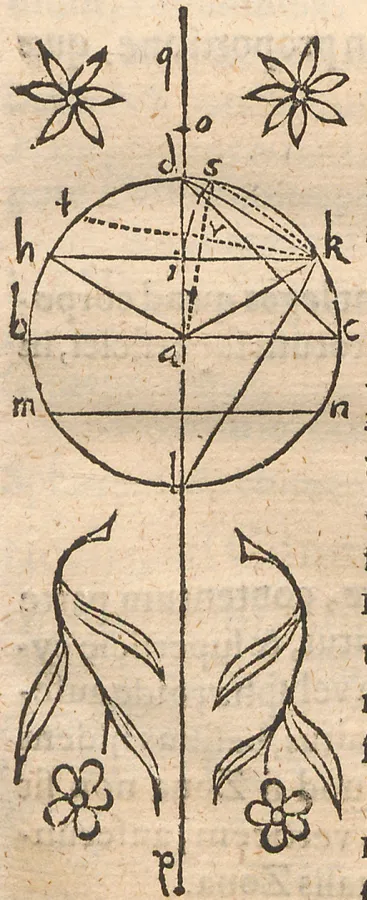
Sint segmenta HKD, HLD. Ergo centro H vel K, termino segmenti in plano circuli HDK, distantia HI vel KI, scribatur arcus circuli IS, secans HDK in S, & ab S, per A, ducatur diameter, eumque ad rectos secet recta ex K, quæ sit KT, sectio R. Hoc facto fiant rectangula tria, primum sub AD semidiametro & DL altitudine seu diametro globi totius, quod repræsentet soliditatem totius globi: secundum sub AD semidiametro & DI altitudine segmenti, quod repræsentabit soliditatem sectoris sphæræ HAKD: tertium ex AI (altitudine coni HKA) in RS, quod dico repræsentare in eadem proportione conum HIKA solidum: itaque sicut conus HIKA ablatus à sectore HAKD, relinquit segmentum HIKD; sic etiam tertium rectangulum ablatum à secundo, relinquet planum æquevalens in eadem proportione segmento sphæræ HIKD.
Let the segments be HKD and HLD. Then about the centre H or K, an end of the segment in the plane of the circle HDK, with distance HI or KI, let the arc IS be described, cutting HDK at S; and from S through A let a diameter be drawn, and let a straight line from K, KT, cut it at right angles, the intersection being R. This done, let three rectangles be made: the first under the radius AD and the height DL, or diameter of the whole globe, to represent the solidity of the whole globe; the second under the radius AD and the height DI of the segment, which will represent the solidity of the spherical sector HAKD; the third from AI (the height of the cone HKA) and RS, which I say represents in the same ratio the solid cone HIKA. So that, just as the cone HIKA taken from the sector HAKD leaves the segment HIKD, so the third rectangle taken from the second will leave a plane equivalent in the same ratio to the spherical segment HIKD.
Quod si segmentum sit maius Hemisphærio sc. HKL; pro DI, sumenda est IL, in secundi rectanguli formatione, & ad id est addendum rectangulum sub AI, RS, constitueturque planum æquevalens segmento HIKL maiori.
But if the segment is greater than a hemisphere, namely HKL, then IL must be taken instead of DI in forming the second rectangle, and the rectangle under AI, RS must be added to it; and this will give a plane equivalent to the greater segment HIKL.
Demonstratio. Primùm inter lineas DI, IL, & DL, est proportio segmentorum superficiei & totius, per VIII. Ergo etiam inter rectangula, ductis his lineis in eandem semidiametrum AD, erit eadem proportio: sed sectorum HAKD, HAKL, & globi totius est eadem inter se mutuò proportio, quæ superficierum HDK, KLH, & totius. Ergo & inter facta rectangula est proportio sectorum HAKD, & HAKL. Deinde AD altitudo ducta in basin circularem, æqualem superficiei segmenti HDK, cuius semidiameter KD per VII.) creat Cylindrum, triplum coni æqualis sectori HDKC; & AI altitudo ducta in basin HK circularem cuius semidiameter KI, creat itidem triplum coni HIKA. At vt circulus radio KD, ad circulum radio KI vel KS; sic etiam quadratum KD ad quadratum KS: vt verò quadratum KD ad quadratum KS, sic DI recta ad SR, per VII. Ergo proportio basium circularium, per KD & RS descriptarum, est etiam proportio linearum DI, SR. Sed proportio conorum est composita ex proportione altitudinum & proportione basium; vt habet Archimedes, XI. Sphæroideon. Ergo proportio HDKA, sectoris & HIKA, coni in eo, est composita ex proportione AD ad AI, & DI ad SR. Est autem etiam rectangulorum proportio composita ex proportione laterum correspondentium. Quare proportio HDKA sectoris, & HIKA coni in eo, est eadem, quæ rectangulorum sub AD, DI, & sub AI, SR. Ac proinde ipsa sunt ad mutuam eorum differentiam, vt sector HDKA & conus in eo HIKA, ad mutuam eorum differentiam, scilicet ad HIKA segmentum. Hæc methodus concernit potissimùm conum HIKA, qui est communis differentia, qua segmenta differunt à suis sectoribus, quem conum interdum operæ precium est notum habere.
Proof. First, between the lines DI, IL and DL is the ratio of the segments of the surface and of the whole, by VIII. So between the rectangles too, these lines being multiplied by the same radius AD, the ratio will be the same. But the sectors HAKD, HAKL and the whole globe have among themselves the same ratio as the surfaces HDK, KLH and the whole. So the rectangles made also have the ratio of the sectors HAKD and HAKL. Next, the height AD multiplied by a circular base equal to the surface of the segment HDK (whose radius is KD, by VII) produces a cylinder three times the cone equal to the sector HDKC; and the height AI multiplied by the circular base HK, whose radius is KI, likewise produces three times the cone HIKA. But as the circle of radius KD is to the circle of radius KI or KS, so is the square on KD to the square on KS; and as the square on KD is to the square on KS, so is the straight line DI to SR, by VII. So the ratio of the circular bases described with KD and RS is also the ratio of the lines DI, SR. But the ratio of cones is compounded of the ratio of their heights and the ratio of their bases, as Archimedes has it in On Spheroids XI. So the ratio of the sector HDKA and the cone HIKA in it is compounded of the ratio of AD to AI and of DI to SR. And the ratio of rectangles is likewise compounded of the ratios of corresponding sides. So the ratio of the sector HDKA to the cone HIKA in it is the same as that of the rectangles under AD, DI and under AI, SR. And therefore they are to their difference as the sector HDKA and the cone HIKA in it are to their difference, namely to the segment HIKA. This method concerns chiefly the cone HIKA, which is the common difference by which the segments differ from their sectors, and which it is sometimes worth having known.
Episagma comparativum.
Comparative addendum.
Sic segmenta Conoidis parabolici sunt inter se in proportione, quæ est inter quadrata axium. Arch. sphæroid. XXVI.
So the segments of a parabolic conoid are to each other in the ratio of the squares of their axes. Archimedes, On Spheroids, XXVI.
Corollarium I.
Corollary I.
Segmenta segmentorum Sphæræ easdem habent leges quod corpora attinet, quæ supra fuerunt ejusdem generis segmentorum superficiei, in corollario ad VII.
Segments of segments of a sphere follow the same laws as regards their bodies as segments of the surface of the same kind did above, in the corollary to VII.
Corollarium II.
Corollary II.
Zona sphæræ & sphæroidis, seu corpus annulare, contentum parte superficiei sphæræ vel sphæroidis mediâ, quæ Zona dicitur, & superficie cylindrica intus, hæc inquam sic investigatur. A sphæra vel sphæroide auferuntur bina segmenta æqualia, & Cylinder Zonæ æquealtus, basibus ijsdem cum segmentis ablatis; remanetque corpus Zonæ. Quod si Zona non sit media globi vel sphæroidis, sed inclinata ad polum seu verticem, auferuntur segmenta inæqualia, & truncus coni, vt remaneat talis Zona.
The zone of a sphere or spheroid, or ring-shaped body, contained by the middle part of the surface of the sphere or spheroid, called the zone, and a cylindrical surface within, is found as follows. Two equal segments are taken from the sphere or spheroid, and a cylinder of the same height as the zone, with the same bases as the segments taken away; and the body of the zone remains. But if the zone is not the middle of the globe or spheroid but inclined towards the pole or vertex, unequal segments are taken away, and a frustum of a cone, so that such a zone remains.
Intelligitur autem Zona, cui circumcirca sit æquabilis latitudo, & sub qua sit tectus Truncus conicus parallelarum basium, cujus dimensiones jam in proximo theoremate sequentur.
By a zone is meant one that has an even breadth all round, and under which is covered a conical frustum with parallel bases, whose measurements will now follow in the next theorem.
Theorema XVI.
Theorem XVI.
Conus secatur variè: aut enim per verticem & basin, & id vel plano, vel superficie alia coni minoris, habentis eundem verticem.
A cone is cut in various ways: either through the vertex and the base, and that either by a plane or by the surface of another, smaller cone with the same vertex.
In vtroque casu segmenta Coni æquealta, sunt vt eorum Bases inter se.
In either case, segments of the cone of equal height are to each other as their bases.
Nam Conus est hîc veluti circulus corporatus; idem igitur à sectione patitur, quod circulus suæ baseos.
For the cone is here like a circle given a body; it therefore suffers from the section the same as the circle of its base.
Aut secatur Conus plano parallelo lateris, cuius circumductu Conus est creatus; aut neque parallelo, sed supra verticem extra figuram concursuro cum latere: vtroque casu fiunt portiones indefinitæ, de quarum soliditate nulla dum disquisitio facta fuit à Geometris, vsu quippe non exigente.
Or the cone is cut by a plane parallel to the side by whose turning the cone was made; or by one not parallel, but one that would meet the side above the vertex, outside the figure. In either case indefinite portions are made, into whose solidity geometers have so far made no inquiry, since use did not require it.
Aut secatur Conus plano per latus vtrumque; fiuntque partes duæ, Verticalis superior, & Truncus inferior. Verticalem, plano ad axem obliquo, Archimedes portionem Coni maluit appellare; agnoscens Conos non alios quam æquicruros: Apollonius vero Conos faciens alios æquicruros, alios scalenos (cujus exemplum in Schemate IV.) talem portionem, quantumvis axe per obliquum secto, dummodò sectio sit circulus, pro Cono & ipsam agnoscit.
Or the cone is cut by a plane through both sides, and two parts are made, the upper or vertical part and the lower frustum. The vertical part, cut by a plane oblique to the axis, Archimedes preferred to call a portion of a cone, recognizing no cones but isosceles ones; but Apollonius, making some cones isosceles and others scalene (an example of which is in Schema IV), recognizes such a portion too as a cone, however obliquely the axis is cut, provided the section is a circle.
Quod attinet segmentum verticale, ejus sectio fit Ellipsis, quæ habet centrum suum extra axem, versus latus Coni longius. In Schemate IX. Coni GYN axis est GAB, cujus segmentum verticale GNA, basin habet Ellipsin, quæ repræsentatur per lineam NZ, cujus centrum seu medium, vbi latissima, est infra A, sectionem ejus cum axe, versus N.
As for the vertical segment, its section is an ellipse, which has its centre off the axis, towards the longer side of the cone. In Schema IX the axis of the cone GYN is GAB, whose vertical segment GNA has as its base an ellipse represented by the line NZ, whose centre or middle, where it is widest, lies below A, its intersection with the axis, towards N.
Atque hoc est semper majus segmento recto illo, in quo planum ad basin NY parallelum per terminum axis, ab Ellipsi secti transit, sc. per A. Nam planum secans, in A fixum, & ad axem GA inclinatum, plus de corpore Coni acquirit parte AN, quàm amittit parte AZ.
And this is always greater than the upright segment in which the plane parallel to the base NY passes through the end of the axis cut by the ellipse, namely through A. For the cutting plane, fixed at A and inclined to the axis GA, gains more of the body of the cone in the part AN than it loses in the part AZ.
An autem huic segmento GNA æqualis sit Conus ille, cujus basis, basi NY parallela, per centrum Ellipsis infra A transit; id consideratione dignum est: mihi nondum liquet, nec jam vacat. Vide de hoc infra Th. sequenti aliqua.
Whether the cone whose base, parallel to the base NY, passes through the centre of the ellipse below A is equal to this segment GNA is worth considering; it is not yet clear to me, nor have I time now. See something on this below in the next theorem.
Interim in genere de omni segmento verticali verum est Th. XI. Sphæroid. Archimedis; secundum quod Coni, segmentive Verticalis, ad Conum proportio, componitur ex proportionibus Basium inter se, & Altitudinum inter se.
Meanwhile, Archimedes’ On Spheroids XI is true in general of every vertical segment; by which the ratio of a cone or vertical segment to a cone is compounded of the ratios of their bases to each other and of their heights to each other.
Ergo area Ellipsis NA, ad aream circuli NY est proportionis solidorum GNA. ad GNY pars vna. Inest autem harum arearum proportio (per Epis. II. ad Th. II.) in rectangulo diametrorum Ellipsis & quadrato NY, tanquam notioribus. Pars altera proportionis corporum est inter GZ altitudinem segmenti GNA super plano NAZ, & GB altitudinem coni NGY super plano NY. Multiplicatis igitur in se mutuò terminis proportionum ZG in GB, & rectangulo diametrorum Ellipsis NA, in quadratum NY; vt posterior factus ad priorem, sic est corpus coni NGY ad corpus segmenti GNA. Potest etiam quodque seorsim computari; vt GNA, ducta altitudine GZ in planum Ellipsis NA, prodit triplum corporis GNA.
So the area of the ellipse NA to the area of the circle NY is one part of the ratio of the solids GNA to GNY. And the ratio of these areas lies (by Addendum II to Theorem II) in the rectangle of the diameters of the ellipse and the square on NY, as better known. The other part of the ratio of the bodies is between GZ, the height of the segment GNA above the plane NAZ, and GB, the height of the cone NGY above the plane NY. Multiplying, then, the terms of the ratios crosswise, ZG by GB, and the rectangle of the diameters of the ellipse NA by the square on NY: as the latter product is to the former, so is the body of the cone NGY to the body of the segment GNA. Each can also be computed separately; as GNA: multiplying the height GZ by the plane of the ellipse NA gives three times the body GNA.
In specie si planum secans parallelum fuerit basi Ny: proportio corporum, segmenti & totius, erit triplicata altitudinum vel radiorum in basibus circularibus, vel sescuplicata planorum.
In particular, if the cutting plane is parallel to the base NY, the ratio of the bodies, of the segment and the whole, will be the cube of the ratio of the heights or of the radii of the circular bases, or the 3/2 power of the ratio of the planes.
Nimirum quia hoc pacto segmentum verticale, & conus totus fiunt solida similia. Multiplicatis igitur cubice singulis seorsim vel altitudinibus vel radijs basium, erit vt numerus cubicus major ad minorem, sic Conus totus ad segmentum. Aut si sola plana baseon nota essent, quæruntur illorum radices, multiplicanturque in illa.
Because in this way the vertical segment and the whole cone become similar solids. Cubing each of the heights or of the radii of the bases separately, then, as the greater cube is to the lesser, so is the whole cone to the segment. Or if only the planes of the bases were known, their roots are sought and multiplied by them.
Quod Truncos attinet, facilis est ex dictis, illos inquirendi Methodus. Ex vno enim modorum præmissorum computatur & conus veluti totus, & segmentum verticale deficiens, ex data vel altitudine vel basis radio. Quod si nescitur ejus, vt deficientis, altitudo, si quidem eâ fuerit opus, quæritur ex comparatione basium Trunci cum altitudine; vt enim differentia Radiorum in basibus, ad altitudinem (si Truncus sub planis perpendicularibus fuerit) sic radius basis minoris ad alitudinem segmenti deficientis; ablato igitur corpore segmenti deficientis à Cono toto, relinquitur corpus Trunci quæsitum.
As for frustums, the method of finding them is easy from what has been said. For by one of the foregoing ways the cone as if whole is computed, and the missing vertical segment, from the given height or radius of the base. If the height of the missing part is not known, should it be needed, it is found by comparing the bases of the frustum with its height: for as the difference of the radii of the bases is to the height (if the frustum lies between perpendicular planes), so is the radius of the lesser base to the height of the missing segment. Taking the body of the missing segment from the whole cone, then, the body of the frustum sought remains.
In his verò Truncis, qui sub parallelis basibus continentur, rursum est brevior methodus vt prius. Nam quia bases talium Truncorum ignorari non possunt, earum diametri (quælibet in seipsam) multiplicantur cubicè, & ablato cubo minori à majori; erit vt maximus ad differentiam, ita Conus totus ad Truncum.
But for those frustums contained between parallel bases there is again a shorter method, as before. For since the bases of such frustums cannot be unknown, their diameters (each by itself) are cubed, and the lesser cube is taken from the greater; then as the greatest is to the difference, so is the whole cone to the frustum.
Clavius alium docet modum, ingeniosiorem quidem, sed & difficiliorem, vt mihi videtur. Non minus enim quàm suprà, computanda est area basis vtriusque; & jam hoc insuper accedit, quod quærenda est area medio loco proportionalis inter planum vtriusque basis. Id autem fit vel multiplicatione & divisione numerorum prolixorum; vel duabus extractionibus radicum, earumque multiplicatione: tunc addenda omnia tria plana, & summa in altitudinem Trunci multiplicanda. Atqui ex radijs circulorum qui requiruntur ad investigationem arearum, multò faciliori negocio potest haberi quicquid quæritur.
Clavius teaches another way, more ingenious indeed, but also, as it seems to me, more difficult. For no less than above, the area of each base must be computed; and now there is the further step that the area must be found which is the mean proportional between the planes of the two bases. This is done either by multiplying and dividing lengthy numbers, or by two extractions of roots and their multiplication; then all three planes must be added, and the sum multiplied by the height of the frustum. Yet from the radii of the circles, which are needed to find the areas, whatever is sought can be had with much less trouble.
Cùm autem Truncorum Conicorum, qui fiunt plano ad axem recto, multiplex sit vsus, & præsenti materiæ cum primis necessarius, ob doliorum figuram; subjungam hic pulcherrimum Theorema, & compendium exoptatissimum; etsi demonstrationem cognationis causâ differo deorsum in Supplementum Archimedeæ Stereometriæ, & Th. XXII. Dividitur autem Truncus in medium Cylindrum & circumjectam ei conicam veluti Tunicam, qui segmentum est Coni dissimile superiorum, sc. superficie Cylindricâ factum: Ergo si tres Diametri, duæ basis minoris, una majoris, extendantur in vnam rectam: erit ut rectangulum sub tota & sub differentia basium, ad triplum quadrati basis majoris uel minoris, ita corpus Tunicæ ad corpus Cylindri vel majoris uel minoris.
Since, however, frustums of cones made by a plane at right angles to the axis have many uses, and are above all necessary to the present matter because of the shape of barrels, I shall add here a most beautiful theorem and a most desirable shortcut; though for kinship’s sake I put off the proof to the Supplement to Archimedes’ Solid Geometry, Theorem XXII. The frustum is divided into a middle cylinder and a conical coat, as it were, put round it, which is a segment of the cone unlike those above, namely one made by a cylindrical surface. So if three diameters, two of the lesser base and one of the greater, are laid out in one straight line: then as the rectangle under the whole and the difference of the bases is to three times the square of the greater or lesser base, so is the body of the coat to the body of the greater or lesser cylinder.
Ergo duplum minoris adde maiori, summam duc in differentiam maioris & minoris, pro Tunica: deinde minorem quadra, quadrati triplum sume pro Cylindro inscripto; summam & huius & illius pro toto Trunco.
So add twice the lesser to the greater, and multiply the sum by the difference of the greater and lesser, for the coat; then square the lesser and take three times the square for the inscribed cylinder; and the sum of this and that for the whole frustum.
Vt si sint basium diametri 3. 5. differentia 2. ad bis 3. adde 5 fiunt 11, quæ duc in 2, fiunt 22 pro tunica, Et quadratum de 3. est 9, cujus triplum 27, est pro Cylindro: Ergo 49 pro Trunco, in quacunque proportione altitudinis. Sed hæc per sequens Theorema, ejusque Corollarium fient adhuc compendiosiora.
For example, if the diameters of the bases are 3 and 5, the difference is 2. To twice 3 add 5: that makes 11, which multiply by 2: that makes 22 for the coat. And the square of 3 is 9, three times which, 27, is for the cylinder: so 49 for the frustum, in whatever proportion of height. But by the following theorem and its corollary this will become shorter still.
Theorema XVII.
Theorem XVII.
Segmenta Cylindri recta, parallelis axi superficiebus rescissa, sunt inter se, vt segmenta basis.
Upright segments of a cylinder, cut off by surfaces parallel to the axis, are to each other as the segments of the base.
Nam Cylinder est hic veluti circulus aut Ellipsis corporata; quare hic idem illi accidit, quod figuris hisce in basi, in sectione eadem. In Schemate VIII. planum EFQX est parallelum axi DH. Ergo vt portio circuli EFI vel XQC, ad portionem EFA vel XQB: sic portio Cylindri FFIXV ad portionem EFABX. Vide Coroll. Th. II.
For the cylinder is here like a circle or ellipse given a body; so the same happens to it here as to these figures in the base, in the same section. In Schema VIII the plane EFQX is parallel to the axis DH. So as the portion EFI or XQC of the circle is to the portion EFA or XQB, so is the portion FFIXV of the cylinder to the portion EFABX. See the corollary to Theorem II.
Segmenta vero, plano per axem transeunte, dummodo non secet alteram basium, sunt vt segmenta axis inter se.
But segments made by a plane passing through the axis, provided it does not cut either base, are as the segments of the axis to each other.
Nam Cylinder rectus, sectus plano ad axem recto, est veluti linea corporata, & quidem cylindrico corpore prædita: quare accidit illi idem quod lineæ Alia verò segmenta per axem, æqualia sunt Cylindris eâdem axis longitudine. Nam quantum ex vno latere Cylindri deficit segmento, quo minus sit rectum; tantum ei accedit ab altera parte; quod in sectione coni non fit, ob inæqualem eius crassitiem. In Schemate VIII, plana PST rectum, LSV obliquum ad axem GB, secant illum communiter in R: vt igitur GR ad RB, sic non tantum portiones rectæ KT ad TN, sed etiam obliquæ LVK ad VNL. Quantum enim ipsi LVK deficit à partibus L, scilicet LRT, tantum ei superest ex partibus V, scilicet VRP, simile ipsi LRT.
For a right cylinder cut by a plane at right angles to the axis is like a line given a body, and indeed a cylindrical body; so the same happens to it as to the line. And other segments through the axis are equal to cylinders with the same length of axis. For as much as the segment lacks on one side of the cylinder of being upright, so much it gains on the other side; which does not happen in the section of a cone, because of its uneven thickness. In Schema VIII the planes PST, at right angles, and LSV, oblique to the axis GB, cut it together at R. So as GR is to RB, so are not only the upright portions KT to TN, but also the oblique LVK to VNL. For as much as LVK lacks in the part at L, namely LRT, so much it has over in the part at V, namely VRP, similar to LRT.
Segmentum segmenti Cylindracei, quale cernitur in Schemate XIV. secuturo, literis GST, contentum scilicet tribus superficiebus, semicirculo GT, semiellipsi GS planis, & curva Cylindricâ VTS; sic, vt sectionis planorum linea perpendiculariter incidat in G punctum axis HF; hoc inquam segmentum habet se ad totum Cylindrum TY æquealtum vt 7. ad 33. vel 14. ad 66. ferè, ad segmentum verò HGS residuum ad semicylindrum HGTS, (plano scilicet per axem HG ducto rescissum) vt 14. ad 19. Nam infra in supplemento Archimedæo demonstrabitur hoc de vna specie Cylindri, quando scil. eius altitudo æquat circumferentiam basis, Theor. XIX. XX. XXI. At cùm non tantum totus globus sit æqualis toti semi-cylindro, & totum strictum toti segmento Cylindri, vbi vertices ellipsis sectricis tangunt bases: sed etiam partes globi & stricti æquales, secundum aliquotam circumferentiæ partem quibus sunt proportionales, sint æquales partibus segmentorum semicylindri & Cylindri dictorum, secundum eandem quotam altitudinis, vi ejusdem explicationis corporum rotundorum in rectum; sequitur vt & segmenta ista segmentorum, quorum vnius basis est circulus, alterius semicirculus, sint altitudinibus suis proportionalia, & sic inter se in omni altitudine retineant proportionem eandem quæ est totorum, sc. 7. ad 33. Quibus vero bases non sunt circulus & semicirculus, sed alia circuli segmenta, illa miscent proportionem basium huic proportioni 7. ad 33. Itaque etiam de his cylindraceorum segmentorum segmentis valet axioma, non minus quam de conis & pyramidibus, quod quæ insistant eidem basi, sint inter se vt altitudines.
A segment of a cylindrical segment, such as is seen in Schema XIV, to follow, with the letters GST, contained namely by three surfaces, the plane semicircle GT, the plane half-ellipse GS, and the curved cylindrical VTS, so placed that the line where the planes cut falls perpendicularly on the point G of the axis HF: this segment, I say, is to the whole cylinder TY of equal height as 7 to 33, or about 14 to 66, and to the remaining segment HGS of the half-cylinder HGTS (cut off, that is, by a plane drawn through the axis HG) as 14 to 19. For this will be proved below in the Supplement to Archimedes for one kind of cylinder, namely when its height equals the circumference of the base, Theorems XIX, XX, XXI. But since not only is the whole globe equal to the whole half-cylinder, and the whole close ring to the whole segment of the cylinder where the vertices of the cutting ellipse touch the bases, but also equal parts of the globe and the close ring, according to some aliquot part of the circumference to which they are proportional, are equal to parts of the segments of the said half-cylinder and cylinder according to the same aliquot part of the height, by force of the same laying out of round bodies straight; it follows that those segments of segments, of which the base of one is a circle and of the other a semicircle, are proportional to their heights, and so keep among themselves at every height the same ratio as the wholes, namely 7 to 33. But those whose bases are not a circle and a semicircle but other segments of a circle mix the ratio of the bases into this ratio of 7 to 33. So of these segments of cylindrical segments too the axiom holds, no less than of cones and pyramids, that those standing on the same base are to each other as their heights.
Denique Cylindri per aliam superficiem cylindricam eodem axe secti limbus exterior, dividitur à superficie conica, cuius sunt bases, infera circulus amplior, supera angustior, in duo novæ speciei segmenta circularia, quorum interius Th. priore Tunicam appellavimus, puta cylindri angustioris.
Finally, the outer rim of a cylinder cut by another cylindrical surface with the same axis is divided by a conical surface, whose bases are a wider circle below and a narrower one above, into two circular segments of a new kind, of which in the previous theorem we called the inner one the coat, namely of the narrower cylinder.
Horum igitur Limbi segmentorum proportio inter se est, quæ duarum medietatum Arithmeticarum, quæ constituuntur inter diametrum minorem & diametrum maiorem.
The ratio of these segments of the rim to each other, then, is that of the two arithmetic means set between the lesser diameter and the greater.
Diviso enim numero, puta diametri majoris, in partes duas, in diametrum minorem & in excessum, factisque quadratis, tam à minore, quam à majore, majus quidem quadratum continebit partes quatuor, I. quadratum minoris, II. quadratum differentiæ, & III. IV. rectangula duo sub minore & differentia. Triplicatis deinde quadratis, existent pro majoris triplo, tria minoris, tria differentiæ, & sex rectangula. Et hæc tria quadrata differentiæ cum sex rectangulis sunt differentia tota quadratorum triplicatorum. Quare vt quadrata ad suos circulos, adque cylindros æque altos, sic hæc differentia ad limbum cylindricum totum. Atqui Th. antecedenti differentiam jussi sumus multiplicare in vnam majorem & duas minores, id est, in seipsam & in tres minores, pro parte limbi interiore, quæ Tunica fuit indigetata. Ablato igitur quadrato differentiæ vno & tribus rectangulis, à quadratis tribus & sex rectangulis, restant quadrata differentiæ duo & tria rectangula, pro reliquo limbi. Est autem trium rectangulorum & vnius quadrati, ad tria rectangula & duo quadrata proportio eadem, quæ trium minorum cum vna differentia ad tres minores cum duabus differentijs, eademque quæ vnius minoris cum parte tertia differentiæ ad vnam minorem cum duabus tertijs differentiæ. At si ad minorem addis primo partem vnam, pòst partes duas differentiæ, constituis duo media arithmetica inter minorem & majorem. Atque id est quod proposueramus.
For dividing the number, say of the greater diameter, into two parts, the lesser diameter and the excess, and making squares of both the lesser and the greater, the greater square will contain four parts: I. the square of the lesser, II. the square of the difference, and III., IV. two rectangles under the lesser and the difference. Then, tripling the squares, there will be for the triple of the greater three squares of the lesser, three of the difference, and six rectangles. And these three squares of the difference with the six rectangles are the whole difference of the tripled squares. So as the squares are to their circles, and to cylinders of equal height, so is this difference to the whole cylindrical rim. But in the previous theorem we were told to multiply the difference by one greater and two lesser, that is, by itself and three lesser, for the inner part of the rim, which was named the coat. Taking away, then, one square of the difference and three rectangles from three squares and six rectangles, there remain two squares of the difference and three rectangles for the rest of the rim. And the ratio of three rectangles and one square to three rectangles and two squares is the same as that of three lesser with one difference to three lesser with two differences, and the same as that of one lesser with a third of the difference to one lesser with two thirds of the difference. But if to the lesser you add first one part, then two parts of the difference, you set up two arithmetic means between the lesser and the greater. And that is what we had proposed.
Corollarium I & Praxis.
Corollary I and Practice.
Hinc facile habetur proportio Trunci conici ad Cylindros, Trunco inscriptum & circumscriptum. Inter diametros constitue duo media arithmetica, & multiplica differentiam totam diametrorum in horum minus pro Tunica, quam indue Cylindro minori, hoc est adde quadrato ejus diametri, pro Trunco. Ecce exemplum.
From this the ratio of a conical frustum to the cylinders inscribed in and circumscribed about it is easily had. Set up two arithmetic means between the diameters, and multiply the whole difference of the diameters by the lesser of them for the coat; put this on the smaller cylinder, that is, add it to the square of its diameter, for the frustum. Here is an example.
Sint diametri 3. 5. Differentia 2. quæ non communicat cum
ternario
Ergo substitue triplos 9. 15 Differentia 6. Quia eadem manet
proportio.
Let the diameters be 3 and 5. The difference is 2, which has no
common factor with 3.
So substitute their triples, 9 and 15, difference 6, since the ratio
stays the same.
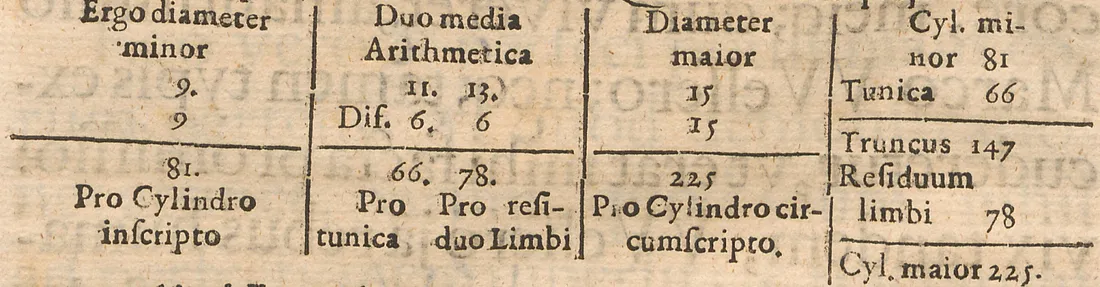
| Ergo diameter minor | Duo media Arithmetica | Diameter maior | |
|---|---|---|---|
| 9. | 11. 13. | 15 | Cyl. minor 81 |
| 9 | Dif. 6. 6 | 15 | Tunica 66 |
| 81. | 66. 78. | 225 | Truncus 147 |
| Pro Cylindro inscripto | Pro tunica — Pro residuo Limbi | Pro Cylindro circumscripto. | Residuum limbi 78 |
| Cyl. maior 225. |
| So the lesser diameter | Two arithmetic means | Greater diameter | |
|---|---|---|---|
| 9. | 11. 13. | 15 | Lesser cyl. 81 |
| 9 | Diff. 6. 6 | 15 | Coat 66 |
| 81. | 66. 78. | 225 | Frustum 147 |
| For the inscribed cylinder | For the coat — For the rest of the rim | For the circumscribed cylinder | Rest of the rim 78 |
| Greater cyl. 225. |

| Aliud Exemplum | |||
|---|---|---|---|
| Dia- | metri | ||
| 5. | 7. | 9. | 11 |
| 5. | 6. | ||
| Cyl. 25. | Tun. 42 — | Truncus. 67 |
| Aliud exemplum | |||
|---|---|---|---|
| Dia- | metri | ||
| 19. | 20. | 21. | 22 |
| 19 | 3 | ||
| Cyl. 361. | Tun. 60 — | Truncus 421 |
| Another example | |||
|---|---|---|---|
| Dia- | meters | ||
| 5. | 7. | 9. | 11 |
| 5. | 6. | ||
| Cyl. 25. | Coat 42 — | Frustum 67 |
| Another example | |||
|---|---|---|---|
| Dia- | meters | ||
| 19. | 20. | 21. | 22 |
| 19 | 3 | ||
| Cyl. 361. | Coat 60 — | Frustum 421 |
Vel quod eodem recidit,
Or, what comes to the same,
Multiplica diametros inter se, multiplica etiam differentiam in sui partem tertiam, & adde factos; provenit Truncus in ea dimensione, vt cujuslibet diametri quadratum valet suum Cylindrum. En superiora tria Exempla
Multiply the diameters together, multiply also the difference by its own third part, and add the products: the frustum results, in that measure in which the square of either diameter is worth its cylinder. Here are the three examples above.

| 9 · 6 · 9 | 5 · 6 · 5 | 19 · 3 · 19 |
| 15 · 2 · 9 | 11 · 2 · 5 | 22 · 1 · 19 |
| 135 · 12 · 81 Cyl. | 55 · 12 · 25 Cyl. | 418 · 3 · 361 Cyl. |
| 12 · minor | 12 · minor | 3 · minor. |
| 147 Truncus | 67. Truncus | 421. Truncus. |
| 9 · 6 · 9 | 5 · 6 · 5 | 19 · 3 · 19 |
| 15 · 2 · 9 | 11 · 2 · 5 | 22 · 1 · 19 |
| 135 · 12 · 81 cyl. | 55 · 12 · 25 cyl. | 418 · 3 · 361 cyl. |
| 12 · lesser | 12 · lesser | 3 · lesser |
| 147 frustum | 67 frustum | 421 frustum |
Corollarium II.
Corollary II.
Segmenta limbi cylindri maioris circa minorem, superficie conicâ facta, stantia super eâdem basi, non minus quam cylindri ipsi, adeòque & Trunci toti sub ijsdem basibus circularibus parallelis, sunt in proportione suarum altitudinum.
Segments of the rim of a greater cylinder about a lesser, made by a conical surface and standing on the same base, are, no less than the cylinders themselves, and so too the whole frustums between the same parallel circular bases, in the ratio of their heights.
Etsi verò superior basis non fuerit inferiori parallela, nec circulus, sed Ellipsis ad axem obliqua: nihilominus bina limbi segmenta, exterius & interius, sunt in proportione illarum altitudinum, quas habet Ellipseos centrum & diameter minor, eademque diameter cylindricæ baseos rectæ. Itaque non de nihilo est, quod Th. præcedenti, portionibus conicis, obliquo ad axem plano resectis, quæsivi methodum dimensionis à diametro Ellipsis longiore. Etsi superficies talem limbum inæquabilis altitudinis dispescens, non est Coni recti, cui sit idem axis cum Cylindris, sed coni scaleni.
And even if the upper base were not parallel to the lower, nor a circle, but an ellipse oblique to the axis, the two segments of the rim, outer and inner, are nevertheless in the ratio of those heights which the centre and the minor diameter of the ellipse have, the same diameter as that of the upright cylindrical base. So it is not for nothing that in the previous theorem, for conical portions cut off by a plane oblique to the axis, I sought the method of measurement from the greater diameter of the ellipse. Although the surface dividing such a rim of uneven height is not that of a right cone with the same axis as the cylinders, but of a scalene cone.
Apostrophe ad Patronos.
Address to my Patrons.
Cum libellus iste manuscriptus per menses sedecim apud librarium Augustanum delituisset, commendatus illi ab eximio illo Germaniæ nostræ decore, meique dum viveret, amantissimo Marco VVelsero; neque tamen typis excuderetur, vt erat mihi facta promissio: vix tandem, VVelsero jam rebus humanis exempto, libellum meum extorsi detentori, postliminioque recepi.
This little book, in manuscript, had lain hidden for sixteen months with a bookseller at Augsburg, to whom it had been commended by that eminent ornament of our Germany, Marcus Welser, a very dear friend to me while he lived; yet it was not printed, as had been promised me. At last, with difficulty, Welser being now departed from human affairs, I wrested my little book from the one who held it and took it back home.
Ex eo tempore consilium cepi, libellum, quamvis in magna operarum penuria, excudendi domi: qua occasione potestas mihi facta fuit, non correctiorem tantum, sed & auctiorem, quam erat initio conscriptus, extrudendi. Nec diffiteor, temporis aliquantum subtractum studijs cæteris, impensumque huic speculationi; nec pœnitet jacturæ. Nam fieri nequaquam potest, vt immortalitatis fructum metat labor, qui sementem temporis fecit nullam.
From that time I resolved to print the little book at home, despite a great shortage of workmen; and this gave me the chance to send it out not only more correct but also larger than it was first written. Nor do I deny that some time has been taken from my other studies and spent on this inquiry; nor do I regret the loss. For it can by no means happen that labour should reap the fruit of immortality which has sown no seed of time.
Et censuisti Tu quidem, Illris & Gse L. B. Iörgere; quæ de figuris ab Archimede non tactis, ad rationes tamen doliorum propriissimè pertinentibus, affecta tantum audiebas, vti nequaquam omitterentur, quin potius operi subjungerentur, appendicis loco.
And you, Illustrious and Noble Lord Baron Jörger, judged that what you heard of only begun, concerning figures untouched by Archimedes yet belonging most properly to the reckoning of barrels, should by no means be left out, but rather added to the work in the place of an appendix.
Ego verò & perfeci potissimam eorum partem; vt quod demonstrationes attinet, parum, quod vsum, nihil ad perfectionem supersit: & tractatum in ipsum libellum hic inserui suo loco, cumque partibus cæteris ita connexui, vt non appendix cauda, sed caput aut cor speculationis totius, vt est quidem, videri possit: quod & Te, L. B. Iörgere, & multò maximè Te, Illustrissime Domine de Liechtenstein (cujus in hac Philosophiæ parte exercitationes assiduas, facultatemque comparatam egregiam judicandi, ex quo Te primùm in præfatione libri sum allocutus, multò nunc rectiùs & copiosiùs habeo cognitam & perspectam) vbi tempus ad isthæc cognoscenda vacaverit, ipsos censituros existimo. Valete & fruimini. Id. Iulijs Anno 1615.
I have indeed completed the greater part of them, so that little remains for perfection as regards the proofs, and nothing as regards their use; and I have put the treatise into the little book itself here, in its place, and joined it to the other parts in such a way that it may seem not an appendix or tail but the head or heart of the whole inquiry, as indeed it is. And this I believe both you, Lord Baron Jörger, and much more you, Most Illustrious Lord of Liechtenstein (whose constant exercise in this part of philosophy, and the excellent power of judgement you have acquired, I now know and see much more truly and fully than when I first addressed you in the preface of the book), will judge for yourselves when you have time to look into these things. Farewell and enjoy them. On the Ides of July, in the year 1615.
4. 6. — 24
2. 3. — 6.
2. 2. 4.↩︎
4. 6. — 24
2. 3. — 6.
2. 2. 4.↩︎